Instagram
 Facebook
 Tiktok
 Youtube
 X
X LinkedIn
 (501) 224-1044

You’ve started catching it in photos. A softness along the jawline, a little loose skin at the neck, a tiredness that no amount of sleep seems to fix. And somewhere in the back of your mind sits the question almost everyone asks first: am I the right age for this?
Here’s the honest answer. There isn’t a magic number. A facelift isn’t keyed to a birthday. It’s keyed to what’s actually happening in your face, and that timeline looks different for everyone.
Facelifts are also more common than you might think. There were 737,028 facelift procedures performed worldwide in 2024, ranking the surgery among the most-requested cosmetic operations globally. What’s shifted is who’s asking, with patients now exploring their options across a much wider span of ages.
At Dr. Suzanne Yee Cosmetic & Laser Surgery Center in Little Rock, a cosmetic surgery practice in central Arkansas, that individual approach guides every facelift decision, led by a triple board-certified cosmetic surgeon rather than a fixed rule about age. This guide walks through the signs that you’re ready and what each decade typically looks like. You’ll also see how technique is matched to anatomy, when non-surgical options make more sense, and how your health shapes the safest timing.
Key takeaways
- A facelift addresses structural changes like jowls and a loosening neck, not surface concerns like fine lines and texture, which respond better to non-surgical treatments.
- There’s no universal “best age.” Most patients pursue surgery somewhere from their 40s through their 60s, but readiness depends on skin elasticity, the degree of sagging, and your goals.
- The 50s are often considered a sweet spot because aging changes are pronounced enough to correct meaningfully while skin still has good elasticity for natural healing.
- The right technique, from a mini facelift to a deep-plane lift, is matched to your anatomy and the extent of your aging, not chosen by age alone.
- Overall health matters more than the number on your driver’s license. A healthy patient in their 70s can be a safer candidate than an unwell patient in their 50s.
What signs tell you it’s time for a facelift?
The clearest signal isn’t a year. It’s a change in the deeper structure of your face. A facelift is designed for sagging skin, deep folds, jowls, and a loss of jawline definition that creams, lasers, and injectables simply can’t reach anymore. And if you find yourself gently pulling your skin back in the mirror to preview a firmer result, that instinct is worth listening to.
Surgeons often put it this way: it’s about change, not age. The key indicator for considering a facelift is the point when lower-face jowling and loose, sagging neck skin become your main concern. That’s gravity and tissue descent at work, not something surface treatments were built to fix.
Skin elasticity plays a quiet but decisive role. Elasticity is your skin’s ability to stretch and snap back, and as it fades, tightening from the outside stops holding. When your skin no longer redrapes smoothly on its own, that’s often the moment a surgical lift starts to make sense.
There’s also a tipping point with injectables. Fillers restore volume beautifully for years, until they don’t. Past a certain stage of laxity, adding more product can look heavy rather than refreshed. If you’re spending more on maintenance and liking the result less, that’s worth paying attention to.
A few changes commonly point toward surgery rather than another round of non-surgical care:
- Jowls forming along a once-defined jawline
- Loose or banding skin in the neck and under the chin
- Deep folds from the nose to the mouth that linger at rest
- Filler or laser results that no longer deliver what they used to
Reading these signs accurately is genuinely hard to do alone in a bathroom mirror. It’s exactly what a facelift consultation is for, where Dr. Yee evaluates your facial structure, skin elasticity, and medical history to tell you honestly whether cosmetic facial rejuvenation in central Arkansas is the right next step. Knowing what you’re seeing is the first step toward deciding what, if anything, to do about it.
What’s the best age for a facelift, decade by decade?
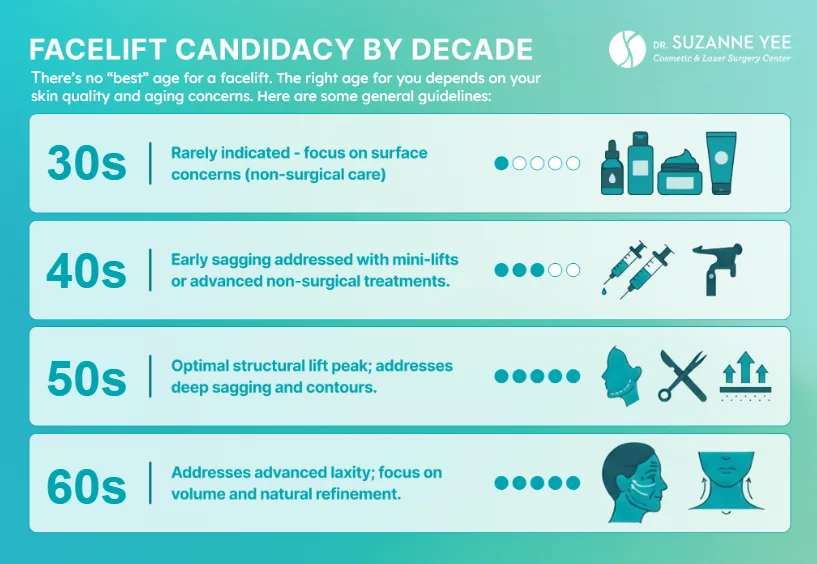
If signs matter more than age, where does that leave the decades? Think of the following less as rules and more as patterns surgeons see, because your face may run ahead of or behind the calendar. A helpful companion to this section is the wellness guide by decade, which maps what tends to change at each life stage.
Your 30s and the under-35 question
A facelift in your 30s is rarely the right call, and most patients under 35 simply haven’t developed the structural sagging that surgery corrects. At this stage, the changes you notice are usually surface-level and respond well to non-surgical care.
A small number of younger patients with genetic skin laxity, early jowling, or significant volume loss may be candidates for a conservative mini lift. When a lift is done at this age, results often look especially natural, since younger skin tends to retain elasticity and heal efficiently. Wanting to address a concern early doesn’t make you vain, it makes you informed.
Your 40s
The 40s are when many people first see jowling and neck laxity that don’t bounce back. For some, this becomes a high-return decade to intervene early, correcting moderate changes before they deepen.
A lift in your 40s often pairs naturally with strong, long-lasting results. ASPS reports that patients who had facelift surgery before age 50 enjoyed very high satisfaction a year out and held meaningful satisfaction more than a decade later. Acting in this window isn’t about chasing youth, it’s about working with skin that still has plenty of resilience.
Your 50s
The 50s are widely considered the sweet spot, and the data backs up the instinct. The ASPS procedural statistics show patients in their 50s make up the peak demographic for facelift surgery.
The reason is balance. By this decade, jowling, folds, and neck laxity are usually pronounced enough that a lift makes a real difference. Skin still has enough elasticity to settle into a smooth, natural result. If you’ve been waiting for the “right time,” this is often where it lands.
Your 60s, 70s, and beyond
A facelift in your 60s can produce excellent, natural-looking results, and good candidacy continues well past that. Plenty of patients in their 60s are thrilled they didn’t talk themselves out of it.
Age alone doesn’t close the door later, either. A study of patients aged 75 and older found that, when matched for overall health, their outcomes and safety were comparable to those of middle-aged patients. In other words, a healthy 70-something can be a better candidate than a less healthy 50-something. It’s a reassuring reminder that the calendar is only part of the picture.
Which type of facelift fits your age and anatomy?
Once you and your surgeon agree it’s time, the next question is which lift, and that depends on your anatomy far more than your age. Your surgeon tailors the approach to the degree of your aging, your skin elasticity, and the strength of your SMAS, the deeper muscle-and-tissue layer that a modern lift repositions. Here’s how the main options compare.
| Technique | Best suited for | What it addresses |
|---|---|---|
| Mini facelift | Early jowling, mild to moderate laxity, good elasticity | Lower face and jawline, smaller incisions |
| Full facelift | Moderate to significant aging | Mid and lower face, jowls, deeper folds |
| Deep-plane facelift | Deeper folds, greater midface descent | Releases retaining ligaments, repositions deeper tissue |
Mini facelift
A mini facelift targets early jowling and lower-face laxity through smaller incisions near the ears, with a streamlined recovery. It suits patients who still have good skin elasticity and want a subtle, natural refinement rather than a sweeping change. For many people in their 40s and early 50s, it’s the right-sized option.
Full facelift
A full, or traditional, facelift addresses more advanced aging across the mid and lower face, repositioning deeper tissue and refining the jawline. When concerns extend lower, a neck lift to restore a youthful neckline is frequently combined into the same plan to sharpen the transition from jaw to neck.
Deep-plane facelift
A deep-plane facelift works beneath the SMAS, lifting skin and deeper tissue together and releasing the ligaments that tether an aging face. This composite approach suits deeper nasolabial folds and greater midface descent. It’s a more involved technique, which is exactly why choosing an experienced surgeon matters.
Adjunct procedures and Endotines
Facelifts are most often paired with a neck lift, the most common add-on and one that most patients need, along with eye area facial rejuvenation options, fat grafting to restore lost volume, or brow work, depending on what’s aging together. The neck lift typically includes a platysmaplasty, which tightens the platysma muscle to redefine the jawline and neckline. Many patients also maintain their results with a non-surgical skin treatment once they’ve fully healed.
One detail Dr. Yee discusses in facelift planning is Endotine(R) anchors. In her words, Endotines will be placed to help hold tissue in the new position. They’re made of lactic acid and begin to dissolve at approximately 2 months, fully dissolved by 1 year. In plain terms, they’re small absorbable anchors that hold lifted tissue in place while it heals, then disappear on their own.
Karla, a Little Rock patient about six weeks out from her lower facelift, shared her experience:
“I am 6 wks out of my lower facelift with Dr Yee. My results are so natural and took years off my appearance. This can be a scary experience, but Dr Yee and her staff put me at ease before and after the procedure. I will definitely be using Dr Yee for any future procedures, and highly recommend her.”
When should you choose non-surgical alternatives instead?
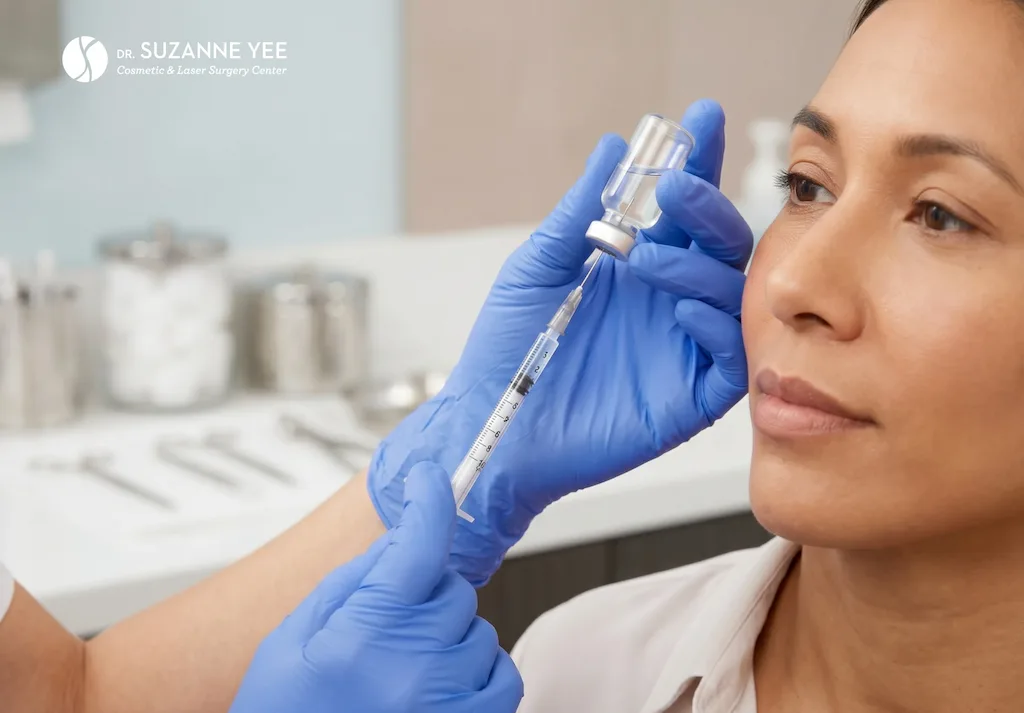
If your concerns are still mostly on the surface, you may not need surgery yet, and that’s good news worth hearing. For fine lines, early volume loss, and mild laxity, non-surgical options often deliver exactly what you’re after with no downtime. The art is matching the treatment to the stage you’re actually at.
For early aging, several approaches tend to work well:
- Injectable fillers that restore youthful facial fullness without surgery in the cheeks and folds
- Neuromodulators to soften expression lines
- Laser and energy-based treatments to improve tone and texture
- Skin-tightening treatments for mild laxity
These treatments shine early and can genuinely buy time, delaying the point at which surgery becomes the better answer. What they can’t do is lift and reposition tissue that has structurally descended. Once skin laxity and jowling cross a certain threshold, fillers and lasers stop keeping pace, and pushing them further is where results start to look overdone.
There’s a real cost to overusing injectables in place of a lift you actually need. Beyond the expense that adds up over years, layering more filler onto a face that needs structural support can distort proportions instead of restoring them. A candid surgeon will tell you when you’ve reached that line, even if it means recommending you wait. Knowing where you stand on that curve is what keeps your results looking like you.

How do your health and lifestyle affect facelift timing?
This is where age finally takes a back seat. For safety and healing, your overall health and habits weigh far more than the year you were born. A thoughtful evaluation looks at the whole picture before anyone talks about a date on the calendar.
Age versus overall health
Chronological age is a weak predictor of surgical risk on its own. What matters is how well your body can come through surgery and heal. That’s why two patients of the same age can be very different candidates. As the research on older patients showed, health status, not birthdays, drives outcomes.
Health conditions and smoking
Certain conditions, like poorly controlled diabetes, bleeding disorders, or unmanaged high blood pressure, can affect healing and are carefully reviewed before surgery. None of these is automatically disqualifying, and many are simply managed and optimized first. Smoking is the big modifiable one, because it constricts blood flow and slows healing. If you smoke, this is also the time to step away from that habit, ideally six weeks before and after surgery.
Weight loss and GLP-1 medications
The rise of GLP-1 medications like semaglutide has changed timing conversations on two fronts. First, significant weight loss can deflate the face and add laxity, prompting some patients to consider a lift sooner. Second, these medications slow stomach emptying, so anesthesia care calls for careful management around surgery. The practical advice is to let your weight stabilize and to be upfront about any GLP-1 use during planning.
Medical clearance and your consultation
Before surgery, you’ll go through a medical clearance that reviews your history, medications, and overall health to confirm you’re well positioned for a smooth recovery. This isn’t a hurdle, it’s part of how your surgeon keeps you safe. General anesthesia is administered by a Certified Registered Nurse Anesthetist (CRNA) as part of an experienced surgical team, ensuring your safety and comfort throughout the procedure. It all takes place within an AAAHC-accredited surgical center in Little Rock.
The consultation itself is a two-way evaluation. It’s not only Dr. Yee assessing your candidacy, it’s your chance to assess her, ask anything, and decide if the fit feels right.
Before recommending an approach, she asks about your daily routine, your work, and what you want to feel comfortable doing again. Then she explains why a given plan fits your anatomy rather than handing you a template. Nothing is rushed, and nothing is off limits, including the questions that feel small.
Jacque, a Little Rock facelift patient, described that feeling of being looked after:
“I can’t emphasize enough how pleased I am with the results of my facelift, but more importantly, with the way I have been treated on each visit. I feel cared for and valued by everyone involved in my journey.”
Cost is part of timing too, and it shouldn’t be a guessing game. To help make a well-timed procedure more accessible, the practice offers flexible financing through Cherry, Alphaeon Credit, CareCredit, PatientFi, and Alle. Once you know you’re a healthy candidate, the next natural question is how long the results will hold.
How long will your facelift results last?
Let’s clear up the biggest misconception first. A facelift doesn’t stop the clock, and no honest surgeon will tell you it does. What it does is reset your starting point, so you keep aging naturally but stay roughly ten years ahead of where you’d be without it.
That framing really matters. Thinking of it as “results last X years” can set you up to feel let down at year eight when you notice normal aging happening. The truer, kinder picture is that you’ll always look ahead of an un-operated version of yourself. Aging simply continues after surgery, which is exactly why the “ahead of the curve” way of thinking is the more realistic and reassuring one.
Does getting a lift earlier mean it lasts longer? Not in a strictly literal sense, but younger skin with better elasticity does tend to hold a refined result gracefully over time. Technique plays a meaningful role here too. More comprehensive lifts that reposition deeper tissue generally hold their shape longer than approaches focused on skin alone.
A few lifestyle factors strongly influence how long you stay ahead of the curve:
- Sun protection, since UV exposure breaks down the collagen that keeps skin firm
- Not smoking, which otherwise accelerates facial aging
- A stable weight, to avoid repeated stretching and deflation
- A consistent skincare routine, including medical-grade products
Some patients eventually choose a refresher procedure years later. It isn’t because the first one “wore off,” but because they’ve kept aging from that younger baseline and want to reset it again. That’s continued natural aging, not a failure of the original result. Thinking this way makes the decision feel less like a deadline and more like a long-term relationship with your own face.
Conclusion
You came here with a simple, slightly nervous question: am I the right age for a facelift? We hope that by now, the answer feels a little clearer, and a lot less tied to a number. Because the truth is, age was never really the point. What matters is whether the changes you’ve noticed in your face have reached the place where surgery is the most honest path forward, and whether your health sets you up for a smooth, safe experience.
A good next step costs you nothing. Browsing real patient before-and-after photos that match your starting point is one of the most grounding things you can do. When you’re ready, a personal consultation fills in the details photos can’t show.
Whenever that moment arrives, Dr. Yee and her team believe every patient deserves to feel heard, respected, and confident in their choice, with results that enhance rather than transform. To talk through your timing in person, schedule your visit or call (501) 289-5460.
Frequently asked questions
What is the average age people get a facelift?
There’s no single average, but most patients pursue a facelift somewhere from their 40s through their 60s. Surgeons see the largest share in the 50s, when aging changes are pronounced enough to correct while skin still heals well. Your own timing depends more on your skin and concerns than on hitting an average.
Is 70 too old for a facelift?
No. Research shows that healthy patients in their 70s can have outcomes and safety comparable to middle-aged patients. What matters is your overall health, not your age, which is exactly what a medical clearance is designed to evaluate.
How long does a facelift last?
A facelift doesn’t expire on a set date. You’ll keep aging naturally, but you’ll stay roughly ten years ahead of where you’d be without the surgery. Sun protection, not smoking, and a stable weight all help you stay ahead of the curve longer.
What’s the difference between a mini facelift and a full facelift?
A mini facelift uses smaller incisions to address early jowling and lower-face laxity, with a shorter recovery. A full facelift treats more advanced aging across the mid and lower face by repositioning deeper tissue. Your surgeon recommends the right one based on your anatomy and goals.
How long is facelift recovery?
Mild swelling, bruising, and tightness are common in the first few days and improve over about two weeks. Most patients return to work and normal activities within 10 to 14 days, while strenuous exercise is held for at least four to six weeks. Early improvements show by around four to six weeks, with the final result settling over six months to a year.
Will a facelift make me look unnatural or pulled?
A well-done modern facelift repositions deeper tissue rather than just tightening skin, which creates a refreshed, natural look instead of a pulled one. The “windswept” results people fear usually come from outdated, skin-only techniques. Our guide on what makes a good, natural-looking facelift explains what separates a refreshed result from an overdone one. Choosing an experienced, board-certified surgeon is the single best safeguard.
Can I get a facelift after significant weight loss?
Yes, and significant weight loss often adds the facial laxity that makes a lift worthwhile. The key is letting your weight stabilize first, so your result reflects your settled face.
*Disclaimer: This content is for educational purposes only and does not constitute medical advice. A consultation with a qualified board-certified surgeon is required to determine the best treatment plan for your individual needs.