
 (501) 224-1044
There’s a worry most people considering a facelift never say out loud. It isn’t the surgery, and it isn’t even the recovery. It’s the fear of walking into a room afterward and having everyone immediately know.
You want to look rested, not rearranged. You’ve probably seen a result that made you wince, a face stretched into that tight, almost startled expression, and quietly thought, I never want that.
Here’s the reassuring part. A natural facelift isn’t luck or a happy accident, it’s the predictable result of the right technique in experienced hands.
In one 10-year study of 214 facelift patients, every single patient reported being satisfied with their results. That gap between the look you fear and the look you want comes down to choices, most of them made before you ever wake up.
At Dr. Suzanne Yee Cosmetic & Laser Surgery Center in Little Rock, every facelift is built around one idea, enhancement, not transformation. This article breaks down what separates a natural result from an overdone one, which techniques deliver it, how scars stay hidden, how to choose the right surgeon, and what recovery really feels like.
Key takeaways
If you only read one section, read this one. Here’s what determines whether a facelift looks natural or obviously done.
- The overdone, “windswept” look almost always comes from outdated technique, pulling skin sideways under tension, not from a patient asking for too much.
- Repositioning the deeper tissue layer, rather than tightening skin alone, is the single biggest factor in a natural, long-lasting result.
- Lifting in a more vertical direction, restoring lost volume, and treating the whole face as one unit keeps a result balanced instead of distorted.
- Facelift incisions are tucked along the hairline and around the ears, and while no surgery is truly scarless, well-placed incisions fade to become very hard to spot.
- Choosing a surgeon who specializes in the face, holds the right board certifications, and shows honest before-and-after photos matters more than any single technique.
Why do some facelifts look natural while others look pulled or overdone?
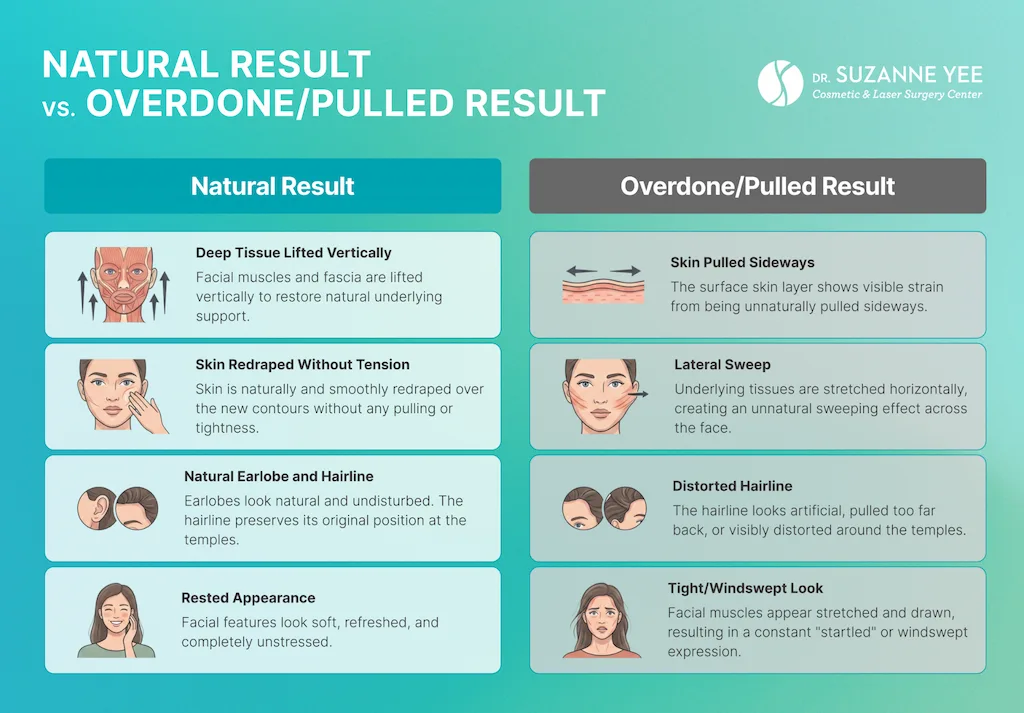
The difference rarely comes down to how much was done. It comes down to how it was done. An unnatural facelift has recognizable signs, what surgeons call the “windswept” look, where the cheeks pull toward the ears and the face takes on that unmistakable just-had-work-done expression.
It’s easy to assume someone who looks overdone simply went too far. More often, the real cause is technical. The telltale signs of an over-tightened result, including the so-called extreme face lift appearance, trace back to one mistake, relying on the skin to do a job it was never built for.
Skin isn’t a structural material. When a lift is created by pulling and stitching skin tightly, the face can look taut at first, then age poorly as that skin slowly stretches back out. The tension also drags the cheek sideways, the pattern surgeons named the “lateral sweep.”
Direction matters just as much as tension. Your face doesn’t fall straight sideways as it ages. It descends downward and slightly inward, so a natural correction lifts things back up and slightly back, never toward your ears. When the lift runs sideways instead, the result fights your own anatomy, and your eye reads it as artificial instantly.
| A natural-looking result | An overdone result |
|---|---|
| Deeper tissue lifted up and back | Skin pulled sideways under tension |
| Skin redraped loosely, no strain | Skin alone carries the weight |
| Earlobes and hairline keep their shape | Pulled earlobes, shifted hairline, lateral sweep |
| Looks rested and like you | Looks tight, flat, and “windswept” |
It makes complete sense to feel cautious here, especially when the bad results are the ones that get noticed and remembered. The good ones, by design, you never clock as facelifts at all. This is exactly the standard Dr. Yee works toward, an outcome built on artistry so you look like a more refreshed version of yourself. Once you see that the overdone look is a technique problem, the natural question is which technique avoids it.
Which facelift technique gives the most natural-looking results?

Not all facelifts are the same operation, and among the advanced facial lifting options, the technique your surgeon chooses has the biggest influence on whether your result looks natural. Here’s a clear way to compare the main approaches and what each one actually moves.
| Technique | What it repositions | Natural-result fit |
|---|---|---|
| Skin-only | The skin alone | Lowest, tightens then relaxes |
| SMAS | The SMAS layer plus skin | Strong and reliable |
| Deep plane | Deeper tissue as one unit | Highest, tension-free |
| Mini facelift | A limited lower-face lift | Good for early, mild aging |
| Mid-facelift | Cheek fat pads and the midface | Restores cheek volume; often paired with a deeper lift |
Skin-only lifts
This is the oldest approach, and it’s largely why “facelift” once carried such a stiff reputation. A skin-only lift tightens the outer skin without addressing the structures underneath. Because skin can’t hold tension long-term, these results tend to look pulled early and fade fastest, which is why most experienced surgeons have moved beyond them.
The SMAS facelift
Beneath your skin lies the SMAS, short for the superficial musculoaponeurotic system. Think of it as a supportive internal layer that connects your facial muscles to your skin. A SMAS facelift lifts and tightens this deeper layer, so the skin is repositioned without bearing the load. It’s a dependable technique that produces natural, lasting results for many patients.
The deep plane facelift
The deep plane technique goes a step further, lifting the skin and deeper tissue together as one connected unit. Because everything moves as a single block and the skin is laid back down without strain, the result looks especially natural. In comparative evidence, deep plane approaches earn higher patient-satisfaction scores than older skin-tightening methods.
The mini facelift
A mini facelift is a smaller operation aimed at mild, early sagging around the jawline, one of the facial cosmetic procedures with minimal downtime. For the right person, it offers a subtle refresh. It isn’t a shortcut for advanced aging, and a good surgeon will tell you honestly when a mini lift won’t give you the result you’re picturing. Knowing the technique is only half the story, the finer details are where natural results are won or lost.
What surgical details separate a natural facelift from an overdone one?
If technique sets the foundation, the details are where artistry lives. Two surgeons can both perform a deep plane facelift and get very different results, because naturalness depends on dozens of small judgments. These are the ones that matter most.
Lifting in the right direction
The angle of the lift, what surgeons call the vector, is everything. Because your face ages downward and inward, the most natural correction lifts on a more vertical path rather than pulling toward the ears. Get the direction right, and the face looks lifted. Get it wrong, and it looks swept.
Treating the face as one unit
A natural face is balanced. When a surgeon lifts the midface but ignores the jawline and neck, the mismatch becomes a dead giveaway that work was done. The most natural results address the cheeks, jawline, and neck together, which is also why a facelift is often paired with a neck lift or brow lift.
To hold that repositioned tissue securely, Dr. Yee uses small absorbable anchors called Endotine(R). In her own words to patients, Endotines are placed to help hold tissue in the new position. They’re made of lactic acid, beginning to dissolve at approximately two months and fully dissolving by one year, so nothing has to be removed later.
Restoring lost volume
Aging isn’t only about sagging. It’s also about deflation, the gradual loss of youthful fullness in the cheeks and around the eyes, and simply tightening a deflated face can look gaunt.
That’s why many surgeons add fat transfer, moving a patient’s own fat to restore softness, with one study of 151 cases reporting a mean injection volume of around 32 mL with no complications. Globally, facial fat grafting rose 19.2 percent in a single year, often combined with facelifts for this reason.
Knowing when to stop
Restraint is a skill. Some of the most recognizable bad results come from overcorrection, when too much skin is removed or the tissue is pulled too tightly. A surgeon focused on natural results knows that less is often more. The goal is to look like you on your best day, not a tighter, flatter version of someone else.
Karla, a facelift patient who wanted a result that didn’t draw attention, shared their experience:
“I am 6 wks out of my lower facelift with Dr Yee. My results are so natural and took years off my appearance. This can be a scary experience, but Dr Yee and her staff put me at ease before and after the procedure. I will definitely be using Dr Yee for any future procedures, and highly recommend her and her staff.”
How are facelift incisions and scars hidden?
Scarring is one of the most common concerns patients carry into a consultation, and it’s a fair one. The reassuring reality is that facelift incisions are designed from the start to hide in plain sight, tucked into places your eye already skips over.
Incision placement
A traditional facelift incision begins in the hair above the ear, follows the natural curve around the front of the ear, and continues behind it into the hairline. Placed this way, it rides along borders that naturally camouflage it. The earlobe is handled carefully so it keeps its soft, natural attachment rather than being tugged downward.
Protecting the hairline
A skilled surgeon plans the incision to preserve your hairline and hair-bearing skin. That avoids the visible step-offs or shifted hairlines that can quietly betray a facelift. Closure technique matters too, since the goal is a fine, flat line rather than a widened one.
The scar-healing timeline
Fresh incisions look their most noticeable early on, then improve steadily. There would be measurable improvement within the first months, and scars often stabilize by around six months as healing remodels the tissue. Feeling concerned about scarring is completely natural, and knowing this timeline tends to take the edge off the worry.
It’s worth being honest, a truly scarless facelift is a bit of a myth, since any incision leaves some mark. The realistic promise isn’t no scar, it’s a scar placed and cared for so well that it becomes genuinely hard to find.
Caring for healing incisions
How you care for your incisions influences how discreetly they heal. Most surgeons recommend gentle scar care, often including silicone gel or sheets and diligent sun protection to keep the line from darkening. Your surgeon will give you a personalized plan, and following it closely is one of the simplest ways to support a clean result. With healing covered, the most important decision is still ahead, who you trust to do the surgery.
How do you choose a surgeon for natural-looking facelift results?
If one factor outweighs all the others, it’s this one. The facelift is widely regarded as one of the most demanding procedures in cosmetic surgery, and choosing your surgeon is the single most effective thing you can do to protect your result. Here’s how to choose well.
Board certification that matters
Start with credentials, but know what to look for. Certification by the American Board of Facial Plastic and Reconstructive Surgery signals dedicated training in the face, and you can verify a surgeon’s status through the ABFPRS.
Where the surgery happens matters just as much. Accredited surgical facilities carry serious-complication rates under 0.5 percent, according to Cleveland Clinic.
At Dr. Suzanne Yee Cosmetic & Laser Surgery Center, board-certified cosmetic surgery in Little Rock means your facelift is performed by a triple board-certified cosmetic surgeon. That credential means certification by the American Board of Cosmetic Surgery for Facial Cosmetic Surgery, the same board for Body, Breast, and Extremity, and the American Board of Facial Plastic and Reconstructive Surgery. Procedures take place at an AAAHC-accredited surgical center in Little Rock, the same place patients across Central Arkansas can see during a visit.
A focus on facial surgery
Experience with the specific operation you want is its own kind of credential. A surgeon who concentrates on the face, and who performs your particular technique often, brings a trained eye for the subtle balance that reads as natural. Don’t be shy about asking how frequently your surgeon performs facelifts and the approach they’re recommending for you.
Reading before-and-after photos
Before-and-after galleries are your best window into a surgeon’s aesthetic. Look for patients who share your age, skin quality, and facial structure, and study whether the results look refreshed or tight. Be wary of warning signs in photos, windswept cheeks, overly tight mouths, or hollowed midfaces. The way your face ages also shifts by decade, so it can help to explore the wellness guide by decade to understand what’s typical in your 40s, 50s, and 60s.
Questions to ask at your consultation
A consultation is a two-way evaluation. It isn’t only the surgeon’s chance to assess you, it’s equally your chance to decide whether they’re the right fit. Ask directly how the surgeon defines a natural result and what their aesthetic philosophy is.
A good surgeon also asks about your daily routine, your work, and what you want to feel comfortable doing again. The plan should be built around your anatomy and your life, not a template. This is where an in-person visit earns its value, since a hands-on assessment of your skin and facial structure can’t be replicated on a screen.
To make the decision easier, the office offers flexible financing through Cherry, Alphaeon Credit, CareCredit, PatientFi, and Alle.
L C, a patient who carefully vetted board certification before choosing a surgeon, shared their experience:
“I had 2 cosmetic surgery procedures prior to choosing Dr. Yee for my recent surgery. She is Board Certified and many cosmetic surgeons are not, so be careful. I was most impressed with the detailed preparations she required and followed me through prior to the actual surgery. My recovery was faster than expected with less bruising than expected. I am extremely pleased with the results of her knowledge and skilled hands!”
What does facelift recovery look like, and when will results look natural?
Recovery is the part most patients underestimate emotionally, the stretch where you’ve had the surgery but can’t yet see the result. Knowing the rhythm ahead of time makes the waiting far easier, so here’s how it typically unfolds.
The first days
Your facelift is performed under general anesthesia, administered by a Certified Registered Nurse Anesthetist (CRNA) as part of the experienced surgical team, so you won’t feel anything during the procedure. In the first few days afterward, expect mild swelling, bruising, and a feeling of tightness. Mild headaches can also be part of early facial-surgery recovery, and your surgeon will explain what’s normal and when to call.
Returning to normal
These early effects ease over the next two weeks. Most patients feel ready to return to work and normal activities within about 10 to 14 days, though it’s wise to avoid strenuous exercise for at least four to six weeks. The hardest part for many people is simply slowing down, and most say afterward that the rest was worth it.
Seeing your final result
Patience is the quiet ingredient in a natural result. Early improvements usually become visible around four to six weeks. You’ll have a good sense of your final look near the six-month mark, though it can take a year or more for everything to fully settle. Our week-by-week facelift recovery timeline maps out each stage of that healing. Recovery isn’t something you navigate alone here, since the team checks in proactively between visits rather than waiting for you to call.
Keeping your results ahead of the curve
A facelift doesn’t stop time, and that’s an honest thing to understand going in. You’ll keep aging naturally, but from a younger starting point, so you stay years ahead of where you’d be without it. Protecting your skin from the sun, not smoking, and a steady skincare routine all help your result hold for the long run.
Conclusion
You started reading with a quiet fear that a facelift might leave you looking tight, pulled, or like a stranger in your own photographs. By now you can see the overdone look isn’t the price of admission. It’s the result of outdated technique, and a natural, refreshed outcome is something you can actually plan for.
One of the most helpful things you can do next is look at real before-and-after results from patients who started where you are now. When you’re ready, a personal consultation fills in the details that photos alone can’t show you.
Dr. Suzanne Yee and her team in Little Rock believe every patient deserves to feel heard, respected, and confident in their choice, never pushed toward a bigger change than they came in asking for. If that’s the kind of care you’re looking for, schedule your personal consultation or call (501) 289-5460 to start the conversation.
Frequently asked questions
Can people tell if you have had a facelift?
When the surgery is done well, most people simply notice you look rested or ask if you’ve been on vacation. Telltale signs like windswept cheeks or a too-tight mouth come from poor technique, not from facelifts in general. A natural result is, by design, hard to detect.
How do I avoid the pulled or windblown look from a facelift?
The single best safeguard is choosing a surgeon who repositions the deeper tissue layer and lifts in a more vertical direction. Reviewing plenty of before-and-after photos and asking the surgeon to define a natural result also helps you steer clear of the overdone look.
What is the most natural-looking facelift technique?
Techniques that lift the deeper structural layer, such as the SMAS and especially the deep plane facelift, tend to look the most natural because the skin is redraped without tension. The best technique for you depends on your anatomy and degree of aging, which a board-certified surgeon can assess in person.
Does fat transfer help make a facelift look more natural?
Often, yes. Aging involves volume loss as well as sagging, so restoring lost fullness with your own fat can prevent a gaunt, over-tightened look. Many surgeons combine fat transfer with a facelift for a softer, more youthful result.
Should I get a neck lift at the same time as my facelift?
Frequently it makes sense. The face and neck age together, so pairing your facelift with surgical options for an aging neck keeps your result balanced and avoids an obvious mismatch. Your surgeon can tell you during a consultation whether combining them suits your goals.
What age is best for a natural-looking facelift?
There’s no single right age. Most patients consider a facelift in their 40s to 60s, when sagging and deeper creases become more noticeable. Candidacy depends far more on your skin quality, health, and goals than on a number.
Can non-surgical treatments like Sofwave replace a facelift for natural results?
For early, mild laxity, minimally invasive ways to lift sagging skin can offer a subtle lift, but they can’t match surgery once sagging is moderate to advanced. An in-person consultation with a triple board-certified cosmetic surgeon is the best way to learn which option fits your stage of aging.
*Disclaimer: This content is for educational purposes only and does not constitute medical advice. A consultation with a qualified board-certified surgeon is required to determine the best treatment plan for your individual needs.



 Instagram
 Facebook
 Tiktok
 Youtube
 X
X LinkedIn