Instagram
 Facebook
 Tiktok
 Youtube
 X
X LinkedIn
 (501) 224-1044

You’ve started reading about facelifts and quickly hit a wall of names. Mini, SMAS, deep plane, preservation, mid-facelift. They all promise a younger look, but it’s hard to pick one which would ultimately be the best for you.
That confusion is normal, and it’s the whole reason this guide exists. A facelift isn’t one operation. It’s a family of facial lifting techniques available at different depths, and the right choice depends on your anatomy, your goals, and how much change you’re hoping to see.
Facial rejuvenation surgery remains one of the most requested procedures in the world, with 737,028 facelifts performed globally in 2024. Interest keeps climbing every year.
But the number of techniques marketed under the single word “facelift” keeps growing, too. Knowing what separates them is how you walk into a consultation prepared rather than overwhelmed.
At Dr. Suzanne Yee Cosmetic & Laser Surgery Center, a trusted plastic surgery practice in Little Rock, every facelift is performed by a triple board-certified cosmetic surgeon. She tailors the technique to the patient in front of her, not to a one-size-fits-all template. This guide covers what a facelift can and can’t fix and how each main technique works. It also compares them on results, recovery, and cost, walks through the real risks, and shows how to choose the right approach and surgeon for you.
Key takeaways
- A facelift repositions sagging deeper tissue, jowls, and loose skin in the mid-face and neck, but it won’t erase fine lines, sun damage, or uneven skin tone, which need resurfacing or injectable treatments instead.
- The main techniques sit on a spectrum from lighter to deeper: skin-only and mini lifts, the SMAS facelift, the deep plane and preservation deep plane, the mid-facelift, and the full facelift that addresses all three facial zones.
- Deeper techniques like the deep plane reposition skin, fat, and muscle as one unit, which tends to look more natural and hold longer.
- Cost rises with the depth and complexity of the technique and the time in surgery, and a transparent quote should spell out exactly what’s included.
- The single biggest factor in a safe, natural result isn’t the technique name; it’s choosing a board-certified surgeon experienced in the specific approach your face needs.
What can a facelift actually fix, and what can’t it?
Before comparing techniques, it helps to know what a facelift is really treating. The honest answer surprises a lot of people, because surgery solves one set of problems beautifully and leaves another set untouched.
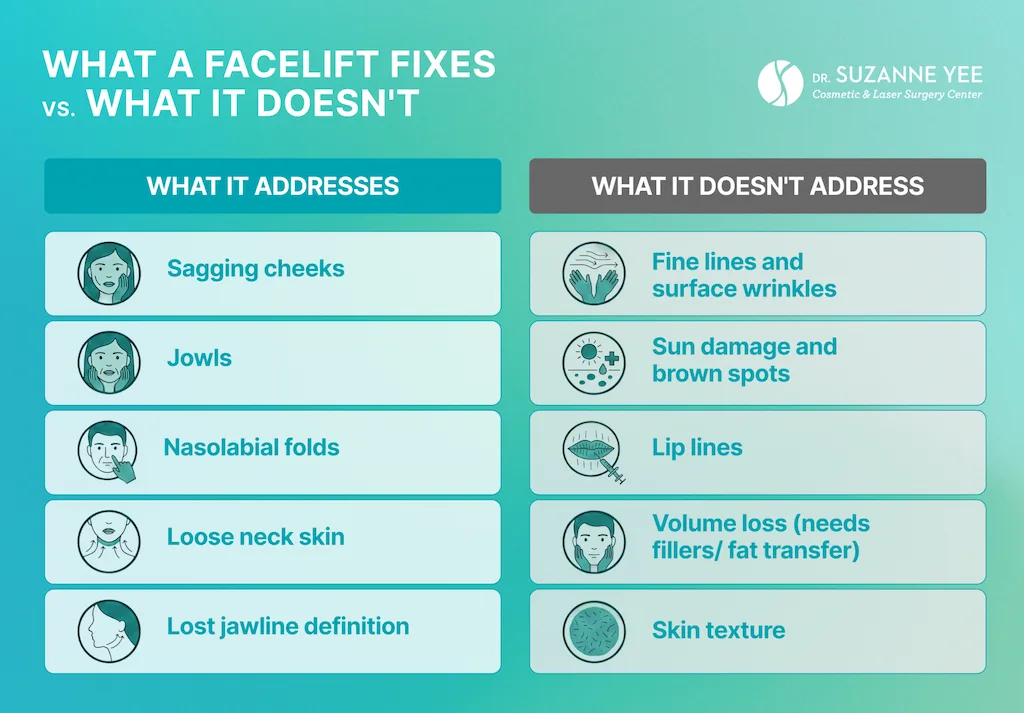
A facelift addresses the structural side of aging. As the years pass, the deeper support layers of your face loosen, fat pads drift downward, and skin loses its spring. That’s what creates sagging cheeks, jowls along the jawline, deep folds from the nose to the mouth, and a softening neckline. Repositioning and tightening those layers is exactly what a facelift does well.
What it doesn’t do is change the quality of your skin itself. A facelift won’t treat fine lines, sun damage, or changes in skin color, and it can’t stop the aging process going forward. That surface damage builds up over years of sun exposure. Up to 90 percent of the skin changes people struggle with come from photoaging, and no amount of lifting reverses it.
Here’s what that means for you. If your main concern is crepey texture or brown spots, surgery isn’t your answer, and a good surgeon will tell you so.
A facelift typically won’t improve:
- Fine lines and surface wrinkles, which respond better to skin laser resurfacing or chemical peels
- Sun damage, brown spots, and uneven skin tone
- Lost volume in the cheeks or temples on its own, which often calls for fat transfer or fillers
- The vertical lines around the lips
The degree of sagging and how much your mid-face has descended also shapes which technique you’ll need. Mild looseness is a different problem than significant drooping with deep folds, and the gap between the two is what separates a lighter lift from a deeper one. It’s worth taking time to understand where you fall, because researching this carefully before a consultation is exactly the right instinct. With that foundation, the different techniques start to make a lot more sense.
What are the main types of facelifts, and how does each one work?

Think of facelift techniques as a spectrum, from gentle adjustments near the surface to deeper repositioning of the structures underneath. The further down a technique works, the more lift and longevity it can offer, and usually the more recovery it asks for in return.
| Technique | What it works on | Often suited to |
|---|---|---|
| Skin-only lift | Skin alone, redraped and trimmed | Limited use today, mainly excess skin laxity |
| Mini facelift | Lower face and early jowls, shorter incisions | Mild to moderate lower-face laxity |
| SMAS facelift | The deeper muscle and tissue layer | Moderate aging of the mid and lower face |
| Deep plane | Skin, fat, and muscle moved as one unit | Significant mid-face descent and jowls |
| Mid-facelift | Descended cheek fat pads | Cheek flattening and deep nose-to-mouth folds; rarely performed as a standalone procedure today |
| Full facelift | All three zones: mid-face, lower face, neck | More advanced, widespread aging |
Skin-only and mini facelifts
The skin-only facelift is the original approach, lifting and re-draping skin without touching the deeper layers. It’s rarely used on its own now, because pulling skin alone tends to fade faster and can look tight rather than refreshed.
The mini facelift is the lighter modern option. It targets the lower face and early jowls through smaller incisions placed near the ears and hidden in the hairline. At the Little Rock office, minimally invasive mini facelift surgery suits patients with mild to moderate looseness and good skin elasticity. It’s a subtler change with a more streamlined recovery, which can be reassuring if your concerns are just beginning to show.
The SMAS facelift
The SMAS facelift goes a layer deeper. SMAS stands for the superficial musculoaponeurotic system, which is the sheet of muscle and connective tissue beneath your skin that gives the lower face its support. By tightening and repositioning this layer rather than the skin, a SMAS lift produces a more durable, natural result.
It’s long been the workhorse of facial rejuvenation for a reason. A 2025 meta-analysis of 21 studies and 2,896 patients reported 87.8 percent patient satisfaction with SMAS techniques, with a strong safety record.
Deep plane and preservation deep plane
The deep plane facelift is the technique people often call the most advanced, and the label is earned. Instead of tightening the SMAS separately from the skin, the surgeon releases the ligaments that tether the face and lifts skin, fat, and muscle together as one composite unit. Because nothing is pulled tight against the skin, the result moves naturally and avoids that “windswept” look.
In that same meta-analysis, deep plane techniques reached 94.4 percent patient satisfaction, the highest of the group. The preservation of the deep plane is a newer refinement of this approach. It limits how much the skin is lifted away from the deeper tissue, which reduces the empty space underneath and can lower the chance of fluid collecting as you heal.
These deeper techniques rely heavily on the surgeon’s skill and knowledge of facial anatomy. Dr. Yee, who serves on the National Education Faculty and trains other physicians in advanced techniques, places Endotine(R) anchors to help hold the lifted tissue in its new position. These are small absorbable anchors made of polylactic acid that begin to dissolve at about two months and are completely gone by fifteen months, so nothing has to be removed later.
Mid-facelift and full facelift
The mid-facelift focuses specifically on the cheeks. When the cheek fat pads drift downward, they flatten the cheeks and deepen the folds running from the nose to the mouth. Mid face lift surgery repositions those pads higher, often for patients in their 30s and 40s noticing early cheek changes rather than jowling.
A full facelift, by contrast, addresses all three zones at once: the mid-face, the lower face and jawline, and the neck. It’s the most comprehensive option for more widespread aging, often chosen by patients across their 40s through their 60s. It’s frequently paired with Little Rock neck lift options or eyelid surgery for balance.
The right technique shifts with what’s changing at each stage of life. To see how those concerns evolve over the decades, the wellness guide by decade is a helpful place to start.
Non-surgical alternatives
You’ll also see non-surgical options marketed as facelifts. A thread lift uses dissolvable sutures to lift tissue modestly, and a “liquid facelift” uses injectable fillers to restore volume and soften folds. Both can refresh early signs of aging, and they’re appealing if you’re not ready for surgery. If that describes where you are right now, you can explore dermal filler treatments for facial volume before committing to an operation.
They aren’t a true substitute for a surgical lift, though. Fillers and threads can’t reposition significantly sagging tissue, and their effects are temporary. If genuine descent and loose skin are the issue, surgery is the tool that actually addresses it. Once you know how each technique works, the next natural question is how they stack up on the things you’ll live with day to day.
How do facelift techniques compare in results, recovery, and longevity?
This is where the choice gets real, because the differences you’ll feel come down to how natural the result looks, how long recovery takes, and how long the improvement holds. The general rule is intuitive: deeper techniques ask more of you up front and tend to give back more in return. Our side-by-side breakdown of how the mini, SMAS, and deep plane approaches compare goes deeper on matching each one to your goals.
On naturalness, the deeper techniques have an edge. Because a deep plane lift repositions tissue as one unit instead of pulling skin, it tends to produce the most natural, untouched-looking result. That’s why it earned the highest satisfaction scores in the research above.
Lighter lifts can look wonderful too, especially when the aging they’re treating is early. It comes down to matching the technique to the amount of change present.
Recovery scales with how much work is done. After a facelift, it’s normal to have mild swelling, bruising, and tightness in the first few days, easing over about two weeks. Most patients feel comfortable returning to work and normal activities within 10 to 14 days, while strenuous exercise waits at least four to six weeks. A lighter mini lift generally feels more manageable, and a deeper technique asks for a bit more patience as swelling settles, so your exact timeline is something your surgeon maps out for your specific plan.
The first week can feel frustrating if you’re someone who likes to stay busy, and that’s completely understandable. Most patients tell us the hardest part was simply slowing down.
Karla, a Little Rock patient about six weeks out from her lower facelift, shared her experience:
“I am 6 wks out of my lower facelift with Dr Yee. My results are so natural and took years off my appearance. This can be a scary experience, but Dr Yee and her staff put me at ease before and after the procedure. I will definitely be using Dr Yee for any future procedures, and highly recommend her and her staff.”
On longevity, it helps to set the right expectation. No facelift stops the clock, and you keep aging naturally after surgery, no matter the technique. What a well-done lift does is reset your starting point, so you stay years ahead of where you’d be had you never had it.
Deeper techniques tend to hold that advantage longer because they reposition the structural layers, while lighter lifts may refresh for a shorter span. Knowing that going in helps you choose with clear eyes, rather than chasing a permanent fix that doesn’t exist.

How much does each type of facelift cost, and what affects the price?
Cost is one of the first questions on most people’s minds, and it can feel stressful to ask about when you’re already weighing a big personal decision. The honest framing is that there’s no single price for “a facelift,” because the techniques differ so much in time and complexity.
In general, lighter procedures like a mini facelift cost less than a SMAS facelift, and a deep plane facelift sits at the higher end. The reason is straightforward. A deep plane technique takes longer in the operating room, requires more specialized work to release and reposition the deeper structures, and therefore carries higher surgical, anesthesia, and facility costs than a lighter lift. Procedures like a cheek lift or deep plane facelift, and adding neck and platysmal (muscle band) work, further increase the length and complexity of surgery, which raises the cost accordingly.
What’s often more useful than a sticker price is knowing what’s actually included. At Dr. Yee’s Little Rock practice, your quote bundles the surgeon’s fee, anesthesia, facility fees, and follow-up visits into one transparent total, and patients are only responsible for their pre-op labs and any prescribed medications. That clarity matters because a low base quote elsewhere can balloon once those extras get added back in.
A clear quote should separate what’s bundled from what’s not:
- Bundled in your quote: the surgeon’s fee, anesthesia, facility fees, and your follow-up visits
- Your responsibility: pre-operative lab work and any prescribed medications
Cost also shifts with where you live and your surgeon’s experience and credentials, since a highly trained, board-certified surgeon reflects years of specialized skill.
To help make your goals more accessible, the practice offers flexible financing through Cherry, Alphaeon Credit, CareCredit, PatientFi, and Alle, with qualifying plans that let you spread the cost into manageable monthly payments. Knowing your options up front takes some of the financial weight off, so you can focus on the decision that matters most.
What are the risks of different facelift techniques?
It’s natural to feel a flicker of nerves reading about surgical risks, and acknowledging that is the right place to start. The reassuring reality is that facelift surgery has a long, well-studied safety record, and the vast majority of patients heal without any serious problems.
That said, every surgery carries some risk, and being informed helps you feel in control rather than anxious. The most common issue is a collection of blood that can gather under the skin in the first day or so, called a hematoma. Surgeons reduce the likelihood with careful technique and blood pressure control during and after surgery, and when it does happen, it’s managed promptly.
Nerve concerns understandably worry people most, but reassurance is genuinely warranted here. A large meta-analysis of more than 15,000 patients found that any lasting nerve effect is extremely rare, well under one percent. The temporary numbness or tightness most patients notice tends to settle as the nerves recover.
Deeper techniques involve more extensive work, so minor issues can be a little more common. Even so, a large review of nearly 11,000 patients found deep plane and SMAS approaches comparably safe overall.
One thing firmly in your control is smoking. Smoking meaningfully slows healing and raises the chance of skin and wound problems after a facelift. If you smoke, this is also the time to step away from that habit, ideally six weeks before and after surgery, which gives your body the best possible foundation to recover well. Choosing an experienced, board-certified surgeon and following your aftercare instructions closely are the two most powerful things you can do to keep your odds in the reassuring range.
How do you choose the right facelift technique and surgeon?
After all the technical details, the decision really comes down to two linked questions: which technique fits your face, and who you trust to perform it. The good news is that you don’t have to figure out the technique on your own, because matching it to your anatomy is the surgeon’s job, not yours.
The right approach depends on how much aging is present and where. Earlier or more superficial changes may be served well by a mini or SMAS lift, while significant mid-face descent and pronounced jowls often point toward a deep plane technique. A skilled surgeon evaluates your skin, your facial structure, and your goals before recommending anything, which is exactly what should happen at a thorough consultation.
When you’re vetting a surgeon, a few questions cut through the noise:
- Are you board-certified, and by which boards specifically?
- How often do you perform the exact technique you’re recommending for me?
- Which approach do you recommend for my face, and why that one?
- Can I see before-and-after photos of patients with a starting point like mine?
That last point deserves emphasis. Reviewing before-and-after results is one of the most reliable ways to judge a surgeon’s aesthetic style, so look for natural, balanced outcomes rather than tight or stretched ones.
This is also the moment to confirm credentials directly. Dr. Yee is triple board-certified, including by the American Board of Cosmetic Surgery (ABCS) and the American Board of Facial Plastic and Reconstructive Surgery (ABFPRS). She has spent decades refining facial techniques at her AAAHC-accredited surgical center in Little Rock.
A real consultation is a two-way street. It isn’t just a chance for the surgeon to assess you. It’s equally your chance to evaluate her.
Before recommending an approach, your surgeon asks about your daily routine, your work, and what you want to feel comfortable doing again. She explains why a given technique fits your anatomy rather than handing you a template. These conversations happen in person at the Little Rock office, where a hands-on assessment and a look at the facility tell you things a screen never could.
If you’d like that kind of candid, unhurried conversation, you can schedule a consultation to talk through your options with no pressure.
This is also where many patients decide to combine procedures for a more harmonious result, pairing a facelift with a neck lift, eyelid surgery, or getting a brow lift in Little Rock so the whole face ages in balance.
Jacque, a Little Rock facelift patient who valued how she was treated as much as her result, shared her experience:
“I can’t emphasize enough how pleased I am with the results of my facelift, but more importantly, with the way I have been treated on each visit. I feel cared for and valued by everyone involved in my journey.”
Conclusion
You came here facing a wall of confusing names, unsure which “facelift” was actually meant for you. By now, the picture should feel clearer. These techniques sit on a spectrum from light to deep, each matched to a different degree of aging. The best choice is the one that fits your face and your goals, not the one with the trendiest name.
A helpful next step is simply browsing real before-and-after results from patients whose starting point looks like yours, since photos make the differences between techniques tangible in a way words can’t. When you’re ready, an in-person consultation fills in the personal details that no article or gallery can.
That’s the heart of how Dr. Suzanne Yee approaches facial rejuvenation in Little Rock: exceptional results paired with genuine care, and a belief that every patient deserves to feel heard, respected, and confident in their choice. When it feels right for you, you can request your personal consultation or call (501) 224-1044 to begin the conversation.
Frequently asked questions
What is the difference between a mini facelift and a full facelift?
A mini facelift targets early sagging in the lower face and jawline through smaller incisions, with a more streamlined recovery. A full facelift addresses more advanced aging across the mid-face, jowls, and neck for a more comprehensive result. The right one depends on how much change is present, which your surgeon assesses in person.
Can a facelift be done under local anesthesia?
Some practices offer local anesthesia with sedation for certain lifts. At the Little Rock office, surgical procedures are performed under general anesthesia given by a Certified Registered Nurse Anesthetist (CRNA), keeping you comfortable and safe throughout. Your anesthesia plan is reviewed with you before surgery.
What is a preservation facelift, and how is it different from a deep plane facelift?
A preservation facelift is a newer refinement of the deep plane technique. It still releases the deeper ligaments and repositions tissue as a unit, but it limits how much the skin is lifted away from the underlying layers. That can reduce empty space under the skin and may ease some aspects of recovery.
Will a facelift make me look pulled or “done”?
A natural result is the goal, and modern, deeper techniques are designed to avoid that stretched look by repositioning tissue rather than pulling skin tight. Reviewing before-and-after photos is the best way to confirm a surgeon consistently produces natural, balanced outcomes.
At what age should I consider getting a facelift?
There’s no single right age. Surgery becomes worth considering when sagging and deeper folds no longer respond to non-surgical treatments, which happens at different times for different people. Many patients explore a facelift somewhere between their 40s and 60s, but your skin quality and concerns matter more than the number.
Can I combine a facelift with a neck lift or eyelid surgery?
Yes, and it’s common. Combining a facelift with a neck lift, brow lift, or Little Rock cosmetic blepharoplasty often creates a more balanced, harmonious result, since the whole face ages together. Your surgeon reviews safe, sensible combinations during your consultation based on your goals and anatomy.
What is a thread lift, and is it a real alternative to a surgical facelift?
A thread lift uses dissolvable sutures to lift tissue modestly and is far less invasive than surgery. It can refresh early, mild sagging, but it can’t reposition significantly loose skin or deeper tissue, and the effect is temporary. For genuine descent, a surgical lift is the more lasting answer.
*Disclaimer: This content is for educational purposes only and does not constitute medical advice. A consultation with a qualified board-certified surgeon is required to determine the best treatment plan for your individual needs.