Instagram
 Facebook
 Tiktok
 Youtube
 X
X LinkedIn
 (501) 224-1044

If you’ve ever wondered why your midsection doesn’t reflect all the work you’ve put into your health, you’re not alone, and it isn’t a sign that you’ve done something wrong. A tummy tuck is often misunderstood as a shortcut to weight loss, but that isn’t what it’s designed to do.
Abdominoplasty is a body contouring procedure that addresses what diet and exercise simply can’t reach: separated abdominal muscles and excess skin that no amount of effort in the gym will tighten on its own.
You’re in good company if you’ve been considering it. More than 349,000 tummy tucks were performed in the United States in 2024 according to ASPS, ranking it the third most popular cosmetic surgery, and one of the top five surgical procedures for women worldwide.
Behind those numbers are real people, often patients who’ve reached their goal weight or finished growing their families and find that their bodies tell a different story than the one they’ve been working so hard to write.
At Dr. Suzanne Yee Cosmetic & Laser Surgery Center in Little Rock, every conversation starts with listening. Understanding what a tummy tuck can and can’t do for you, specifically, matters far more than any general explanation of the procedure. The practice is led by a triple board-certified cosmetic surgeon with over 35 years of experience, and the goal of this article is to walk alongside you as you learn; covering candidacy, the different procedure types, what surgery and recovery actually look like, and the results you can genuinely look forward to.
Key takeaways
- A tummy tuck removes excess skin, tightens separated abdominal muscles, and reshapes your midsection, but it is not a weight loss procedure and works best when you’ve been at a stable weight for at least six months.
- The three main types, mini, full, and extended, differ based on how much excess skin you have and whether your flanks need attention, and your surgeon recommends the right one after a hands-on evaluation.
- Surgery takes two to five hours under general anesthesia, involves a horizontal incision low on the abdomen, and is typically performed on an outpatient basis so you go home the same day.
- Serious complications are uncommon, with a major complication rate of just 2.1 percent in a study of nearly 56,000 patients, and choosing a board-certified cosmetic surgeon at an accredited facility reduces your risk further.
- Most patients take about two weeks off work, start light walking the day after surgery, and reach full recovery at six to 12 months as final results settle into place.
Am I a good candidate for a tummy tuck?
The best candidates for abdominoplasty are people whose bodies have changed in ways that even the healthiest habits can’t undo, and that’s not a personal failing, it’s simply how some bodies respond to pregnancy, weight loss, or time. During a consultation, Dr. Yee takes the time to understand your goals, listen to what’s been bothering you, and look closely at your anatomy to help you figure out together whether a tummy tuck is the right fit.
Stable weight and timing
You should be at or near your goal weight for at least six months before scheduling a tummy tuck. Significant weight fluctuations after surgery can stretch the repaired tissues and compromise your results.
If you’re planning future pregnancies, most surgeons recommend waiting. Pregnancy can re-separate muscles and stretch skin that was repaired during the procedure. A 2023 review of 237 cases found that pregnancy after abdominoplasty is safe, but the aesthetic benefits may diminish over time.
Health and lifestyle requirements
Being in good overall health is a baseline requirement. Conditions like uncontrolled diabetes, cardiovascular disease, and cirrhosis can increase the risk of surgical concerns significantly.
Smoking is one of the biggest factors. Active smoking impairs blood supply and wound healing, and research shows it can triple your risk of postoperative issues.
Higher BMI also matters. In a study of 24,861 patients, those with a BMI above 30 experienced a complication rate of 15.2 percent compared to 7.3 percent in those below that threshold.
Realistic expectations
As a procedure focused on core muscle repair and skin tightening, a tummy tuck removes excess skin and fat, repairs separated abdominal muscles (a condition called diastasis recti), and reshapes your midsection for a flatter, firmer contour. It does not replace weight loss, and it won’t eliminate all stretch marks.
What it can do is genuinely meaningful. In one study, 91.4 percent of patients reported satisfaction with their aesthetic outcome. Taking time to understand these distinctions now is the kind of thoughtful research that leads to confident decisions.
At the practice’s AAAHC-accredited surgical center in Little Rock, Dr. Yee and the team of experienced cosmetic plastic surgery specialists will evaluate your abdominal skin, muscle condition, and overall health to determine which approach fits your body and goals. This is also your opportunity to ask questions, review your medical history, and decide whether the fit feels right. A consultation is a two way conversation, not a commitment.
Schedule a consultation to discuss your options with Dr. Yee.
What types of tummy tucks are available?
Not every tummy tuck looks the same. Dr. Yee will determine which technique is best after evaluating how much excess skin you have, where it’s located, and whether your abdominal muscles need repair.
| Type | What it addresses | Incision | Typical recovery |
|---|---|---|---|
| Mini | Lower abdomen only | 3-5 inches below bikini line | 1-2 weeks to work |
| Full | Upper and lower abdomen, muscle repair, navel repositioning | Hip to hip plus around navel | 2 weeks to work, 3 months full |
| Extended | Abdomen plus flanks and hips | Hip to hip extending around sides | 4-6 weeks to work, 12 weeks full |
Full abdominoplasty
A full tummy tuck is the most common approach. It involves a horizontal incision between the hip bones and a second incision around the belly button.
This technique allows the surgeon to remove excess skin and fat from both the upper and lower abdomen, tighten separated muscles along the midline, and reposition the navel. It’s best suited for patients with moderate skin laxity and diastasis recti from pregnancy or weight loss.
Mini abdominoplasty
A mini tummy tuck for loose skin targets only the lower abdomen through a shorter incision, typically three to five inches and placed right below the bikini line. The belly button stays in its original position.
Recovery is faster than a full procedure, with most patients back to work within one to two weeks. The resulting scar is smaller and easier to conceal.
Extended abdominoplasty and liposuction
An extended tummy tuck is designed for patients with significant excess skin around the abdomen and flanks, often following major weight loss. The incision wraps further around the hips to address tissue that a standard procedure can’t reach.
Liposuction is frequently combined with any tummy tuck type for targeted fat elimination treatments in the flanks, hips, or thighs. The two procedures complement each other well. A meta-analysis of over 14,000 patients found that combining them actually lowered the rate of certain concerns like fluid collection.
Understanding which type matches your anatomy is something Dr. Yee determines during a hands-on evaluation, not something you can figure out from photos alone.
What happens during tummy tuck surgery?
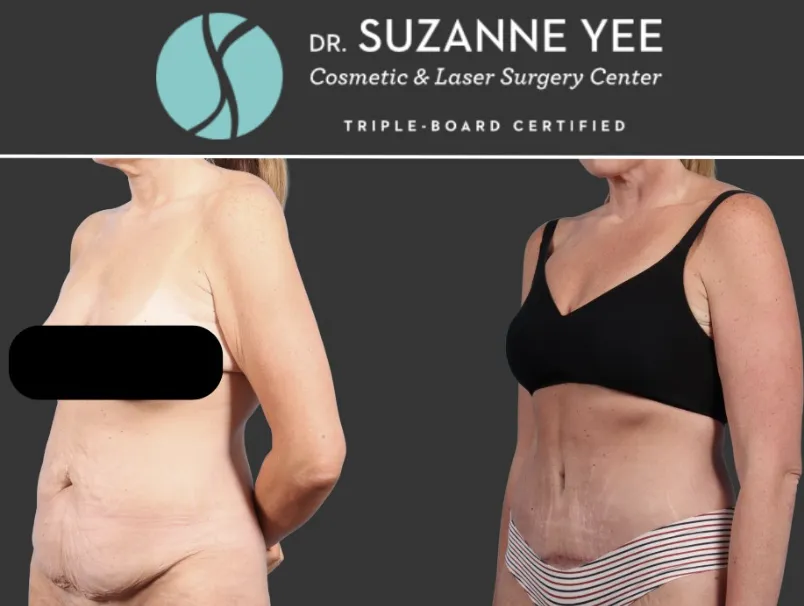
Knowing the steps involved can take some of the mystery out of the process. A tummy tuck is performed under general anesthesia so you’re completely comfortable and won’t feel a thing during surgery.
The procedure begins with a horizontal incision low on your abdomen, positioned along the bikini line so it can be concealed by underwear. In a full abdominoplasty, a second incision is made around the belly button.
The surgeon then lifts the skin to access the underlying abdominal muscles, bringing the separated halves back together with sutures along the midline. Excess skin is trimmed and redraped over the tightened framework, and the belly button is repositioned through a new opening to sit naturally on the flatter surface.
In many cases, liposuction is used alongside the procedure to refine the contour. Studies show it’s incorporated in 86 to 89 percent of tummy tucks performed in the United States.
The surgery typically takes two to five hours, depending on the technique and extent of correction. Most tummy tucks are outpatient, meaning you go home the same day after a short observation period.
If the financial side of surgery is on your mind, flexible financing through Cherry, Alphaeon Credit, CareCredit, PatientFi, and Alle can help make your goals more accessible.

What are the risks and complications of a tummy tuck?
Every surgical procedure carries some degree of risk, and a tummy tuck is no exception. We know that it’s easy to get caught up in worrying about the risks, but the reassuring part is that serious concerns are genuinely uncommon when the procedure is performed by a qualified cosmetic surgeon, such as Dr. Yee.
In a large study of nearly 56,000 tummy tuck patients, the overall major complication rate was just 2.1 percent. The most frequently reported issues were minor bruising beneath the skin at 0.7 percent and infection at 0.6 percent.
Seroma, a small pocket of fluid that forms near the incision site, is one of the more common temporary concerns. It typically resolves on its own or with a simple drainage procedure.
Some patients experience temporary numbness or reduced sensation near the incision as nerves heal. This usually gradually improves over weeks to months.
Scarring is unavoidable, but the horizontal incision is placed several inches below the typical underwear line and can be concealed by bikini bottoms. Dr. Yee uses advanced closure techniques to keep the scar as thin and inconspicuous as possible, and products applied after healing can help it fade further.
Smoking significantly increases the chance of wound healing issues and is considered a contraindication for the procedure. Stopping well in advance is one of the most effective things you can do to minimize your risk.
Feeling uncertain about potential complications is completely natural, and a lot of how those risks play out in real life comes down to who’s performing your surgery and how thoroughly they prepare you for it.
That’s something L C, a patient who came to Dr. Yee after procedures with other surgeons, noticed firsthand:
“I had 2 cosmetic surgery procedures prior to choosing Dr. Yee for my recent surgery. She is Board Certified and many cosmetic surgeons are not, so be careful. I was most impressed with the detailed preparations she required and followed me through prior to the actual surgery. Dr. Yee holds more than a Medical Doctorate and Board Certification in Cosmetic Surgery, she also holds a Doctorate in Pharmacy. This was definitely a benefit to me at pre-surgery and recovery time regarding medication. My recovery was faster than expected with less bruising than expected. I am extremely pleased with the results of her knowledge and skilled hands!”
How do you prepare for and recover from a tummy tuck?
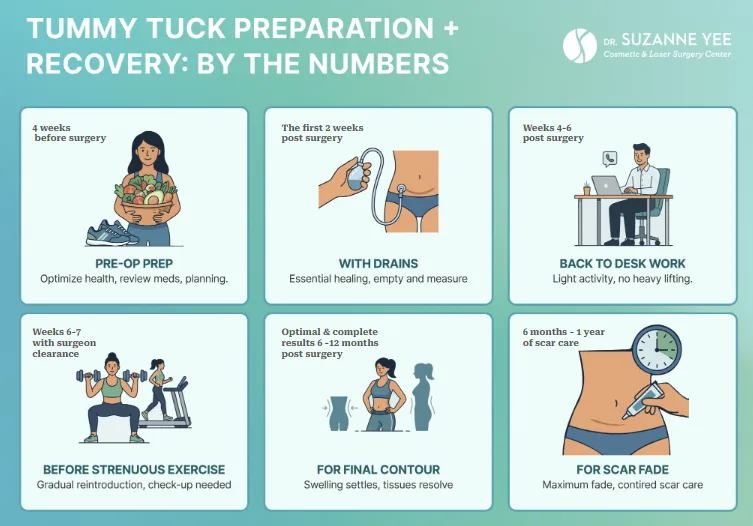
Preparation and recovery are two halves of the same process. What you do before surgery directly affects how smoothly the weeks afterward go.
Before your procedure
If you smoke, Dr. Yee will ask you to stop at least four weeks before your tummy tuck. You’ll also review your medications and supplements, since certain blood-thinning medications may need to be paused temporarily.
Arrange for someone to drive you home and stay with you for the first 24 to 48 hours. Stock up on easy meals, loose clothing, and anything you’ll need within arm’s reach so you’re not bending or stretching unnecessarily.
The first two weeks
The initial days are the most demanding part of recovery. You’ll feel tightness across your abdomen, and some discomfort is normal as your body begins to heal.
Your surgeon may use a long lasting numbing agent that provides relief for up to two days, with oral pain medication handling the rest. Walking in short intervals, even around your house, is encouraged starting the day after surgery. Light movement promotes healthy blood flow and helps prevent concerns like blood clots.
Avoid lifting anything heavier than a few pounds, and arrange for help with childcare since picking up children is off-limits during this period. Most patients take about two weeks off from work, depending on how physically demanding their job is.
Getting back to normal
By weeks four through six, most patients feel significantly better and begin returning to light daily routines. Strenuous exercise and heavy lifting should wait until you receive clearance from your surgeon, typically around the six-week mark.
Full recovery, meaning the point where all internal healing is complete and your results have settled, takes six to 12 months. It’s a gradual process, and being patient with your body during this stretch is something almost every patient says was worth it.
Our patient, Kayla, describes how her recovery went:
“In June of 2024 I had a tummy tuck. Dr. Yee and her staff were very kind and caring. I struggle with bad anxiety and they always made me feel relaxed and comfortable before and after surgery. My recovery went very smoothly, I was shocked that I experienced little to no pain in the days after surgery. My scar is now over a year old and its way less visible than I ever expected. So happy with my results and I will continue services with Dr. Yee and her staff in the future.”
What results can you expect from a tummy tuck?
You’ll notice a difference in your body shape almost immediately after surgery, even though swelling and bruising will obscure the full picture at first. Your abdomen will already look flatter and more contoured than before.
Around the three-month mark, the results start to become much clearer as swelling continues to subside. Final results typically take six to 12 months to fully develop as your tissues settle and your skin adapts to its new contour.
One common question is whether a tummy tuck removes stretch marks. The procedure eliminates stretch marks located on the skin that gets excised, typically the area below the belly button. Stretch marks above the navel usually remain, though they may shift lower and become less visible.
Long-term results depend largely on lifestyle. Maintaining a stable weight through regular exercise and balanced nutrition is the most important thing you can do to preserve your outcome. If you gain a significant amount of weight after surgery, the skin can stretch again and the muscles may separate.
With over 35 years of cosmetic surgery experience, your surgeon can help you set grounded expectations based on your anatomy and goals. Real patient results are available in the photo gallery for a closer look at what’s possible.
Conclusion
You came to this article wondering what a tummy tuck actually involves and whether it could be the right step for you. Now you have a clear picture, from who qualifies and what happens during surgery to what recovery looks like and how long results last.
Browsing real patient photos that match your starting point is one of the most helpful things you can do next. When you’re ready, a personal consultation fills in the details that photos can’t show.
At Dr. Suzanne Yee Cosmetic & Laser Surgery Center in Little Rock, every patient deserves to feel heard, respected, and confident in their choices. The philosophy here is enhancement, not transformation, and the goal is always a result that looks and feels like you.
Request your personal consultation or call (501) 493-3661 to start the conversation.
Frequently asked questions
What is the difference between a tummy tuck and liposuction?
A tummy tuck removes excess skin, tightens separated abdominal muscles, and reshapes the midsection. Liposuction removes fat deposits but does not address loose skin or muscle separation. Many patients benefit from combining both procedures for a more comprehensive result. Our guide to combining a tummy tuck with liposuction walks through when that pairing makes sense, plus the non-surgical alternatives worth knowing.
What is a mini tummy tuck?
A mini tummy tuck focuses on the lower abdomen through a shorter incision, typically three to five inches long. It’s designed for patients with mild to moderate skin laxity below the belly button who don’t need a full procedure. Recovery is faster, and the resulting scar is smaller and easier to conceal.
What is rectus diastasis and does a tummy tuck fix it?
Rectus diastasis is the separation of the two large abdominal muscles that run down the center of your stomach. It commonly develops during pregnancy or after significant weight changes. A tummy tuck repairs this separation by suturing the muscles back together along the midline, restoring core support and a flatter profile.
How long is tummy tuck recovery?
Most patients take about two weeks off from work and can begin light walking the day after surgery. Full clearance for strenuous exercise typically comes around six to eight weeks. Final results continue to develop for up to 12 months as internal healing completes and swelling resolves.
How painful is tummy tuck surgery?
Pain levels vary, but most patients describe the first few days as the most uncomfortable period. Long-acting numbing agents and oral pain medication help manage discomfort effectively. By the end of the first week, most patients report that pain is manageable and steadily improving.
Will a tummy tuck remove my C-section scar?
In many cases, yes. The tummy tuck incision is placed low on the abdomen, and if your C-section scar falls within the area of skin being removed, it is eliminated along with the excess tissue. Your surgeon can assess this during an in-person consultation.
Can I get pregnant after a tummy tuck?
Pregnancy after a tummy tuck is considered safe based on current research. However, carrying a baby will likely stretch the skin and muscles that were repaired, which may affect your results. Most surgeons recommend completing your family before scheduling the procedure.
How much does a tummy tuck cost?
The cost depends on several factors including the technique used, whether additional procedures like liposuction are included, anesthesia fees, and facility costs. Financing through Cherry, Alphaeon Credit, CareCredit, PatientFi, and Alle can make the procedure more accessible with manageable monthly payment plans.
Does insurance cover a tummy tuck?
Insurance typically does not cover a tummy tuck because it is considered an elective cosmetic procedure. In rare cases where the procedure is deemed medically necessary, some plans may cover a portion. Contact your insurance provider directly to understand your specific coverage.
*Disclaimer: This content is for educational purposes only and does not constitute medical advice. A consultation with a qualified board-certified surgeon is required to determine the best treatment plan for your individual needs and any questions you may have about a medical condition or procedure.