Instagram
 Facebook
 Tiktok
 Youtube
 X
X LinkedIn
 (501) 224-1044

You’ve done the work. The meal prep, the early morning walks, the months of discipline. And yet, every time you catch your reflection getting out of the shower, there it is, loose skin that no amount of crunches will tighten, a midsection that just doesn’t match the effort you’ve put in.
If that sounds familiar, you’re far from alone. A tummy tuck (the medical term is abdominoplasty) ranked as the fourth most common cosmetic surgical procedure worldwide in 2023, with over 1.15 million procedures performed globally that year. More people than ever are choosing to address what diet and exercise simply can’t fix on their own. And there’s nothing wrong with that.
At Dr. Suzanne Yee Cosmetic & Laser Surgery Center in Little Rock, triple board-certified cosmetic surgeon Dr. Suzanne Yee has performed cosmetic procedures for over 35 years. In this article, we’ll walk through each phase of a tummy tuck; from figuring out if you’re a good candidate, to preparing for surgery, to what actually happens in the operating room, to what recovery really looks like week by week. The goal is for you to feel informed and confident before making any decisions.
Key takeaways
- A tummy tuck removes excess skin, tightens separated abdominal muscles, and reshapes your midsection, but you’ll need to be at a stable weight for at least six months and be a nonsmoker to qualify.
- Preparation involves lab work, medication adjustments, and arranging help for the first few days at home, with most surgeons asking you to stop smoking four to six weeks before your procedure.
- The main types include full, mini, extended, fleur-de-lis, and open book abdominoplasty, and each one addresses a different degree of skin laxity and muscle separation.
- During surgery, your surgeon makes a horizontal incision low on your abdomen, typically tightens the separated abdominal muscles (though in some cases muscle repair isn’t needed), removes excess tissue, and repositions the belly button, all under general anesthesia in a procedure lasting two to five hours.
- You can typically go home the same day and return to desk work within two weeks, though strenuous activity is off limits for at least six weeks while your body heals.
Am I a good candidate for a tummy tuck?
Most candidates share a few things in common. You should be at a stable weight for at least six to 12 months before considering surgery, because significant weight changes afterward can undo your results. This isn’t about reaching a perfect number on the scale, it’s about making sure your body has settled so the results can last.
If you’ve had a pregnancy, your abdominal muscles may have separated down the middle, a condition called diastasis recti (pronounced die-ASS-tuh-sis REK-tie). It’s essentially a gap between the two vertical muscles that run down the front of your belly, and it’s surprisingly common. Research published in the British Journal of Sports Medicine found that roughly one in three women still have this separation a full year after giving birth. When the gap is significant, surgery is the most reliable way to bring those muscles back together. No amount of planks or crunches can close a wide separation on their own.
Smoking is one of the clearest things that can rule you out. Nicotine narrows your blood vessels, which means less oxygen gets to your healing tissues, and that can cause serious complications. You’ll need to quit at least four to six weeks before and after surgery. Good overall health matters too, since uncontrolled conditions like diabetes or heart disease can increase your risk during any surgical procedure.
The consultation is where the real picture comes together. Dr. Yee examines your abdominal area, evaluates the condition of your skin and muscles, and determines which abdominal wall tightening surgery approach fits your anatomy and your goals.
She reviews your medical history, discusses any medications that may need adjusting, and answers every question you bring, no matter how small it might seem. This isn’t just her evaluating you. It’s equally your chance to evaluate her, see the AAAHC-accredited facility where your procedure would take place, and decide if the fit feels right.
Taking the time to research before committing to something this personal isn’t overthinking; it’s a sign you’re approaching it the right way.
If you’re wondering whether you qualify, schedule a consultation to get a clear, personalized answer rather than guessing on your own.
How do you prepare for tummy tuck surgery?
Once you’ve decided to move forward, preparation becomes the bridge between your consultation and surgery day. Getting these details right helps your body heal more efficiently and sets you up for a smoother recovery. Think of it as doing everything you can now so your body can focus on healing later.
Lab work and medical clearances
Your surgeon will order blood tests, and depending on your health history, you may need additional clearances from your heart or lung doctor beforehand. These aren’t obstacles or hoops to jump through; they’re safeguards that confirm your body is ready for surgery. If anything needs attention first, catching it early gives you time to address it before your procedure date.
Medications and supplements
Certain medications and supplements thin the blood and increase bleeding risk. You’ll receive a list of what to pause before surgery, which commonly includes aspirin, ibuprofen, vitamin E, and supplements like fish oil. Your surgeon may also adjust prescription medications based on your specific situation.
Smoking and alcohol
If you smoke, you’ll need to stop at least six weeks before your procedure and stay smoke free for the same period after. This one really matters, as nicotine seriously compromises your body’s ability to heal. Alcohol should be avoided for two weeks before and two weeks after surgery, since it can thin the blood and cause bleeding or prevent clotting of the blood leading to hematomas. Alcohol can also interfere with anesthesia and slow recovery.
Getting your home ready
Arrange for someone to drive you home and stay with you for at least the first 24 hours. Before surgery day, set up a comfortable recovery spot at home, think recliner or a bed with plenty of pillows for propping yourself up. Stock up on loose, comfortable clothing, your medications, water, snacks, and your phone charger so the essentials are easy to reach. Just keep in mind that getting up to walk around regularly is encouraged early on; gentle movement supports circulation and healing, so you won’t be staying in one spot the whole time.
A little advance planning goes a long way. The more you set up now, the less you’ll need to worry about when your only job is resting.
What are the different types of tummy tucks?
Not every tummy tuck looks the same, and the technique your surgeon recommends depends on how much correction your midsection needs. Here’s how the main types compare.
| Type | Incision | What it addresses | Typical duration |
|---|---|---|---|
| Full (traditional) | Hip to hip + around belly button | Upper and lower abdomen, muscle repair | 2-4 hours |
| Mini | 3-5 inches below bikini line | Lower abdomen only | 1-2 hours |
| Extended | Across abdomen and around hips | Abdomen plus flanks and lower back | 3-5 hours |
Full abdominoplasty
The full tummy tuck is the most common approach. It involves a horizontal incision between the hip bones and a second incision around the belly button. This allows your surgeon to tighten the abdominal muscles along the entire midline, remove excess skin from both the upper and lower abdomen, and reposition the navel for a natural contour.
Mini abdominoplasty
A mini tummy tuck, a partial abdominoplasty, targets only the area below the belly button. The incision is shorter, roughly three to five inches, and sits right along the bikini line. Because it involves less tissue removal and typically no muscle repair above the navel, recovery is quicker and scarring is minimal.
Extended abdominoplasty
If you’ve lost a significant amount of weight or have excess tissue that wraps around your sides and lower back, an extended tummy tuck may be recommended. The incision extends further around the hips, allowing your surgeon to address the flanks and create a more complete contour.
Understanding how the mini, full, and extended approaches differ helps you ask more informed questions about which approach fits your body. If you’d like to see what each technique can accomplish, browse real patient results to compare outcomes.
What happens during the tummy tuck procedure step by step?
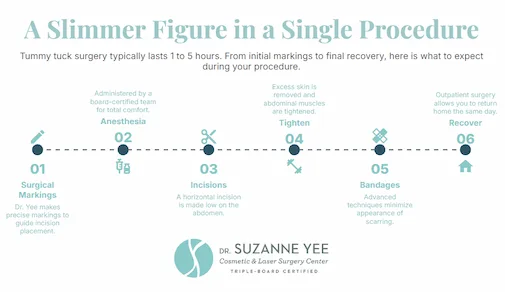
This is the section most people want to read first, and for good reason. Knowing what happens in the operating room, step by step, makes the whole experience feel less abstract and more manageable.
Anesthesia
The procedure begins with general anesthesia, which means you’ll be asleep and won’t feel anything during surgery. A Certified Registered Nurse Anesthetist monitors you the entire time.
Surgical markings and incision
Before the first incision, your surgeon marks the abdomen to map exactly where incisions will be placed and where lifting will occur. The primary incision is horizontal, placed low on the abdomen several inches below the belly button. The length depends on the type of tummy tuck being performed.
Muscle repair
This is the step that makes the biggest difference for many patients, especially moms. Once the incision is made, your surgeon can see the abdominal wall directly. If your muscles have separated down the middle (that diastasis recti we talked about earlier), the surgeon stitches them back together along the centerline, essentially rebuilding the firm internal wall that used to hold everything in place. This is what creates a firmer, flatter profile, and it’s the one thing no amount of exercise can replicate once a significant separation has occurred.
Excess skin and fat removal
With the muscles tightened, excess skin and underlying fat are trimmed away. This is the step where the keyword in your search, stomach skin removal, actually happens. The remaining skin is pulled taut and draped over the newly tightened abdominal wall. If stubborn fat deposits remain, your surgeon may incorporate minimally invasive fat removal options for more precise contouring.
Patient Lisa T. went through both a tummy tuck and liposuction and was pleased with her results:
“I had a tummy tuck and liposuction, and I looked fabulous when it was over. I can get back into my clothes again, and my self confidence is back.”
Belly button repositioning
Because the skin shifts downward during the tightening process, the belly button needs a new opening. Your surgeon creates a small incision in the repositioned skin and sutures the navel into its natural position so it looks proportionate to your new contour.
Drains and closure
Small drainage tubes may be placed beneath the skin to prevent fluid buildup during the first few days of healing. Your surgeon may also use a fibrin sealant like VISTASEAL™ to reduce the risk of seroma and shorten healing time. The incisions are then closed with sutures using techniques designed to minimize scarring.
How long does it take?
A full tummy tuck typically takes two to five hours from start to finish. A mini tummy tuck is shorter, usually one to two hours.
What happens right after your tummy tuck?
The hours and days immediately following surgery are often the part that feels the most uncertain, so let’s take the mystery out of it.
Your procedure is performed on an outpatient basis at an AAAHC-accredited surgical center, which means you won’t need to stay overnight in a hospital. After surgery, you’ll rest in a monitored recovery area while the anesthesia gradually wears off. The team checks your vital signs, manages your comfort, and makes sure you’re fully stable before you head home the same day.
Pain management starts before you even leave the operating room. Your surgeon uses Exparel, a long-acting numbing medication that’s injected directly into the surgical area. Its effects can last up to two days, so the initial discomfort is significantly reduced compared to what you might expect. Oral pain medication is prescribed for the days that follow to keep you comfortable as the Exparel wears off.
Pain was something that our patient Kim S. was concerned about beforehand, and she had this to say about her experience:
“I’m 62 and decided I needed some changes. I had a breast reduction/lift, tummy tuck and liposuction. My experience at this clinic was amazing. My pain was minimal. Which was one thing I worried about beforehand. The staff was so kind and very helpful. Answered all my questions. I did my research before coming to the decision to use Dr. Yee. I would recommend Dr. Yee for all my cosmetic surgeries.”
Walking is encouraged starting the day after surgery. We know that sounds like the last thing you’d want to do, but even short, slow trips around the house make a real difference because gentle movement promotes healthy blood flow and helps reduce the risk of blood clots. You won’t be speed-walking around the block, but shuffling to the kitchen and back counts.
You’ll return to the office for a follow-up appointment the very next day. Your surgeon or her designated staff will check your incisions, evaluate the drainage, and make sure everything is healing the way it should.
What does tummy tuck recovery look like week by week?
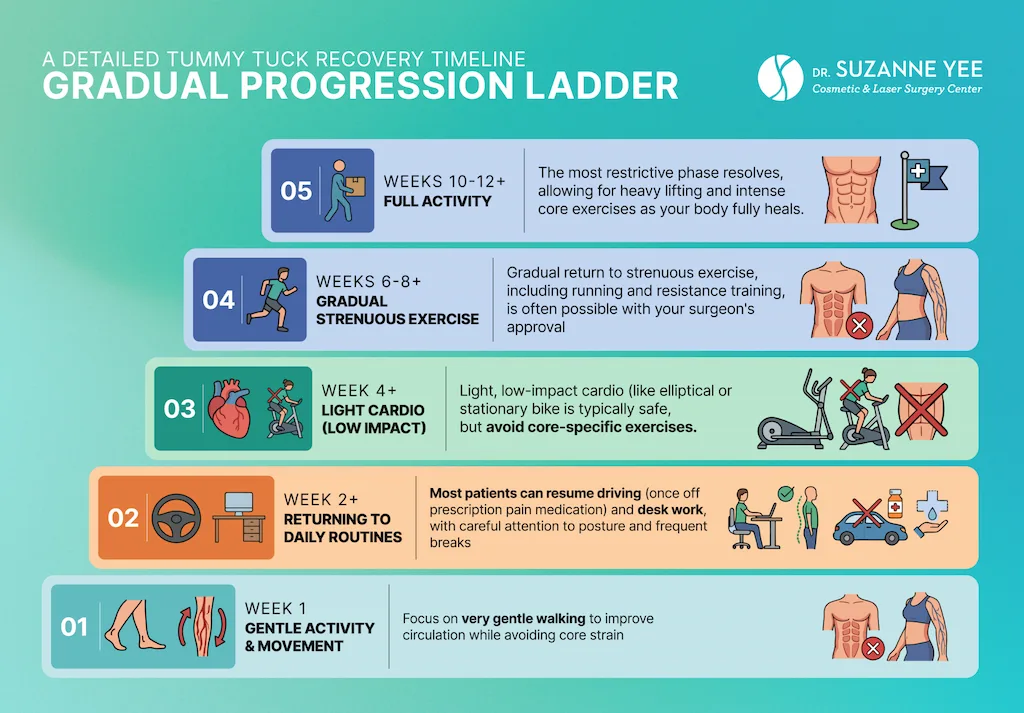
Recovery is gradual, and every week brings visible progress. Here’s a realistic breakdown of what most patients experience, because knowing what’s coming makes it so much easier to get through.
The first one to two weeks are the most restrictive. You’ll need time off work, typically about two weeks for desk jobs and longer if your work involves physical activity. Swelling, bruising, and tightness are normal during this phase, and your surgeon will prescribe medication to keep you comfortable.
Lifting anything heavier than a few pounds is off limits for at least six weeks after surgery. That includes picking up children, carrying groceries, and any exercise beyond light walking. Arrange help ahead of time for these tasks so you’re not tempted to push it.
A few other things to expect during recovery:
- You’ll wear a compression garment (think of it like a snug, supportive wrap around your midsection) for about six weeks. It helps reduce swelling and supports the healing tissues underneath.
- Driving is typically safe once you’re off prescription pain medication and can turn and brake comfortably; usually around the two week mark.
- Light exercise like walking increases gradually, but gym workouts and any exercises involving your core wait until your surgeon gives you the green light.
- Your scar runs horizontally across your lower belly, placed several inches below the underwear line. It will be red and visible at first, but it fades significantly over the following months.

Watch for anything unusual during recovery. While complications are uncommon, you should call your surgeon’s office if you notice increasing redness, fever, or drainage that changes color or has an unusual smell. Catching a potential issue early keeps it from becoming a bigger problem.
Around the three month mark, you’ll start to see a clearer picture of your final results. Full results can take six to 12 months to develop as residual swelling resolves and your tissues settle into their new contour. Be patient with your body during this time; it’s doing incredible healing work beneath the surface, even when progress feels slow.
Susan D., a patient who went through the full process from consultation to follow-up, shared her experience:
“I had a tummy tuck and breast augmentation in January 2022. Dr. Yee and her staff were so compassionate and caring throughout every one of my appointments and they took such good care of me the day of surgery! They checked on me often after surgery and I am beyond pleased with my results. Best decision I ever made!”
Conclusion
Now you know exactly what a tummy tuck involves; every step, from that first consultation conversation all the way through recovery. No more wondering, no more piecing things together from random internet posts at midnight.
Here’s what we hope you take away from all of this: that loose skin, that stubborn pooch, those muscles that split apart during pregnancy or weight changes, none of that is your fault, and none of it means you didn’t try hard enough. Some things just can’t be fixed with diet and exercise alone. That’s not a personal failing. It’s just biology.
If you’re still in the “just exploring” phase, that’s perfectly okay. Browsing real patient photos that match your starting point is a great next step. There’s something about seeing results on someone with a similar body that makes the whole idea click in a way that reading about it can’t.
Among surgical enhancement options in Arkansas, Dr. Suzanne Yee Cosmetic & Laser Surgery Center in Little Rock believes every patient deserves to feel heard, respected, and genuinely cared for. The approach here has always been about enhancement, not transformation — helping you look like the version of yourself you’ve been working so hard toward.
Request your personal consultation or call (501) 224-1044 whenever you’re ready. We’ll be here.
Frequently asked questions
How long does a tummy tuck take?
A full tummy tuck typically takes two to five hours, depending on the extent of correction needed. A mini tummy tuck is shorter, usually finishing in one to two hours. Your surgeon can give you a more precise estimate during your consultation based on your individual treatment plan.
Will I be asleep during the procedure?
Yes. Tummy tucks are performed under general anesthesia, so you’ll be fully asleep and won’t feel anything during the procedure. A CRNA monitors you throughout the surgery to keep you safe and comfortable.
Where will my scars be?
For a standard abdominoplasty, the main scar runs horizontally across your lower abdomen, placed several inches below the typical underwear line, with a small scar around the belly button on a full tummy tuck. Scar placement can vary with other techniques: an open book or fleur-de-lis abdominoplasty adds a vertical incision, and in some cases a small vertical incision is made beneath the belly button. Your surgeon uses advanced closure techniques designed to minimize scarring over time.
Does a tummy tuck remove stretch marks?
A tummy tuck removes stretch marks located on the excess skin that gets trimmed away, which is typically the skin below the belly button. Stretch marks on skin that remains in place, such as those above the navel, will not be removed but may shift to a lower position.
Can I get pregnant after a tummy tuck?
Pregnancy after a tummy tuck is physically possible, but it can stretch the muscles and skin back out, which may diminish your results. Most surgeons recommend waiting until you’re done having children before scheduling the procedure.
How much weight will I lose from a tummy tuck?
A tummy tuck is not a weight loss procedure. It removes excess skin and some fat, which typically amounts to five pounds on average, depending on the extent of the surgery. The goal is body contouring, not the number on the scale.
Are drains always used in a tummy tuck?
Drains are commonly placed during a full tummy tuck to prevent fluid buildup as you heal. Whether drains are needed depends on the surgical technique and your individual case. Some surgeons use techniques or sealants that reduce or eliminate the need for drains.
How soon will I see my results?
You’ll notice a difference in your shape right away, but swelling hides the full picture for a while. Around three months, results become much clearer. Final results typically take six to 12 months as residual swelling fades and your tissues fully settle.
How should I choose a surgeon for a tummy tuck?
Look for a surgeon who is board-certified, has specific experience performing abdominoplasty, and whose before and after results align with the look you’re hoping for. Ask about their certifying boards, surgical volume, and complication rates. An in person consultation gives you a chance to evaluate the surgeon, the facility, and whether the fit feels right.
What is diastasis recti, and does a tummy tuck fix it?
Diastasis recti is the separation of the rectus abdominis muscles that run down the center of your abdomen, commonly caused by pregnancy or significant weight changes. A tummy tuck repairs this by suturing the muscles back together along the midline. Surgery is the only effective way to correct severe separation once it has occurred.
*Disclaimer: This content is for educational purposes only and does not constitute medical advice. A consultation with a qualified board-certified surgeon is required to determine the best treatment plan for your individual needs and any questions you may have about a medical condition or procedure.