Instagram
 Facebook
 Tiktok
 Youtube
 X
X LinkedIn
 (501) 224-1044

So you’re seriously thinking about a tummy tuck. That’s a big step, and if you’ve started looking into it, you’ve probably noticed something frustrating: the more you read, the more options you find. Mini, full, extended, fleur-de-lis, circumferential. Five different procedures, each with its own incision, recovery timeline, and results, all sharing the same name. It’s enough to make anyone close the laptop and walk away.
The information is worth working through, because the right procedure really can change how you feel when you look in the mirror. A 2025 study using the BODY-Q quality-of-life questionnaire found that patients who combine a tummy tuck with liposuction report significantly greater improvements in body image, physical function, and overall life satisfaction. Those are the kinds of numbers that come from people finally feeling at home in their own bodies, and the path there starts with matching the technique to what your body actually needs, not picking the most popular one or the one your friend had.
That’s where having the right surgeon matters. At Dr. Suzanne Yee Cosmetic & Laser Surgery Center in Little Rock, triple board-certified cosmetic surgeon Dr. Yee performs every major abdominoplasty technique and takes the time to tailor each procedure to the person in front of her. In the rest of this article, we’ll walk through each type of tummy tuck together, talk honestly about who each one is designed for, what recovery actually looks like day to day, and how your surgeon decides which approach fits you best during your in-person consultation.
Key takeaways
- A mini tummy tuck targets only the lower abdomen through a four to eight inch incision, while a full tummy tuck addresses the entire midsection with muscle repair and belly button repositioning.
- Extended, fleur-de-lis, and circumferential procedures are designed for patients with more significant loose skin, often after major weight loss, and involve progressively longer incisions and recovery periods.
- Adding liposuction to any tummy tuck type can refine contours in areas where skin removal alone doesn’t reach, and the combination has been growing as outpatient techniques improve.
- Your candidacy for a specific type depends on where your loose skin is, whether your abdominal muscles have separated, and how much excess tissue needs to be removed.
- Recovery ranges from one to two weeks off work for a mini tummy tuck to six weeks or more for a circumferential body lift, with compression garments and activity restrictions scaling with the procedure’s extent.
What are the different types of tummy tucks?
Nearly 946,000 women worldwide had a tummy tuck in 2024, according to ISAPS, making it one of the most popular cosmetic procedures performed today. Five main abdominoplasty types exist, and they differ in how much skin they remove, how extensive the incision is, and what areas of the body they address.
| Type | Target area | Incision | Muscle repair | Recovery to work |
|---|---|---|---|---|
| Mini | Lower abdomen only | 4-8 inches, below bikini line | Lower muscle tightening | 1-2 weeks |
| Full (standard) | Upper and lower abdomen | Hip to hip + around navel | Full rectus repair | 2-3 weeks |
| Extended | Abdomen, flanks, hips | Longer, wrapping to sides | Full rectus repair | 3-4 weeks |
| Fleur-de-lis | Vertical and horizontal excess | T-shaped (vertical + horizontal) | Full rectus repair | 4-6 weeks |
| Circumferential (360) | Entire torso | Belt-like, front and back | Full rectus repair | 6-8 weeks |
Mini abdominoplasty
A mini tummy tuck, one of the less invasive tummy contouring options, targets only the lower abdomen below the belly button. Your surgeon makes a short horizontal incision, typically four to eight inches long, above the pubic area to remove excess skin and, when needed, tighten the muscles of the lower abdomen. Unlike a full tummy tuck, which repairs the entire abdominal wall, this muscle tightening is limited to the area below the belly button. When more skin needs to come off, Dr. Yee may use a longer incision, which is like a mini-extended tummy tuck.
The belly button stays in place, and the scar sits below the bikini line. This is the least invasive option, with the shortest recovery and the smallest scar of all abdominoplasty types.
Full (standard) abdominoplasty
A full tummy tuck, the standard abdominoplasty procedure in central Arkansas, addresses both the upper and lower abdomen. It involves a hip-to-hip incision plus a second one around the navel, allowing your surgeon to remove excess skin and tighten separated muscles across the entire abdominal wall. The belly button is repositioned through a new opening in the tightened skin.
This is the most commonly performed type. It’s designed for patients who have loose skin above and below the navel, often after pregnancy or significant weight changes.
Extended abdominoplasty
An extended tummy tuck does everything a full tummy tuck does, but the incision continues around the flanks and hips. This allows your surgeon to address excess skin and fat on the sides of your body, not just the front.
It’s a solid option after moderate to significant weight loss, when loose tissue extends beyond the abdomen into the hip and love handle area. The recovery is longer because of the added tissue disruption.
Fleur-de-lis abdominoplasty
A fleur-de-lis tummy tuck combines a horizontal incision along the lower abdomen with a vertical incision down the midline, forming a T-shaped scar. This removes excess skin in both the vertical and horizontal directions, something a standard horizontal incision alone can’t accomplish.
It’s primarily recommended after massive weight loss when significant skin hangs from the upper midsection. The trade-off is a more visible vertical scar, but for patients with extensive redundancy, it achieves a contour that other techniques cannot.
Circumferential abdominoplasty (360 body lift)
A circumferential tummy tuck, sometimes called a 360 body lift, wraps the incision around the entire torso. It addresses the abdomen, flanks, lower back, buttocks, and outer thighs in one procedure.
This is the most extensive abdominoplasty option. It’s designed for patients who’ve lost 100 pounds or more and have excess skin affecting most of their lower body. The recovery is the longest, but the scope of improvement is also the broadest.
The role of liposuction
Liposuction is frequently combined with any type of tummy tuck to refine contours and remove stubborn pockets of fat that skin removal alone won’t address. The combination has been growing steadily, with outpatient abdominoplasty now accounting for 81 percent of all cases.
Some surgeons use ultrasonic-assisted techniques that target fat cells while limiting impact to surrounding tissue. If you have stubborn fat deposits alongside loose skin, adding tumescent fat removal techniques to your tummy tuck could provide a more sculpted result.
Choosing the right type starts with understanding your anatomy, which brings us to the next question.
Who is a good candidate for each type of tummy tuck?
The truth is, there’s no single “best” tummy tuck. The right one for you comes down to where your excess skin sits, how much tissue actually needs to come off, and whether your abdominal muscles have separated along the way. The fact that you’re reading this and thinking it through carefully before your consultation? That’s exactly what a good candidate does. You’re already doing this the right way.
If your concern is a small pouch of loose skin below your belly button and you’re near your goal weight, a mini tummy tuck is likely the right fit. It handles the lower abdomen without the longer recovery of a full procedure.
A full tummy tuck is the better choice if loose skin extends above and below the navel. It’s also the right option if pregnancy or weight changes have caused diastasis recti, the separation of abdominal muscles that diet and exercise can’t repair.
For patients who’ve lost a moderate to significant amount of weight and notice loose tissue extending to the flanks and hips, an extended tummy tuck can address the entire midsection and sides. Surgeons typically recommend waiting 12 to 18 months after your weight stabilizes before scheduling.
Fleur-de-lis and circumferential procedures are reserved for patients after massive weight loss, usually 100 pounds or more. These approaches remove the most tissue and leave the longest scars, but for patients whose skin hangs in multiple directions, they’re often the only way to achieve a smooth contour.
Across all types, your surgeon will want to see that you’re at a stable weight, not planning future pregnancies, in good overall health, and a nonsmoker. A BMI under 30 is preferred, as research involving 18,891 patients found that higher BMI roughly doubled the rate of healing concerns.
At a practice offering comprehensive cosmetic surgery services, Dr. Yee personally walks each patient through these factors during a thorough, hands-on assessment, using what she finds on exam to determine which approach will give you the most natural looking result for your anatomy.
That kind of careful preparation is exactly what L C noticed when she chose Dr. Yee after two previous cosmetic surgeries elsewhere:
“I had 2 cosmetic surgery procedures prior to choosing Dr. Yee for my recent surgery. She is Board Certified and many cosmetic surgeons are not, so be careful. I was most impressed with the detailed preparations she required and followed me through prior to the actual surgery. Dr. Yee holds more than a Medical Doctorate and Board Certification in Cosmetic Surgery, she also holds a Doctorate in Pharmacy. This was definitely a benefit to me at pre-surgery and recovery time regarding medication. My recovery was faster than expected with less bruising than expected. I am extremely pleased with the results of her knowledge and skilled hands!”
If you’re ready to find out which type fits your goals, schedule a consultation to discuss your options in a comfortable, no-pressure setting. Browse real patient results in the photo gallery to see how different procedures look on different body types.
What happens during different tummy tuck procedures?
If the thought of surgery feels a little intimidating, you’re not alone; almost everyone is nervous when they walk into their consultation. One of the best ways to settle those nerves is simply knowing what actually happens during a tummy tuck. Every type follows the same general roadmap, even though the scope of the work shifts depending on which procedure fits you best. Once you can picture how the day of surgery is going to unfold, a lot of that uncertainty starts to melt away. Our step-by-step look at how a tummy tuck is performed walks through each phase of the day in detail.
All abdominoplasty procedures begin with surgical markings, followed by general anesthesia so you’re comfortable and won’t feel anything during surgery. Your surgeon then makes the incisions, removes excess skin and fat, repairs the underlying muscle wall if needed, and closes with advanced suture techniques designed to keep scarring as thin as possible.
Where the types diverge is in scope. A mini tummy tuck takes roughly one to two hours because the incision is shorter and the work is limited to the lower abdomen. A full abdominoplasty runs one to five hours, since it covers a much larger area and involves repositioning the belly button through a new opening in the skin flap.
Extended procedures add time because the incision wraps farther around the body. Fleur-de-lis procedures require a vertical midline incision in addition to the horizontal one, removing skin in two directions. Circumferential tummy tucks are the longest, as your surgeon works around the entire torso.
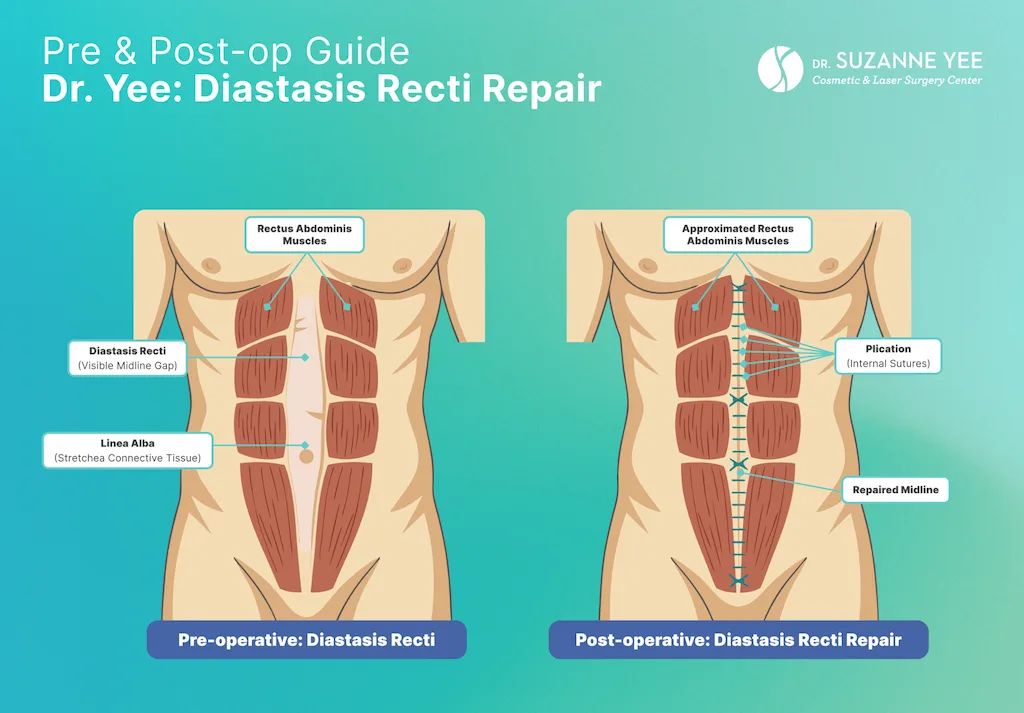
Muscle repair, called rectus plication, is part of every tummy tuck — the difference is how much of the abdominal wall it covers. A mini tummy tuck tightens only the lower abdominal muscles, below the belly button, since that’s the limited area it addresses.
The full, extended, fleur-de-lis, and circumferential procedures repair the entire wall: your surgeon stitches the separated muscle back together along the midline, restoring the flat abdominal contour that diet and exercise alone can’t rebuild.
Most abdominoplasty procedures are outpatient, meaning you go home the same day. You’ll need someone to drive you and stay with you for the first 24 hours, ideally someone who can keep you company while you rest.
It’s worth saying again that nerves are normal, and the right team will meet you with patience instead of rushing you through. Kayla, who had her tummy tuck in June of 2024, came in with the same anxiety many patients feel:
“In June of 2024 I had a tummy tuck. Dr. Yee and her staff were very kind and caring. I struggle with bad anxiety and they always made me feel relaxed and comfortable before and after surgery. My recovery went very smoothly, I was shocked that I experienced little to no pain in the days after surgery. My scar is now over a year old and its way less visible than I ever expected. So happy with my results and I will continue services with Dr. Yee and her staff in the future.”
How long does recovery take for each type of tummy tuck?
Recovery scales with the extent of the procedure. A mini tummy tuck involves the least tissue disruption, so you heal fastest. A circumferential body lift involves the most, so it takes the longest. Knowing the timeline ahead of time makes the whole process more manageable.
| Type | Return to desk work | Light exercise | Strenuous activity | Final results |
|---|---|---|---|---|
| Mini | 1-2 weeks | 2-3 weeks | 6 weeks | 2-3 months |
| Full | 2-3 weeks | 3-4 weeks | 6-8 weeks | 3-6 months |
| Extended | 3-4 weeks | 4-6 weeks | 8-12 weeks | 6-9 months |
| Fleur-de-lis | 4-6 weeks | 6-8 weeks | 10-12 weeks | 6-12 months |
| Circumferential | 6-8 weeks | 8-10 weeks | 12+ weeks | 9-12 months |

The first two weeks
The initial days are the most demanding no matter which type you’ve had. You’ll be walking around the house the day after surgery to promote blood flow, but bending, lifting, and any strenuous activity are off limits. Most patients sleep in a slightly reclined position and take prescribed pain medication for the first week.
You’ll return for a follow-up appointment the next day so your surgical team can check healing progress and answer questions. An AAAHC-accredited surgical center provides the added assurance of meeting national safety standards, and Exparel, a local numbing agent that lasts up to two days, can reduce discomfort in the critical early period.
Drains and compression garments
Drainage tubes collect excess fluid and help prevent seroma, a pocket of fluid that can form under the skin. They’re typically removed within six to seven days once output drops below a certain threshold. Compression garments support your new contours, reduce swelling, and are worn for six weeks.
The combination of drains and compression significantly reduces fluid-related concerns. One study found that progressive tension techniques reduced seroma rates compared to standard approaches.
Timeline for visible results
Swelling takes time to resolve. You’ll notice an immediate difference in your shape, but the full picture emerges gradually over weeks and months.
For a mini tummy tuck, most swelling clears within two to three months. For a full or extended procedure, expect three to six months before your final contour is visible. Scars continue fading for up to a year.
It’s completely normal to feel impatient during this phase. The healing is happening even when it doesn’t look like it yet.
Understanding what recovery looks like is one thing. Knowing which type you actually need is another, and that’s where Dr. Yee’s evaluation becomes the most important step.
How does your surgeon decide which tummy tuck is right for you?
This isn’t a decision you need to make on your own. Your surgeon evaluates several physical factors during an in-person consultation and matches them to the procedure that’ll give you the best result.
The exam starts with assessing where your excess skin is. If loose skin is limited to the area below your belly button, a mini tummy tuck is usually sufficient, and that applies to roughly five percent of patients. If the skin extends above the navel, which data shows in 71 to 74 percent of cases, a full or extended procedure becomes the better option.
Your surgeon also checks for rectus diastasis, the muscle separation that happens during pregnancy or major weight changes. You’ll lie on your back and lift your head while your surgeon feels for the gap between the muscles. If it’s present, muscle repair gets added to the plan.
Fat distribution matters too. If stubborn fat sits alongside loose skin, combining your tummy tuck with liposuction can refine the result. Research has shown that lipoabdominoplasty is safe with no difference in perfusion or healing concerns compared to the traditional approach, and it produces a more sculpted contour.
Future pregnancy considerations
Surgeons recommend postponing a tummy tuck if you’re planning more children. Pregnancy stretches the muscles and skin that the surgery repairs, which could undo your results. Waiting until your family is complete gives you the longest-lasting outcome.
Preparing for your consultation
A consultation should feel like a conversation, not an interview. When you visit Dr. Yee’s Little Rock office, she takes the time to sit with you, listen to what you’re hoping for, examine your anatomy in person, and walk you through which technique fits your situation and why.
And here’s something worth remembering as you walk in: this isn’t just Dr. Yee’s chance to evaluate you. It’s just as much your chance to evaluate her. Ask the questions that have been sitting in the back of your mind. Bring the list you’ve been adding to at midnight. There’s no such thing as too many questions when it’s your body and your peace of mind on the line.
There’s also something an in-person visit gives you that a screen simply can’t. A hands-on assessment leads to a more accurate plan, and you’ll get to see the AAAHC-accredited surgical center where your procedure would actually take place. You’ll have time to ask about anything; technique specifics, what the first week of recovery really feels like, how to prepare your home, what to tell your kids. Nothing is too small.
Cost is often quietly weighing on people during this stage, and it shouldn’t be the thing that keeps you from a result that could change how you feel every day. To help make your goals more accessible, the practice offers flexible financing through Cherry, Alphaeon Credit, CareCredit, PatientFi, and Alle, so you can find a payment plan that genuinely fits your life.
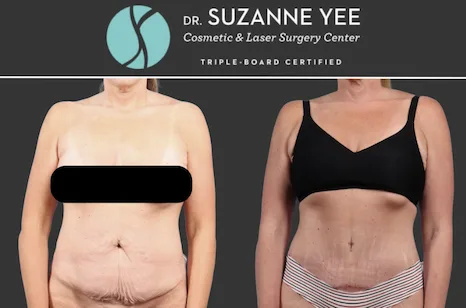
One more thing that helps before your visit: spend a little time with the before-and-after photos. Look for patients whose starting point looks like yours, and notice how different procedures shape different bodies. It gives you a real sense of what’s possible and helps you walk into the consultation with a clearer picture of the conversation you want to have.
Request an appointment to discuss which tummy tuck type matches your anatomy and goals.
Conclusion
You started this article trying to make sense of five procedures that all share one name. Now you know the difference between a mini tummy tuck and a circumferential body lift, you have a feel for which approach likely fits your body, and you understand why a good surgeon won’t simply hand you a recommendation off a checklist. That’s real progress, and it’s more than most people walk into a consultation with.
From here, the next step is gentler than you might think. Spend some time with real patient photos of people whose starting point looks like yours; it’s one of the most grounding things you can do before a consultation. And when you’re ready, a personal visit fills in everything the photos can’t show: the way your skin moves, how your muscles respond, what the right plan actually looks like for you.
At Dr. Suzanne Yee Cosmetic & Laser Surgery Center in Little Rock, every patient deserves to feel heard, respected, and confident in their choices. Dr. Yee believes in enhancement, not transformation, helping you look like the most rested, comfortable version of yourself, not someone unrecognizable. If that’s the kind of care you’ve been looking for, schedule your personal consultation at the Little Rock office, or call (501) 493-3661 to start the conversation. We’d love to meet you.
Frequently asked questions
What’s the difference between a mini and full tummy tuck?
A mini tummy tuck targets only the area below your belly button through a shorter incision and doesn’t involve belly button repositioning. A full tummy tuck addresses the entire abdomen with a hip-to-hip incision, repositions the navel, and repairs separated muscles across the full abdominal wall. The right choice depends on where your excess skin and muscle laxity are located.
What is diastasis recti and does a tummy tuck fix it?
Diastasis recti is the separation of the two rectus abdominis muscles along the midline. It commonly happens during pregnancy or after major weight changes. During a full, extended, fleur-de-lis, or circumferential tummy tuck, your surgeon stitches the muscles back together, restoring core strength and a flatter profile that exercise alone can’t achieve.
What is a fleur-de-lis tummy tuck?
A fleur-de-lis tummy tuck uses both a vertical and horizontal incision, forming a T-shape, to remove excess skin in two directions. It’s designed for patients after massive weight loss who have significant skin hanging from the upper midsection that a standard horizontal incision can’t address.
Who needs an extended tummy tuck?
An extended tummy tuck is for patients whose loose skin and excess tissue reach beyond the front of the abdomen into the flanks and hip area. It’s commonly recommended after moderate to significant weight loss when a standard full tummy tuck wouldn’t reach far enough to contour the sides.
How long do tummy tuck scars take to fade?
Scars continue maturing for 12 to 18 months after surgery. They start out pink or red and gradually lighten over time. Protecting scars from sun exposure and following your surgeon’s aftercare instructions can help them fade as much as possible. A mini tummy tuck leaves the shortest scar, while more extensive types leave longer ones.
How soon after weight loss can I get a tummy tuck?
Most surgeons recommend waiting 12 to 18 months after your weight stabilizes before scheduling a tummy tuck. This gives your skin time to contract naturally and ensures your results won’t be compromised by further weight changes.
Is liposuction better than a mini tummy tuck?
They address different problems. Liposuction removes stubborn fat deposits but doesn’t tighten loose skin or repair separated muscles. A mini tummy tuck removes excess skin from the lower abdomen. If you have both loose skin and stubborn fat, your surgeon may recommend combining them.
Can I combine a tummy tuck with other procedures?
Yes. A tummy tuck is often combined with liposuction, breast augmentation, breast lift, or breast reduction as part of post-pregnancy body contouring in Arkansas, commonly called a mommy makeover. Your surgeon can determine which combinations are safe to perform in a single session based on your health and goals.
Can I get a tummy tuck after pregnancy?
Yes, and it’s one of the most common reasons patients seek abdominoplasty. Pregnancy stretches the skin and separates the abdominal muscles in ways that diet and exercise can’t reverse. Most surgeons recommend waiting until you’re done having children, since a future pregnancy could stretch the repaired tissue.
Are tummy tuck results permanent?
The skin and fat removed during surgery are gone for good, and repaired muscles stay in place as long as they’re not disrupted by another pregnancy or major weight gain. Maintaining a stable weight through healthy habits is the best way to preserve your results long-term.
How much does a tummy tuck cost?
The cost depends on the type of tummy tuck, the extent of correction needed, and whether additional procedures like liposuction are included. The best way to get an accurate estimate is during a personal consultation, where your surgeon reviews your anatomy and goals. Flexible financing through Cherry, Alphaeon Credit, CareCredit, PatientFi, and Alle can help make the procedure accessible.
Does insurance cover a tummy tuck?
In most cases, no. Insurance typically considers a tummy tuck elective. However, if part of the procedure is deemed medically necessary, some plans may provide partial coverage. Check with your insurance provider for details about your specific plan.
*Disclaimer: This content is for educational purposes only and does not constitute medical advice. A consultation with a qualified board-certified surgeon is required to determine the best treatment plan for your individual needs and any questions you may have about a medical condition or procedure.