Instagram
 Facebook
 Tiktok
 Youtube
 X
X LinkedIn
 (501) 224-1044

Liposuction might be the most misunderstood procedure in cosmetic surgery. Ask around and most people will describe a weight-loss shortcut, a way to drop pounds by suctioning them off. That is not what it is, and the gap between that assumption and reality is the best place to start.
Liposuction is a body-contouring procedure. It removes localized pockets of fat that diet and exercise reliably fail to budge, and it leaves the rest of your weight exactly where it was. It is about shape, not the scale, which is why it works best for people already near a stable, healthy weight.
Misunderstood or not, it is one of the most requested body procedures in the world, with more than 2 million performed in 2024, the second most popular cosmetic surgery globally.
At Dr. Suzanne Yee Cosmetic & Laser Surgery Center in Little Rock, patients ask about liposuction more than almost any other body procedure. This guide walks through what it actually is, the techniques available, what surgery day and recovery involve, and how safety and cost are handled, so you can decide whether it is worth a closer look.
Key takeaways
- Liposuction is a body contouring procedure, not a weight-loss method. It removes localized, diet-resistant fat through tiny openings using a thin tube.
- Several techniques exist, including tumescent, ultrasound-assisted VASER, laser-assisted SmartLipo, and power-assisted liposuction. They differ mainly in how the fat is loosened before it’s suctioned out.
- Most patients return to normal activity within three to five days. Regular exercise resumes around two weeks, and final contours settle over three to six months.
- The most important safety step you control is choosing a board-certified surgeon who operates in an accredited facility.
- Results last because removed fat cells don’t return. Staying near a stable weight is what protects your new shape over time.
What are the different types of liposuction?
At its core, every liposuction technique does the same thing. A surgeon makes a few tiny openings, inserts a thin tube called a cannula, and suctions out fat to reshape an area. What separates the techniques is how the fat is loosened before it’s removed, which can affect comfort, precision, and how your skin responds.
| Technique | How it loosens fat | Often chosen for |
|---|---|---|
| Tumescent | Numbing fluid firms the area first | The widely used foundation method |
| VASER (ultrasound) | Sound energy emulsifies fat | Precision around delicate areas |
| SmartLipo (laser) | Laser liquefies fat, warms skin | Some added skin tightening |
| Power-assisted (PAL) | A vibrating cannula breaks up fat | Gentler, efficient extraction |
Tumescent liposuction is the technique most others build on. First developed in the 1980s, it involves injecting a special numbing solution that makes the fatty area swell and firm up, which reduces bleeding and bruising.
Energy-assisted methods then add a step. VASER uses ultrasound to break fat into an emulsion first, while laser-assisted SmartLipo liquefies fat and warms the deeper skin layer. That warming may add some skin tightening, though a recent systematic review found the evidence still too mixed to draw firm conclusions.
If the options feel like a lot to take in, that’s normal. The right technique is something your surgeon matches to your body, not something you have to pick alone.
Lipo 360 and full-body contouring
Sometimes a single trouble spot isn’t the whole story. For many people, the entire midsection holds onto fat, including the sides and the lower back, not just the front of the abdomen. Lipo 360 treats that full circle around the torso in one procedure, which is why it’s become such a popular choice for a smoother, more balanced silhouette.
It’s worth knowing that liposuction can address nearly any area with stubborn fat, from the thighs and arms to the back, chin, and knees. Where you carry fat helps determine which approach fits you best.
Liposuction versus a tummy tuck
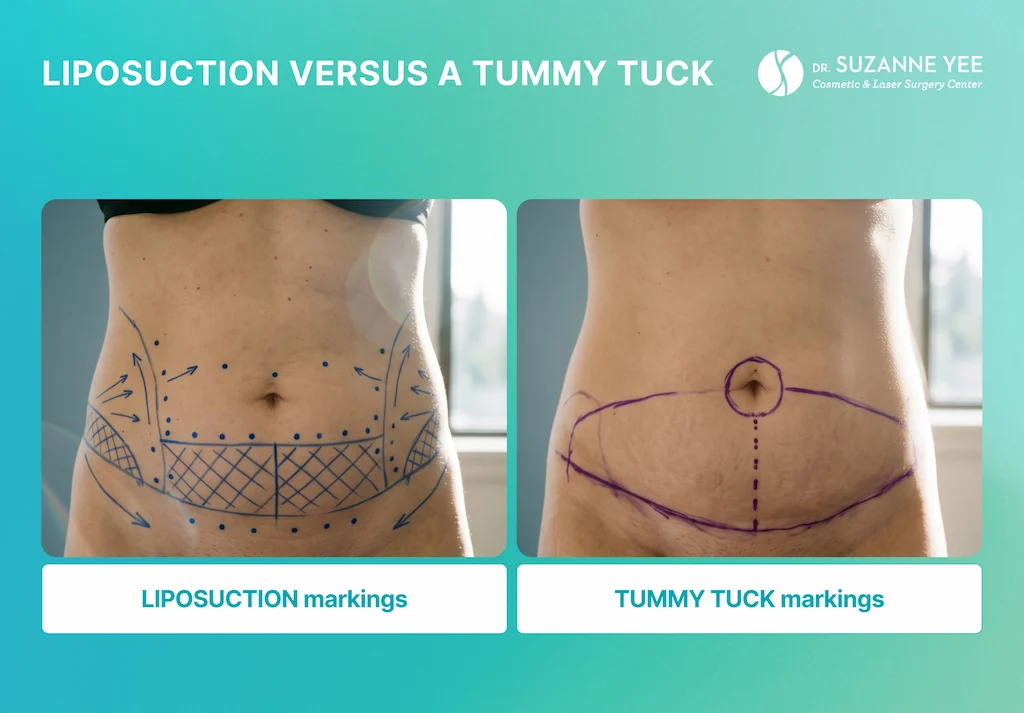
This is one of the most common points of confusion, and it matters because the two procedures solve different problems. Liposuction removes fat, full stop. It does not tighten loose skin or repair stretched abdominal muscles.
A tummy tuck, on the other hand, removes excess skin and can tighten separated muscles, which is why it’s often the better fit after pregnancy or major weight loss. In many cases, the two are combined. If you’re unsure which camp you fall into, that’s a great question for a consultation, where someone can actually assess your skin and muscle tone.
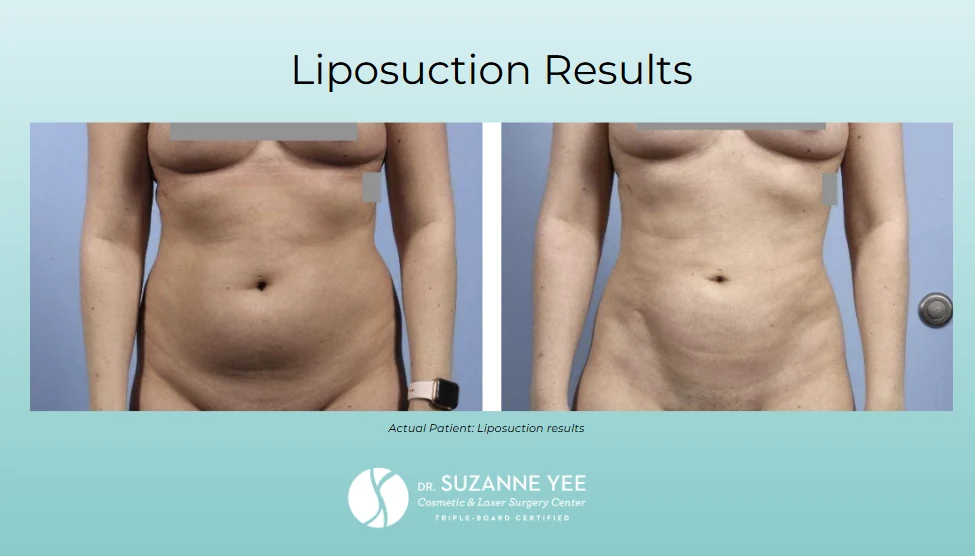
Curious what real results look like? You can browse real patient before-and-after photos to see how different bodies and goals translate into outcomes.
What happens during the liposuction procedure?
Knowing what surgery day involves tends to take a lot of the nervous edge off, so let’s walk through it from preparation to closing. In the weeks before, you’ll get specific instructions to set yourself up for smooth healing.
Preparation usually includes a few key steps:
- Maintain a stable, healthy weight rather than crash dieting beforehand.
- Pause blood-thinning medications and supplements, such as NSAIDs, vitamin E, and fish oil, as directed.
- If you smoke, this is also the time to step away from that habit, ideally six weeks before and after surgery, since it supports healing.
- Arrange a ride home and someone to stay with you for the first 24 hours.
- Set up a comfortable recovery space with essentials within easy reach.
On surgery day, your surgeon marks the treatment areas while you’re standing, since gravity shifts fat and the markings guide precise sculpting. At her accredited Little Rock surgery center, Dr. Yee performs liposuction using ultrasound-assisted VASER LipoSelection, and also offers laser-assisted SmartLipo and advanced VASER Hi-Def for more defined contouring. High-definition body contouring like this may be performed by Dr. Yee or Dr. Homayoun Pournik, a cosmetic surgeon who focuses on body contouring.
Then comes anesthesia, and patients ask about this a lot. Some practices offer IV or twilight sedation, but here, surgical procedures are performed under general anesthesia, so you’re comfortable and won’t feel anything during the procedure. General anesthesia is administered by a Certified Registered Nurse Anesthetist (CRNA) as part of an experienced surgical team, keeping your safety and comfort the priority throughout.
Once you’re comfortable, a few small openings are made, and the cannula gently loosens and suctions out fat until the desired shape is reached. Depending on how many areas are treated, the procedure can take anywhere from about an hour to several hours. The openings are then closed, covered with small dressings, and a compression garment is applied to support your new shape. Most liposuction is done on an outpatient basis, which means you head home the same day to begin healing.
What is liposuction recovery like?
The first day or two might feel frustrating, especially if you’re someone who likes to stay busy and independent. Give yourself permission to slow down, because rest in those early days genuinely pays off later. The good news is that recovery from modern liposuction is often quicker than people expect.
Many patients return to normal daily activity within three to five days, then ease back into their regular exercise routine around two weeks, once they’ve been cleared. Some mild swelling, bruising, and tenderness are completely normal early on, and these settle in a short time.
Your results then continue to refine over the following three to six months as the last of the swelling resolves and your contours emerge.
That compression garment plays a real role here. It supports the treated area and helps minimize swelling while your body heals, and your surgeon will give you a personalized timeline for wearing it. About a week after surgery, you’ll come back to the office for a follow-up visit to make sure everything is healing on track.
What patients often remember most isn’t the recovery itself, but how supported they felt through it.
Jamie, a patient who came through the full surgery and recovery process, shared their experience:
“Dr. Yee and her staff provided exceptional care, from my initial consult, through the surgery process, recovery, and follow-up appointments. From the moment I walked in, your surgery center has had such a welcoming and positive vibe. Your staff made me feel comfortable and at ease.”
If staying patient through healing is the hard part, having a team check in on you makes it far easier. When you’re ready to talk through what recovery would look like for your situation, reach out to our team to start the conversation.
Is liposuction safe, and what are the risks?
It’s completely natural to want the honest answer here before going further. The reassuring reality is that liposuction has a strong safety record when it’s performed by a qualified surgeon in an accredited setting. Serious problems are uncommon, and many of the things patients worry about are simply normal parts of healing.
Some swelling, bruising, and temporary numbness are expected and fade as you recover, not signs that something went wrong. True complications are rare. Serious early issues like a hematoma, which is a pocket of blood beneath the skin, occur in less than one percent of cases. Your surgeon will walk you through the small number of warning signs to watch for, such as a fever or worsening calf pain, so you know exactly when to call.
A couple of other things are worth understanding plainly:
- Mild unevenness can appear as swelling goes down, and it usually smooths out as healing finishes.
- Scars are very small thanks to the tiny openings, and good aftercare helps them fade until they’re hard to notice.
- Skin needs reasonable elasticity to retract well, which is part of why candidacy matters.
The single most powerful thing you can do for your own safety is choose the right surgeon. Look for someone board-certified who performs liposuction regularly and operates in an accredited facility.
Dr. Yee is a triple board-certified cosmetic surgeon with more than 35 years of experience. She holds certification from the American Board of Cosmetic Surgery, the American Board of Otolaryngology–Head and Neck Surgery, and the American Board of Facial Plastic and Reconstructive Surgery.
A consultation is also your chance to evaluate the surgeon, not just the other way around, so trust how heard and informed you feel. Doing this much research before a personal decision is exactly the right instinct.
How much does liposuction cost?
The financial side can feel stressful, especially when you’re already weighing a big personal decision. There’s no single price tag for liposuction, because the cost depends on your specific plan rather than a flat rate. Understanding what drives it helps you budget with clarity instead of guesswork.
Several factors shape the total:
- The number of areas being treated and how much fat is removed.
- The technique used, since some advanced approaches involve more time and technology.
- Facility and anesthesia fees, plus post-operative items like your compression garment and medications.
- Whether you combine liposuction with another procedure.
One thing that makes planning easier is transparency about what a quote actually includes. At Dr. Yee’s Little Rock practice, your quote bundles the surgeon’s fee, anesthesia, facility fees, and follow-up visits into one transparent total, and patients are only responsible for their pre-op labs and any prescribed medications. Liposuction is a cosmetic procedure, so it generally isn’t covered by insurance. Genuinely medical conditions like lipedema can sometimes be an exception worth discussing with your provider.
Kelli, a patient reflecting on her whole experience, shared:
“The whole process was amazing from the initial consultation to the follow up appointments. I felt comfortable and truly cared about from all of the staff. Dr. Yee is incredibly skilled and I’m grateful for her expertise. I’m so very pleased with the results and it has changed my life in so many positive ways.”
Cost should never be the thing that quietly stops you from exploring your options. To help make a procedure more accessible, our office offers flexible financing through Cherry, Alphaeon Credit, CareCredit, PatientFi, and Alle, so you can choose a payment plan that fits your budget. Knowing your options upfront takes some of that weight off, so you can focus on the decision itself.
Conclusion
You came here because a stubborn pocket of fat wouldn’t respond to all the effort you’ve put in, and you wanted to understand whether liposuction could actually help. Now you know what it is, how the techniques differ, what recovery looks like, and how safety and cost are handled. That’s a lot of clarity to carry into any decision.
A good next step is simple and low-pressure. Browsing real patient before-and-after photos that match your starting point can tell you a great deal, and a personal, in-person consultation later fills in the details that photos can’t.
That’s the heart of how Dr. Suzanne Yee cares for patients across Little Rock and Central Arkansas: enhancement, not transformation, and the belief that you deserve to feel genuinely heard and confident in your choices. When the timing feels right, you can schedule your personal consultation at the Little Rock office, or call (501) 493-3661
to begin.
Frequently asked questions
How much weight can you lose with liposuction?
Liposuction isn’t designed for weight loss, so most people don’t see a big change on the scale. It removes a limited, safe amount of localized fat to reshape an area, not to lower your overall weight. Think of it as refining your shape rather than shrinking your number.
Is liposuction performed under general or local anesthesia?
It depends on the practice and the plan. Some surgeons use local or sedation approaches, while others perform it under general anesthesia for comfort and safety. Here in Little Rock, the procedure is done under general anesthesia administered by a Certified Registered Nurse Anesthetist at an accredited surgical center, so you’re fully comfortable throughout.
Is liposuction painful, and what does recovery feel like?
Most patients describe the discomfort as soreness similar to a hard workout or a sunburn rather than sharp pain. Some swelling and bruising are normal in the first days and settle fairly quickly. Prescribed or over-the-counter medication usually keeps any discomfort manageable.
How long will I wear a compression garment after liposuction?
A compression garment supports the treated area and helps control swelling while you heal. The exact length of time varies by person and by how much was treated, so your surgeon gives you a personalized schedule. Wearing it as directed is one of the simplest ways to support a smooth result.
Can you get liposuction if your BMI is over 30?
Generally, the best candidates have a BMI under 30 and are within about 30 percent of their goal weight. A higher BMI doesn’t automatically rule you out, but it can raise risks and affect results. The honest answer comes from an in-person evaluation of your health and goals.
What is the maximum amount of fat that can be safely removed in one session?
Surgeons limit how much fat is removed in a single session to protect your safety, rather than taking as much as possible. The right amount depends on your body, the areas treated, and your overall health. This is determined during your consultation and surgical planning.
What is Lipo 360, and how is it different from regular liposuction?
Lipo 360 treats the entire circumference of the midsection, including the front, sides, and lower back, instead of a single spot. Regular liposuction targets one or two specific areas. Lipo 360 is offered here for patients wanting a more uniform, all-around contour.
Can you combine liposuction with a fat transfer at the same time?
Yes, and it’s a popular pairing. Fat removed during liposuction can be purified and reinjected to add natural volume elsewhere, like the buttocks or face, and a consultation will show whether it fits your goals.
*Disclaimer: This content is for educational purposes only and does not constitute medical advice. A consultation with a qualified board-certified surgeon is required to determine the best treatment plan for your individual needs.