Instagram
 Facebook
 Tiktok
 Youtube
 X
 LinkedIn

 (501) 224-1044

Whether liposuction is safe has less to do with luck than with a short list of decisions made long before you are on the table: who is holding the cannula, where the procedure happens, how much fat comes out in one session, and how honestly your health was assessed beforehand.
That reframes the question worth asking. “Is liposuction safe” has no flat yes-or-no answer; the more useful question is what makes a given liposuction safe, and most of those factors are ones you can see and vet in advance.
It helps that this is well-charted territory. Liposuction is one of the most-studied cosmetic procedures in the world, with more than 2 million performed in 2024, so we know a great deal about what is routine and what is genuinely rare.
At Dr. Suzanne Yee Cosmetic & Laser Surgery Center in Little Rock, those safety factors shape every step, from screening to the operating setting. Ahead, we separate the temporary side effects from the true complications, walk through recovery and possible long-term effects, and lay out how to lower your own odds of a problem.
Key takeaways
- In accredited surgical settings, liposuction has a strong safety record, with serious complications occurring in well under 1 percent of cases.
- Most early experiences, such as swelling, bruising, soreness, and temporary numbness, are normal parts of healing rather than complications.
- Longer-term effects like contour unevenness or loose skin are uncommon and tied to skin quality and technique. The fat removed is gone for good, but remaining cells can still grow with weight gain.
- Rare but serious risks climb mainly with large-volume removal, combined procedures, and unaccredited facilities, all of which a careful surgeon helps prevent.
Is liposuction actually safe, and what does the clinical data show?
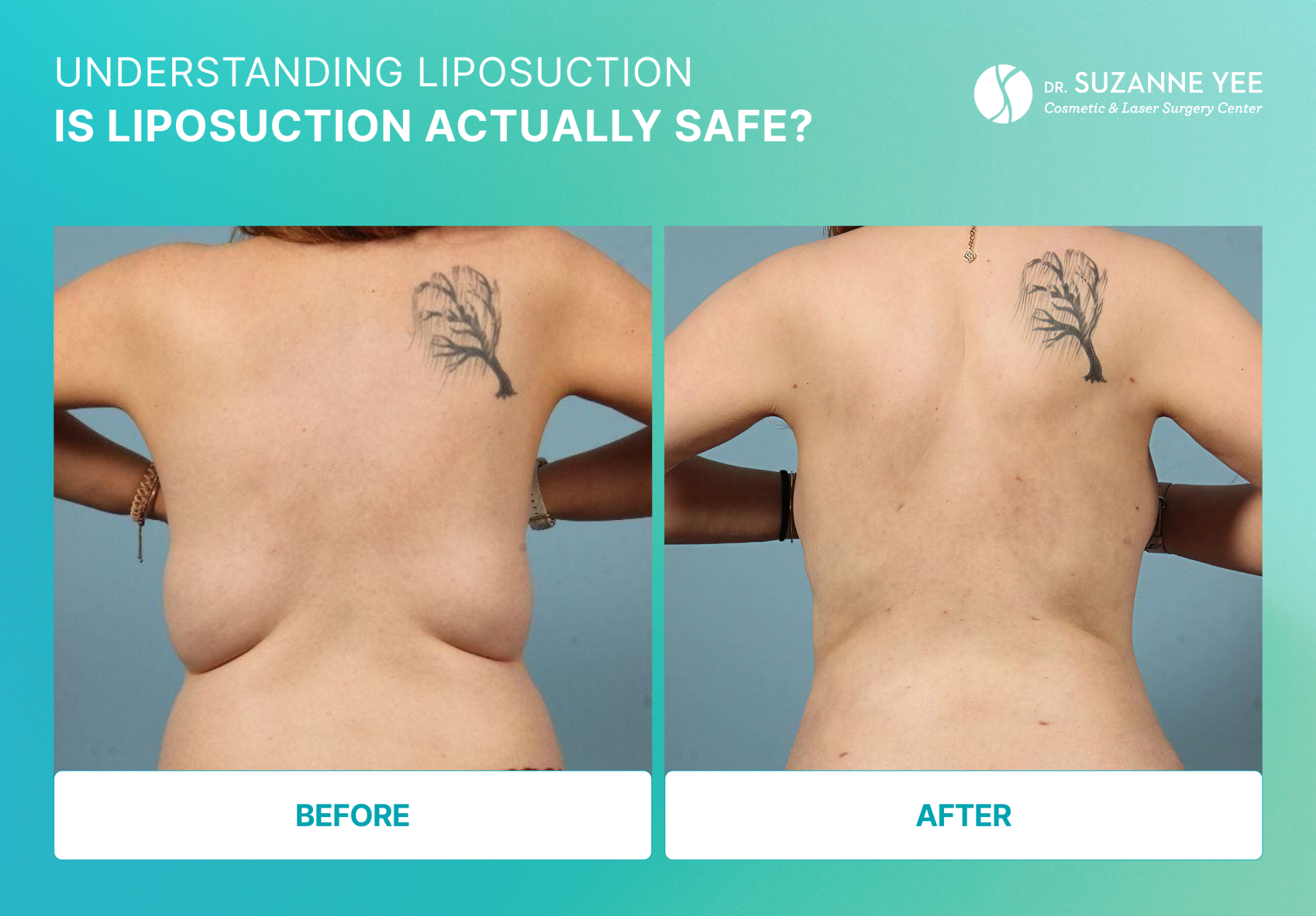
The short answer is yes, when it’s done on the right candidate in the right place. The numbers here come from large studies, not guesswork. One national analysis of 246,119 outpatient cases in accredited facilities found a confirmed complication rate of just 0.40 percent.
That word “accredited” matters as much as the surgery itself. An accredited center is held to national standards for equipment, staffing, and emergency readiness. That’s exactly why serious problems stay so rare there.
This is where the practice you choose makes a real difference. Dr. Yee is a triple board-certified cosmetic surgeon, certified by the American Board of Cosmetic Surgery, the American Board of Otolaryngology–Head and Neck Surgery, and the American Board of Facial Plastic and Reconstructive Surgery. Her training spans both facial and body procedures.
She performs liposuction at her own AAAHC-accredited surgical center in Little Rock, so you can see the facility before you decide.
Who counts as a safe candidate? Liposuction is a body-contouring procedure, not weight-loss surgery, so it works best when you’re close to your goal. The general guidelines look like this:
- A BMI under 30 and a weight within about 30 percent of your ideal
- Good overall health with no poorly controlled conditions
- Firm, elastic skin that can shrink to your new contour
- A non-smoker, or someone willing to step away from nicotine around surgery
- Stable weight for the past 6 to 12 months
Your medical history shapes your personal risk too. Well-managed conditions usually aren’t a barrier, though factors like uncontrolled diabetes or a history of clots need a closer look.
This isn’t meant to discourage you. It’s the same checklist a careful surgeon uses to confirm the answer is yes for you. The surest way to know where you stand is to schedule a consultation for an in-person evaluation.
What is normal to experience during recovery versus a sign of a real complication?
Most of what worries people in the first week is simply healing, not something going wrong. Knowing the difference ahead of time takes a lot of the anxiety out of those early days. Many patients return to normal activity within three to five days and ease back into exercise in about two weeks. Mild swelling, bruising, and tenderness are expected, and they settle as your results refine over 3 to 6 months.
A compression garment is part of that process. It supports the treated area and helps your skin settle while swelling goes down.
Two terms you might hear are seroma and hematoma. A seroma is a small pocket of fluid your body usually reabsorbs on its own. A hematoma is minor bruising-type bleeding beneath the skin. Both are uncommon, and when they happen, they’re straightforward for your surgeon to manage.
So when should you actually pick up the phone? Reach out promptly for a new or worsening fever, spreading redness or warmth, foul-smelling drainage, or sudden lopsided swelling with rising pain. Sudden shortness of breath or chest pain is a call-right-away situation.
None of these are common, and naming them isn’t meant to frighten you. It’s so you can recover with confidence instead of second-guessing every twinge.
This is where genuine aftercare shows its value. With Dr. Yee, you return to the Little Rock office about a week after surgery, so your healing can be checked in person. The team also reaches out between visits rather than waiting for you to worry first.
Kayla, a patient who came in carrying real anxiety about surgery, shared how recovery went:
“I struggle with bad anxiety and they always made me feel relaxed and comfortable before and after surgery. My recovery went very smoothly, I was shocked that I experienced little to no pain in the days after surgery. My scar is now over a year old and it’s way less visible than I ever expected.”
What are the potential long-term side effects and permanent changes to my body?
Beyond the first few weeks, most patients are simply enjoying their results. Still, it’s fair to ask what could change for the long haul. Lasting side effects are uncommon and usually tied to skin quality, technique, and weight. Here’s how likely the main ones really are.
| Long-term effect | How common | What influences it |
|---|---|---|
| Contour unevenness | About 2 percent | Even fat removal and technique |
| Loose or sagging skin | Varies | Your skin’s natural elasticity |
| New fat with weight gain | Preventable | Maintaining a stable weight |
| Visible scarring | Minimal | Tiny incisions and sun protection |
Changes in sensation worry people most, but they rarely last. Some areas may feel less sensitive or a little tingly for a few weeks as nerves settle. A systematic review found that lasting numbness is very rare.
Contour unevenness is the most common issue, showing up in roughly 2 percent of cases. Skilled, even fat removal is the best protection against it. Skin matters too, because liposuction removes fat but doesn’t tighten skin. If your skin has lost some natural bounce, it may not fully contract over your new shape.
What about weight gain later? The reassuring part is that the fat cells removed are gone for good. An ASPS study that followed 301 patients found no fat regrowth in treated areas.
The cells you still have can grow if you gain weight, so a steady weight is what keeps your contour. Wanting to protect an investment in yourself is a reasonable instinct.
Scars are permanent, but they’re tiny, usually just a few millimeters, and tucked into natural folds. With sun protection, they fade to near-invisibility. To see how this looks on real patients, view before-and-after photos by procedure.
What are the rare but life-threatening medical risks I should be aware of?
Let’s talk about the serious stuff directly, because avoiding it only makes it scarier. The vast majority of patients go through liposuction without anything close to a major event. The rare risks below climb mainly with large-volume removal, combined surgeries, and unaccredited facilities.
Blood clots are the risk surgeons watch most closely. A clot can form in a deep vein during the stillness of surgery, and in rare cases travel to the lungs.
The risk is low for liposuction alone and higher for longer or combined operations. Abdominoplasty is the bigger factor here; when it includes tightening of the abdominal muscles, reported blood-clot rates reach about 2.3 percent, versus roughly 0.36 percent without that step. Early movement, good hydration, and risk screening are the standard defenses.
Two more concerns relate to the fluids and medication used during surgery. The numbing solution in tumescent liposuction contains lidocaine, and staying within safe-dosing limits prevents the rare toxicity that can occur. Large-volume removal, generally 5,000 milliliters or more, shifts more fluid in the body, which is why surgeons cap how much is done in one session.
Anesthesia matters here too. Different practices use different approaches, and the type of anesthesia plus who administers it affects your safety. That’s one more reason an accredited center with a qualified anesthesia provider is so important.
The takeaway isn’t fear. Every one of these rare risks has a known, established way to prevent it.
How can I minimize my risk of complications and ensure a safe procedure?
Here’s the empowering part. The single biggest safety factor is a choice you make before surgery ever happens, and that’s who you choose to do it. A nationwide review found that over 22 percent of practitioners marketing cosmetic surgery online weren’t board-certified for it. Verifying real board certification and an accredited facility is the most protective step you can take.
That makes the consultation your screening tool, not just the practice’s. This visit isn’t only a chance for the surgeon to evaluate you. It’s equally your chance to evaluate her. Ask to see the surgical center’s accreditation, ask how anesthesia is handled, and ask to see her own patients’ before-and-after photos.
With Dr. Yee, that conversation is built to be unhurried. She asks about your daily routine, your activity level, and what you want to feel comfortable doing again, then explains why a technique fits your anatomy.
Surgical procedures are performed under general anesthesia, administered by a Certified Registered Nurse Anesthetist (CRNA) as part of our experienced surgical team, so you’re comfortable and monitored throughout. That clarity is what “Exceptional Results. Genuine Care.” looks like in the room.
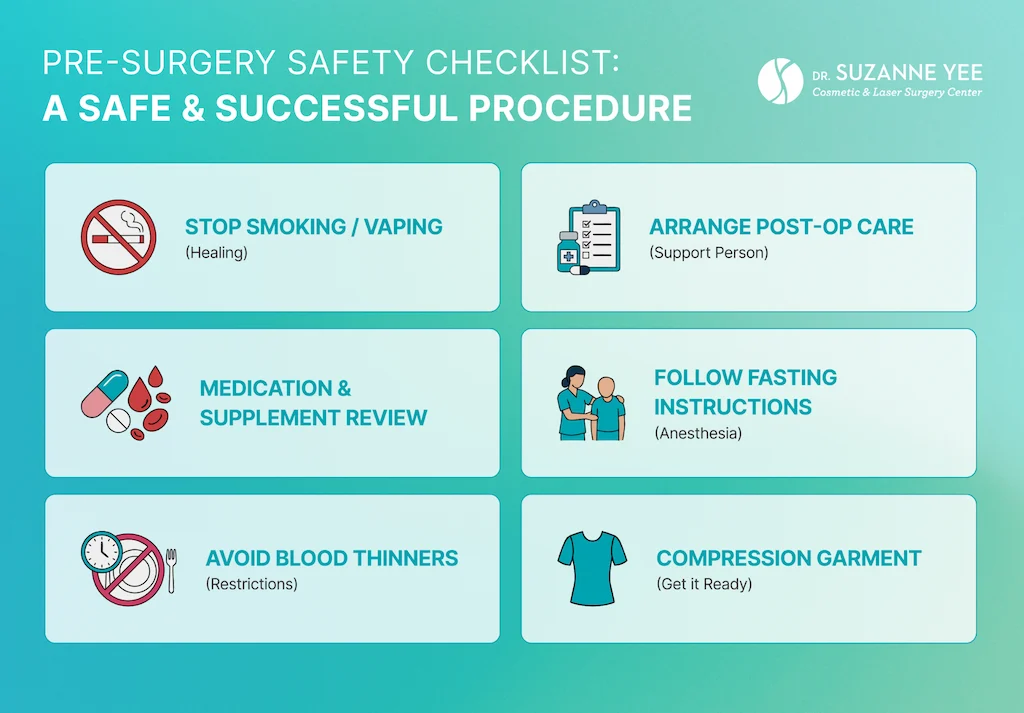
Your own preparation matters just as much, and most of it is about reducing bleeding and supporting healing:
- Share every medication and supplement, since blood thinners like aspirin and even fish oil or garlic can increase bleeding
- If you smoke, this is also the time to step away from that habit, ideally six weeks before and after surgery
- Wear your compression garment as directed to support comfort and manage swelling
- Arrange a ride home and someone to help you for the first day or two
One more decision shapes your risk: doing liposuction alone or combining it with another procedure. Solitary liposuction is exceptionally safe, with a major complication rate of only 0.7 percent in one large database. Combining procedures can be the right call, but it carries higher risk, so it’s a conversation to have openly, sometimes alongside a tummy tuck.
Cost shouldn’t push you to cut corners on safety. Your quote bundles the surgeon’s fee, anesthesia, facility fees, and follow-up visits into one transparent total, and you’re only responsible for pre-op labs and any prescribed medications.
To make that manageable, the office offers flexible financing through Cherry, Alphaeon Credit, CareCredit, PatientFi, and Allē. That removes cost as a reason to rush such a personal decision.
When you’re ready, you can book your consultation to talk it through.
L, a patient who researched her options carefully before choosing a surgeon, put the safety point plainly:
“She is Board Certified and many cosmetic surgeons are not, so be careful. I was most impressed with the detailed preparations she required and followed me through prior to the actual surgery.”
Conclusion
You came here with one real question under all the others: is liposuction safe enough to actually consider? The honest answer is that it carries a low, well-understood risk profile, especially for a healthy candidate in an accredited setting. The side effects are mostly the temporary part of healing, and the serious risks are rare and largely preventable. You know what to look for now, and that knowledge is its own protection.
A good next step is seeing the proof for yourself. Looking through real patient before-and-after results that match your starting point tells you more than any statistic can.
Researching this carefully is exactly the right way to approach something so personal. At Dr. Suzanne Yee Cosmetic & Laser Surgery Center in Little Rock, the belief is that every patient deserves to feel heard, respected, and genuinely confident in their choice. When you’re ready to talk it through, reach out to the team or call (501) 224-1044.
Frequently asked questions
Does fat grow back in the same area after liposuction?
No. The fat cells removed during liposuction are gone for good and don’t return to the treated area. The fat cells you still have elsewhere can enlarge if you gain weight, so a stable weight preserves your contour.
How long does it take for liposuction scars to fully fade?
Liposuction incisions are tiny, often just a few millimeters, and placed in discreet spots. They usually fade significantly over several months to a year, and protecting them from the sun makes a real difference.
Is liposuction safer under local or general anesthesia?
Both can be safe, and the right choice depends on the extent of your procedure and your overall health. What matters most is that anesthesia is administered by a qualified provider in an accredited facility. At this Little Rock practice, surgical procedures use general anesthesia administered by a Certified Registered Nurse Anesthetist (CRNA), so you’re carefully monitored throughout.
What are the earliest symptoms of a blood clot after liposuction?
Early signs include new swelling, warmth, or tenderness in one leg. More urgently, sudden shortness of breath or chest pain is a call-your-surgeon-right-away situation. Clots are uncommon, especially with liposuction alone, and moving around gently soon after surgery helps lower the risk.
Is liposuction safe for patients with controlled diabetes or high blood pressure?
Many patients with well-managed conditions can safely have liposuction, though it depends on your individual health picture. Conditions that aren’t well controlled raise the risk of healing problems and need to be addressed first. A thorough consultation and medical review are how a careful surgeon makes that call with you.
How long should I wait after liposuction before flying on an airplane?
Because long flights involve extended sitting, which can raise clot risk early in recovery, many patients are advised to wait before flying. The exact timing depends on your procedure and personal risk factors, so ask your surgeon directly. Following your activity and movement guidance matters most here.
What is the maximum amount of fat that can be safely removed at once?
Surgeons follow established limits on how much fat is removed in one session, since larger volumes shift more fluid and carry higher risk. A board-certified cosmetic surgeon will weigh your body, your health, and any combined procedures to recommend an amount that prioritizes your safety over a single dramatic session.
*Disclaimer: This content is for educational purposes only and does not constitute medical advice. A consultation with a qualified board-certified surgeon is required to determine the best treatment plan for your individual needs.