Instagram
 Facebook
 Tiktok
 Youtube
 X
X LinkedIn
 (501) 224-1044

Flatten the belly and the flanks can suddenly look fuller by comparison. Smooth the front of the waist and the lower back still rolls over the waistband. Treating one section of the midsection in isolation has a way of creating a fresh imbalance right next to the part you just refined.
That mismatch is the whole reason Lipo 360 exists. Rather than spot-treating a single area, it contours the entire midsection, the abdomen, waist, flanks, and lower back, as one connected surface, so the result wraps cleanly all the way around instead of stopping at a seam.
The appetite for this whole-canvas approach tracks with liposuction’s broader rise: more than 2 million procedures worldwide in 2024 made it the second most common cosmetic surgery globally.
At Dr. Suzanne Yee Cosmetic & Laser Surgery Center in Little Rock, that whole-torso approach is one of the most requested body-contouring options. This guide covers what Lipo 360 actually includes, how it compares to a tummy tuck and a BBL, what surgery and recovery feel like, who makes a good candidate, and what shapes the cost.
Key takeaways
- Lipo 360 is circumferential liposuction that contours the entire midsection, the abdomen, waist, flanks, and lower back, in a single procedure for smoother, more balanced results than spot-treating one area.
- It’s a body-shaping procedure, not a weight-loss surgery. It removes stubborn fat that resists diet and exercise, but it isn’t a substitute for either.
- Liposuction removes fat only. A tummy tuck also tightens loose skin and repairs separated muscles, so the right choice depends on your skin and muscle condition.
- Your skin’s natural elasticity strongly influences your final contour, and energy-based skin tightening can be paired with surgery when laxity is a concern.
- Many patients return to normal activity within a week, with final results developing over six to twelve months as swelling fully resolves. Good candidates are close to a stable weight, in good health, and non-smokers with reasonably firm skin.
What is Lipo 360, and which areas does it treat?

Think of Lipo 360 as liposuction that goes all the way around, rather than focusing on one isolated spot. The “360” refers to treating the full circle of your midsection, so the front, the sides, and the back blend together into one continuous contour.
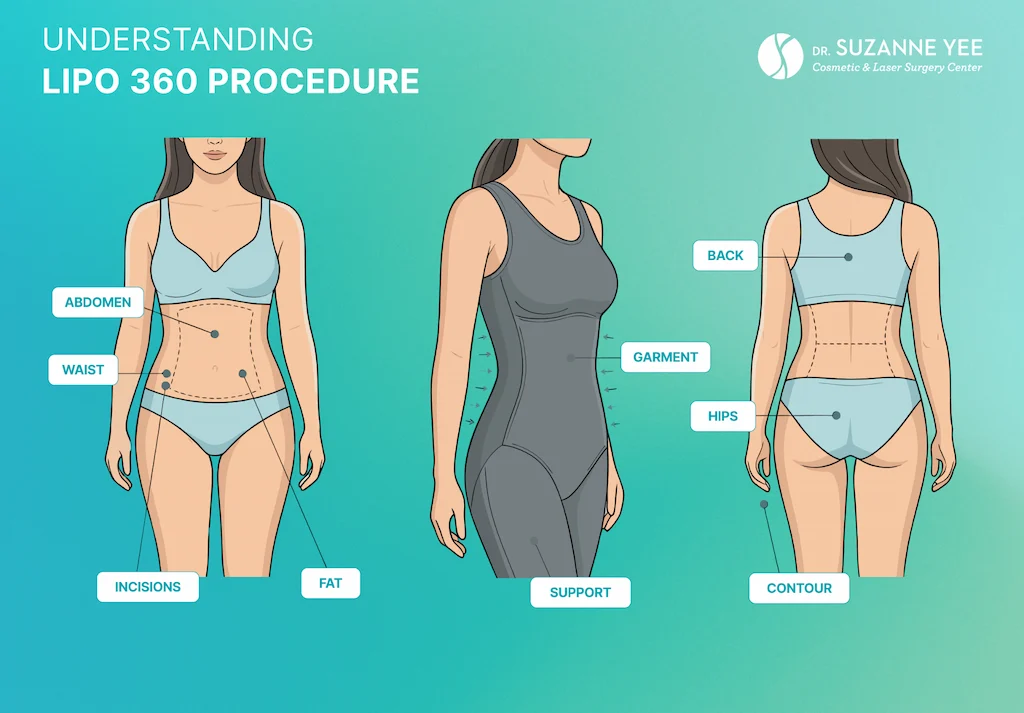
Liposuction itself is straightforward to picture. Your surgeon makes a tiny opening near the area, then uses a thin tube called a cannula to gently suction out fat that won’t respond to diet or exercise. Doing this around the entire torso, instead of just the belly, is what makes the result look seamless rather than patchy.
The areas typically addressed in a 360-degree treatment include:
- Upper and lower abdomen
- Waist and flanks, often called “love handles”
- Hips
- Mid-to-lower back, including the bra-roll area
Here’s the part worth underlining. Lipo 360 is a body-shaping procedure, not a weight-loss surgery. It sculpts stubborn pockets of fat in someone already near their goal weight, rather than replacing healthy eating and movement.
That distinction sets honest expectations. You’re not chasing a number on the scale, you’re refining the shape you already have. With that clear, the next question is how it compares to the other options you’ve read about.
How does Lipo 360 compare to traditional liposuction, a tummy tuck, or a BBL?
If you’ve been researching, you’ve likely run into three terms that sound similar but do different things. The clearest way to choose is to understand what each one actually changes.
Traditional liposuction usually targets one or two spots in isolation, like the abdomen alone. Lipo 360 treats the whole midsection at once, which avoids the mismatched look of slimming the front while leaving the sides and back untouched. A tummy tuck is a different tool, because liposuction only removes fat, while a tummy tuck also tightens loose skin and repairs separated muscles.
| Procedure | What it removes or changes | Best suited for |
|---|---|---|
| Traditional liposuction | Fat from one or two isolated areas | Stubborn fat in a single spot, good skin tone |
| Lipo 360 | Fat around the entire midsection (front, sides, back) | Balanced, full-torso contouring with firm skin |
| Tummy tuck | Excess skin plus separated muscle, often with some lipo | Loose skin or muscle separation after pregnancy or weight loss |
That last column is the real decision point. If your main concern is fat with skin that still bounces back, lipo-based contouring may be enough. If you have loose, stretched skin or muscle separation, a tummy tuck addresses what liposuction cannot.
There’s also the popular pairing of Lipo 360 with a Brazilian Butt Lift. The fat removed from your midsection can be purified and transferred to add natural volume to the buttocks, slimming the waist and enhancing curves in one plan. For sharper muscle definition, high-definition sculpting removes fat around muscle groups so the underlying tone shows through.
Choosing between these isn’t always obvious, and that’s completely normal. Seeing real outcomes can make the differences click, so it helps to browse real patient before-and-after photos and notice which match your starting point.
What happens during the Lipo 360 procedure?
Knowing what surgery day looks like tends to ease a lot of the nervous “what am I signing up for” feeling. The process is more methodical and controlled than most people expect.
Dr. Yee typically performs liposuction at her accredited Little Rock surgery center as an outpatient procedure, so you go home the same day. General anesthesia is administered by a Certified Registered Nurse Anesthetist (CRNA) as part of an experienced surgical team, so you’re comfortable and won’t feel anything during the procedure.
Once you’re resting comfortably, a tumescent solution prepares the area. That’s a special numbing fluid that firms the tissue and shrinks small blood vessels, which means less bleeding and an easier recovery. A few small, discreet openings are made, and the thin cannula sculpts the front, sides, and back in one continuous pass.
Because the whole torso is treated, a Lipo 360 session takes longer than a single-area lipo, often anywhere from one to four or five hours depending on the plan. When the contour looks right, the openings are closed and a compression garment is placed to support your new shape.
It’s normal to feel a flutter of nerves about going under, even when you trust your surgeon. That feeling usually settles once you understand how carefully the day is structured around your safety. With surgery behind you, attention turns to the part patients ask about most: recovery.
What does recovery after Lipo 360 look like?
The first day or two can feel frustrating, especially if you’re used to being independent and on the go. Give yourself permission to slow down, because rest in the early days is what sets up a smooth result.
The encouraging news is that downtime is often shorter than people fear. Many patients return to normal activity within about a week, then ease back into regular exercise in about two weeks. Mild swelling, bruising, and tenderness are a normal part of healing and subside in a short time. A headache in the first day or two is also common as anesthesia wears off, and Dr. Yee talks through what to expect ahead of time so it never catches you off guard.
A compression garment does a lot of quiet work in those early weeks. It supports the treated tissue, manages swelling, and helps your skin settle smoothly against your new contour. About a week after surgery, you’ll return to the Little Rock office for a post-surgery check.
Your final shape doesn’t appear overnight, and that’s by design. Results continue to refine over six to twelve months as swelling fully resolves. Most patients say the hardest part is simply being patient, and that the wait was worth it.
Kayla, a Little Rock patient who came through her own body procedure, shared her experience:
“Dr. Yee and her staff were very kind and caring. I struggle with bad anxiety and they always made me feel relaxed and comfortable before and after surgery. My recovery went very smoothly, I was shocked that I experienced little to no pain in the days after surgery. My scar is now over a year old and its way less visible than I ever expected.”
If you’re weighing whether your body is ready for this, you can schedule a consultation to talk through your timeline before committing to anything. That naturally leads to the bigger question of candidacy.
Who is a good candidate, and how does skin elasticity affect your results?
The best candidates for Lipo 360 share a few practical traits, and you can honestly self-assess against most of them. This is a contouring procedure, so it works best when you’re already close to where you want to be on the scale.
You may be a strong candidate if you:
- Are within about 30 percent of your ideal weight, with a stable body weight
- Are in good overall health and not pregnant or nursing
- Don’t smoke or use tobacco products
- Have reasonably firm skin that can shrink to your new contour
- Carry stubborn fat that resists diet and exercise
Skin elasticity is the factor patients tend to overlook, and it deserves attention. After fat is removed, your skin has to contract and conform to the slimmer shape underneath. The dermal elastic fibers that give skin its bounce are largely formed early in life and rarely replenished, which is why two people can get the same surgery and see different skin retraction.
Here’s what that means for you. When skin laxity is a concern, Dr. Yee can pair liposuction with energy-based skin tightening such as Renuvion, Quantum RF, or laser-assisted techniques, which use controlled energy to firm the skin and spur collagen during the same procedure. This is also where the keyword many patients search, liposuction and skin tightening, becomes a real, combined plan rather than two separate decisions.
Significant weight loss, including from GLP-1 medications, often leaves loose skin that liposuction alone won’t address, so those cases may call for a skin-removal procedure instead. Getting a clear, honest answer about your own skin takes an in-person exam, which leads to the practical questions of cost and timing.
What does Lipo 360 cost, and when will you see results?
Cost is the question almost everyone has and few feel comfortable asking, so let’s talk about it plainly. The honest answer is that there’s no single price, because Lipo 360 is tailored to your body and goals.
Several factors shape the total: the number of areas treated, how much fat is removed, the technique used, anesthesia and facility fees, and whether you combine it with another procedure. Rather than a confusing list of add-ons, at Dr. Yee’s Little Rock practice your quote bundles the surgeon’s fee, anesthesia, facility fees, and follow-up visits into one transparent total. You’re only responsible for your pre-op labs and any prescribed medications.
To keep things accessible, the office offers flexible financing through Cherry, Alphaeon Credit, CareCredit, PatientFi, and Alle, so you can choose a monthly plan that fits your budget. Knowing what’s included upfront takes some of the financial stress off, so you can focus on the decision itself.
As with any surgery, Lipo 360 carries some risks, including bleeding, mild unevenness as swelling goes down, fluid that the body reabsorbs, or temporary changes in skin sensation. Serious concerns are genuinely uncommon, and your surgeon reviews each one with you and explains how the team keeps you safe. A retrospective analysis of patients treated with VASER-assisted liposuction reported high efficacy and a reassuring safety profile.
As for results, you’ll notice an early difference once the initial swelling eases, with your final contour developing over six to twelve months. Those results are long-lasting because the fat cells removed don’t come back, though keeping a stable weight matters since the remaining cells can still enlarge.
Cindy, who recently came through surgery and follow-up care, described the experience this way:
“Dr Yee and her team are Fantastic! From consultation to recovery for breast reduction surgery, they have surpassed all my expectations. Dr. Suzanne Yee provided me with expert surgical care that was patient focused, thorough and thoughtful. Plus, I like that there have been no ‘extra expenses’ after the surgery and they provide what I need for self care at home.”
Conclusion
You came here because the stubborn fat around your middle wouldn’t budge, no matter how disciplined you were. Now you know what Lipo 360 does, how it differs from a tummy tuck and a BBL, what surgery and recovery involve, and who makes a good fit.
A good next step is gentle, not rushed. Browsing real patient photos that match your own starting point is one of the most useful things you can do. When you’re ready, a personal consultation fills in the details photos can’t, including an honest read on your skin.
At her Little Rock practice, Dr. Suzanne Yee believes every patient deserves to feel genuinely heard, from the first conversation through the final follow-up. The goal is to help you look like a refreshed version of yourself, not someone else. If you’re ready to explore what’s possible, schedule your personal consultation or call (501) 493-3661 to get started.
Frequently asked questions
How does Lipo 360 differ from a tummy tuck?
Lipo 360 removes stubborn fat from around the entire midsection but does not tighten skin or muscle. A tummy tuck removes loose, excess skin and repairs separated abdominal muscles, and it often includes some liposuction. If your skin still has a good tone, lipo may be enough, while loose skin or muscle separation usually points toward a tummy tuck.
Can I combine Lipo 360 with a breast lift or augmentation?
Yes, many patients combine body contouring with breast procedures, which is the idea behind a mommy makeover. The benefit is one anesthesia event and one recovery period instead of two. Your surgeon will confirm during your consultation whether combining is right for your health and goals.
How painful is recovery after a 360-degree liposuction procedure?
Most patients describe it as soreness similar to an intense workout rather than sharp pain. Many return to normal activity within about a week, with mild swelling and tenderness that ease over the following weeks.
Is Lipo 360 an option for male patients seeking high-definition contouring?
Yes, men are increasingly choosing 360-degree contouring, often for sharper definition around the abdomen and flanks. The same candidacy basics apply, including a stable weight, good health, and reasonably firm skin.
Can Lipo 360 remove visceral fat, or only subcutaneous fat?
Liposuction only removes subcutaneous fat, the soft layer you can pinch just beneath the skin. It cannot reach visceral fat, the deeper fat around your organs, which responds to diet, exercise, and overall weight loss rather than surgery.
Will my insurance cover the cost of circumferential liposuction?
Lipo 360 is a cosmetic procedure, so it is generally not covered by insurance. Financing options can spread the cost into manageable monthly payments, and your consultation includes a transparent quote so you know what’s covered before deciding.
Can I drive myself home after Lipo 360 surgery?
No. Because the procedure is performed under general anesthesia, you’ll need someone to drive you home and stay with you for the first day. Arranging that help ahead of time makes the first 24 hours far smoother.
What happens if I get pregnant after having Lipo 360?
Pregnancy after Lipo 360 is safe, but it can change the contour you achieved as your body and weight shift. Many patients choose to wait until they’re done having children, and a touch-up can often refine the area later if needed.
Will the incisions from 360 liposuction leave visible scars?
The openings used for liposuction are very small, and your surgeon places them discreetly so any marks fade with proper care. Feeling concerned about scarring is completely natural, and your consultation is a good time to ask exactly where incisions will go.
How soon will I see my final results?
You’ll notice an early difference once the initial swelling begins to ease. Your final, refined contour typically develops over six to twelve months as the remaining swelling fully resolves.
*Disclaimer: This content is for educational purposes only and does not constitute medical advice. A consultation with a qualified board-certified surgeon is required to determine the best treatment plan for your individual needs.