Instagram
 Facebook
 Tiktok
 Youtube
 X
X LinkedIn
 (501) 224-1044

Liposuction is rarely the same operation twice. The fat along the outer thighs behaves nothing like the fat under the chin, which behaves nothing like the soft roll at the bra line, and a good result comes from treating each zone on its own terms rather than as one generic round of “fat removal.”
That is the piece most guides skip. People picture liposuction as a single thing done to a single trouble spot, when in practice it is a technique adapted to the body’s map, denser, more fibrous areas like the back call for one approach, delicate spots like the inner knees another.
It is also among the most common cosmetic surgeries anywhere, with more than 2 million procedures performed worldwide in 2024, according to ISAPS.
At Dr. Suzanne Yee Cosmetic & Laser Surgery Center in Little Rock, every liposuction is performed by a triple board-certified cosmetic surgeon with more than 35 years of experience, on patients already near a stable, healthy weight, since lipo refines contour and is not a weight-loss tool or a fix for loose skin. This guide covers what liposuction can do area by area, how several zones are treated together, how technique and cost shift by body part, and what to expect at a consultation.
Key takeaways
- Liposuction targets localized, diet-resistant fat to refine your shape. It isn’t a weight-loss tool or a fix for loose skin.
- Almost any area can be treated, from the abdomen and flanks to the arms, back, chin, thighs, and calves. Each zone has different fat density and skin quality, which shapes the technique a surgeon uses.
- When loose skin is the real issue, a lift such as an arm lift, thigh lift, or tummy tuck may be needed instead of, or alongside, liposuction.
- Several areas can be treated safely in one session within established fat-volume limits, and larger plans are sometimes staged across separate procedures.
How does liposuction contour the midsection, including the abdomen and flanks?

The midsection is where most people start. The abdomen, waist, and flanks, the spots that spill into a “muffin top,” are among the most treated areas in body contouring.
Liposuction removes the soft pocket of fat just under the skin, the kind you can pinch. Once those fat cells are gone, they don’t grow back, which is part of why the results feel so rewarding.
The flanks, or “love handles,” wrap around your sides and link the front of your torso to your back. Treating them along with the abdomen creates a smooth, continuous waistline instead of a flat front with side bulges.
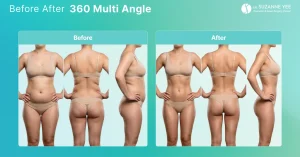
This is also where Lipo 360 differs from traditional liposuction. Traditional lipo focuses on the front, while Lipo 360 treats the full circle of the torso for a balanced result all the way around.
Fat isn’t always the whole story. If pregnancy or weight loss left you with stretched skin or separated muscles, a tummy tuck may be recommended alongside liposuction, since lipo alone can’t tighten those.
For the midsection, triple board-certified cosmetic surgeon Dr. Yee uses ultrasound-assisted VASER(R) technology to loosen fat gently before removing it. Wanting a flatter, more comfortable middle is reason enough to explore your options. Next, let’s move above the waist.
What are your options for arm, back, and chin liposuction?
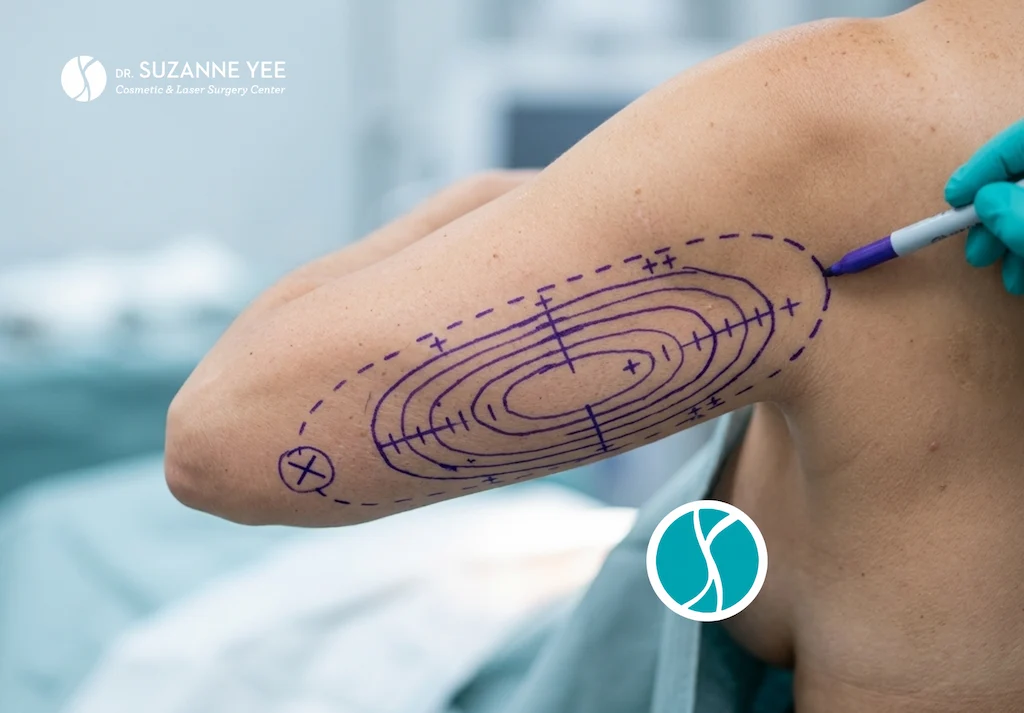
Above the waist, the goal stays the same: a smoother shape where exercise can’t quite reach. The upper arms, back, and area under the chin all respond well to liposuction.
That softness on the back of the upper arm, the “batwing,” is one of the most requested areas. Liposuction can slim and define it nicely when the skin still has good elasticity.
Skin quality is the deciding factor here. If the skin has lost its stretch after weight loss or with age, removing the fat alone can leave it loose. An arm lift that removes excess skin may then be the better fit, sometimes paired with skin-tightening.
Back liposuction targets the rolls that push over a bra band, plus the firm, fibrous fat along the upper back. That density takes a surgeon comfortable with tougher tissue, and the payoff is a cleaner line in clothing and a swimsuit.
The chin and neck are smaller, delicate areas where a little goes a long way. Liposuction here can soften a double chin and bring out a sharper jawline, often combined with skin-tightening.
For men, chest fullness known as gynecomastia is its own concern. Liposuction is commonly used in male breast reduction for a flatter, firmer chest. Feeling self-conscious about it is more common than most men realize, and it’s very treatable.
Not sure whether your arms or chin need lipo alone or some skin-tightening too? That answer depends on your skin, and you deserve a real one. Below the waist, the picture shifts again.
How can liposuction reshape the thighs, knees, and calves?

The lower body is where contouring gets nuanced, because the leg has several zones that each behave differently. Thighs, knees, calves, and ankles can all be treated, but each calls for a careful hand.
The thighs are the most frequently treated lower-body area. They’re usually approached in zones: inner, outer, and front, depending on where the fullness sits.
Outer-thigh fullness, the “saddlebags,” sits at the hip-thigh junction and responds predictably, since the skin there is thicker. Inner-thigh work is more delicate, so the goal is a smoother line rather than aggressive removal.
The “banana roll” is the crescent of fat just below the buttock crease. It can be refined with liposuction, but this is an area where less is genuinely more, since over-treating it can distort the lower buttock.
Knees, calves, and ankles are the trickiest. These areas have a dense layer of fat woven with fibrous tissue and delicate nerves near the surface. Slimming them can make the lower leg look longer, but it demands precision and patience.
Loose skin is the other factor down here. If laxity is a bigger issue than fat, a thigh lift may achieve what liposuction can’t. Satisfaction with lower-body contouring tends to be high when the right technique is matched to your anatomy.
Feeling unsure which leg areas are even worth treating is completely normal. A clear-eyed assessment usually brings a lot of relief.
Jill, a Little Rock patient who was nervous about going under for the first time, shared her experience:
“Dr. Yee and her team were AMAZING! From the initial consultation thru the entire process, they have been so hands on and thorough. I was nervous about surgery, since I had never been put under, but the team put me at ease. They provided me with all the tools I needed to make the right choice.”
That raises a bigger question about treating more than one area at a time.
Can you safely treat multiple areas or get full-body liposuction at once?
It’s a practical question. If several areas bother you, can they be handled in one trip to the operating room? Often yes, within sensible limits, though “full-body liposuction” is more a marketing phrase than a defined procedure.
What people usually mean is treating several zones in one session, like the abdomen, flanks, back, and thighs. Done well, combining areas is both safe and efficient, letting you recover once instead of several times.
The keyword is limits. The American Society of Plastic Surgeons defines large-volume liposuction as removing 5 liters or more of fat. Staying within safe volume thresholds is one of the most important parts of planning a multi-area procedure.
That’s why some plans are staged. If you have a lot to address, your surgeon may split the work into separate procedures spaced months apart. That eases the stress on your body and tends to give cleaner results.
Here’s the reassuring part. For healthy candidates treated within proper limits, liposuction has a strong safety record, and most people experience nothing more than the expected swelling and bruising. A headache in the first day or two is also common as anesthesia wears off, and Dr. Yee talks through what to expect ahead of time so it never catches you off guard.
At Dr. Yee’s AAAHC-accredited Little Rock Surgery Center, liposuction is performed under general anesthesia, administered by a Certified Registered Nurse Anesthetist (CRNA) as part of the experienced surgical team. That keeps you safe and comfortable throughout.
The honest tradeoff is recovery. Many patients return to normal activity within three to five days and resume regular exercise in about two weeks, with results continuing to improve over 3 to 6 months. Treating several areas can stretch that timeline, so build in enough downtime.
Treating multiple zones is also a bigger investment, and that shouldn’t be a barrier to good information. You can view flexible financing options through Cherry, Alphaeon Credit, CareCredit, PatientFi, and Alle to find a plan that fits your budget.
How do liposuction techniques and costs differ by body area?
Not all liposuction is the same, and not all areas cost the same. The technique a surgeon reaches for, and the price that follows, depend on which part of the body is involved.
Denser areas like the back, chest, and flanks often call for ultrasound-assisted liposuction, since the energy loosens that stubborn fat first. Softer areas may not need it. Matching the tool to the tissue is a big part of a smooth result.
Skin tightening is the other piece. When an area is prone to looseness, radiofrequency or helium plasma energy can be paired with liposuction to firm the skin. One study found that adding helium plasma tightening to liposuction improved skin contraction.
Cost follows complexity, not a flat menu. A small area like the chin takes far less time than a full torso, so your investment scales with how many areas you treat, how much fat is removed, and which technique is used.
You won’t find a price tag here, because an honest number only comes from an in-person evaluation. What you can count on is transparency. At this Little Rock practice, your quote bundles the surgeon’s fee, anesthesia, facility fees, and follow-up visits into one total, and you’re only responsible for pre-op labs and any prescribed medications.
It’s normal for the cost question to bring up some stress on top of a big decision. Knowing exactly what’s included, and that financing exists, takes some of that weight off. With the groundwork covered, the next step is seeing what a consultation looks like.
What should you expect at your liposuction consultation?
A consultation can feel like a big step, but it’s really just a conversation. This isn’t only a chance for the surgeon to evaluate you. It’s equally your chance to evaluate her.
At your in-person visit to the Little Rock office, Dr. Yee examines the areas that bother you, checks your skin and health, and talks through what’s realistic. Before recommending anything, she asks about your routine and what you want to feel comfortable doing again, so the plan fits your life and not a template.
You’ll also see the surgical center where your procedure would happen, an AAAHC-accredited facility that meets national safety standards. Meeting the team in person is something a screen simply can’t replicate.
Cost and financing come up here too, openly and without pressure. A payment plan that fits your budget is part of the conversation rather than an afterthought.
Jamie, a patient describing her care from the first consult through recovery, shared her experience:
“Dr. Yee and her staff provided exceptional care, from my initial consult, through the surgery process, recovery, and follow-up appointments. From the moment I walked in, your surgery center has had such a welcoming and positive vibe. Your staff made me feel comfortable and at ease.”
Bring your questions, even the ones that feel small or a little embarrassing. Nothing is off limits. When you’re ready, schedule a consultation to talk through which areas make sense for you.
Conclusion
You came here because of one stubborn area, or maybe a few, that wouldn’t budge no matter how consistent you were. Now you know liposuction can refine almost any of them, from the abdomen and flanks to the arms, back, chin, and legs, as long as the approach fits your anatomy.
A helpful next step is looking at real patient results that resemble your own starting point, since photos show what words can’t. When you’re ready for the details photos can’t fill in, a personal conversation brings it all together.
Every patient deserves to feel genuinely heard, respected, and confident in their choices, and that’s the standard Dr. Suzanne Yee holds for patients across Little Rock and central Arkansas. When the time feels right, schedule your personal consultation or call (501) 493-3661 to start the conversation.
Frequently asked questions
Which body area is the most popular for liposuction?
The abdomen and flanks are consistently among the most requested areas, with the thighs leading the lower body. Ultimately, the right area for you depends on where your own diet-resistant fat sits.
What happens to excess skin after arm liposuction?
If your skin still has good elasticity, it usually tightens nicely around the slimmer contour. If a lot of laxity is present, an arm lift or a combination with skin-tightening may be recommended, since removing fat alone can leave the skin loose.
Is lipo for a double chin performed under local or general anesthesia?
It varies by practice. Some perform small-area chin liposuction under local anesthesia, but many surgeons, including this practice, perform it under general anesthesia at an accredited surgical center for your comfort and safety.
What is the “banana roll” under the buttocks, and can it be treated with liposuction?
The banana roll is the crescent of fat just below the buttock crease. It can be gently refined with liposuction, but it’s an area where a conservative approach is essential, since over-treating it can distort the lower buttock.
How much fat can be safely removed during a single liposuction session?
Surgeons follow established volume limits to keep the procedure safe, and removing 5 liters or more is considered large-volume liposuction that calls for extra precautions. More isn’t better, so if you have several areas to address, your surgeon may suggest staging the work into separate sessions.
Can liposuction on the calves and ankles make my legs look longer?
It can, by slimming the lower leg into a more tapered shape. These areas are dense and delicate, so the technique has to be precise, but the payoff is a longer, more refined-looking leg line.
What is the difference between traditional liposuction and Lipo 360?
Traditional liposuction targets one area, often the front of the abdomen. Lipo 360 treats the entire circle of the torso, including the waist, flanks, and back, for a smoother, more balanced result all the way around.
Is male breast reduction with liposuction permanent?
The fat cells removed during male breast reduction don’t return, so results are long-lasting. Maintaining a stable weight is what protects them, since significant weight gain can still enlarge any remaining fat cells over time.
How long should I expect to wear a compression garment after flank liposuction?
Compression garments support healing and help your new contour settle. The exact timeline is part of the personalized post-op plan your surgeon provides, so following those specific instructions closely is the best way to support a smooth recovery.
What are the ideal BMI requirements for getting liposuction?
Good candidates are generally close to their goal weight with a BMI under 30, in good health, with reasonably elastic skin. Liposuction refines shape rather than treating obesity, so being near a stable weight helps you get the most natural, lasting result.
*Disclaimer: This content is for educational purposes only and does not constitute medical advice. A consultation with a qualified board-certified surgeon is required to determine the best treatment plan for your individual needs.