Instagram
 Facebook
 Tiktok
 Youtube
 X
X LinkedIn
 (501) 224-1044
Almost everyone weighing a brow lift carries the same picture in their head: the over-lifted, permanently startled look that shows up in the worst before-and-after photos. It is worth saying plainly that this is not what a brow lift is meant to produce, and it is not simply bad luck when it happens.
An over-elevated brow is a technical outcome, the result of lifting too aggressively or working in the wrong plane, and it is largely preventable. Most of what gets filed under brow lift “risk” actually splits into two very different groups: the temporary, expected part of healing, and the genuinely rare complication.
The rare end of that range is rarer than the internet suggests. In one review of 500 endoscopic brow and forehead lift patients, surgeons reported no complications during the surgery itself.
At Dr. Suzanne Yee Cosmetic & Laser Surgery Center in Little Rock, the aim here is not to talk you out of a brow lift but to show you exactly what you are weighing. This article covers the common side effects, the uncommon serious risks, how technique shifts the odds, and the questions that put you in control of the result.
Key takeaways
Here’s the short version of what can go wrong with a brow lift, and how much of it you can actually control.
- Most side effects, including swelling, bruising, numbness, scalp itching, and a tight headache-like feeling, are normal healing that fades over the first few weeks.
- Serious complications like lasting nerve injury, trouble closing the eyes, or infection are genuinely rare, reported in roughly 0.1 percent of endoscopic cases.
- Your risk depends heavily on technique. Endoscopic lifts have the lowest revision rate, while hairline and combined eyelid procedures run higher.
- The over-lifted “surprised” look comes from over-elevation, and most early unevenness is swelling, not the final result.
- The biggest factor in your outcome is your surgeon. Board certification, a facial focus, an honest evaluation, and not smoking protect you more than anything else.
What are the most common side effects of a brow lift?
Start with the everyday stuff, because that’s what most patients actually feel. These side effects are signs your body is healing, not signs something went wrong. Knowing what’s normal ahead of time takes most of the worry out of those first days.
Triple board-certified cosmetic surgeon Dr. Suzanne Yee walks every patient through them beforehand, so nothing catches you off guard.
The modern endoscopic brow lift she favors keeps these effects on the milder end, thanks to its small, hidden incisions.
Swelling and bruising
Swelling and bruising around the forehead and eyes are the most visible part of recovery. Gravity pulls the fluid down, so it often settles under the eyes for a few days. It looks worse than it feels, fading over the first few weeks, and resting with your head elevated helps.
Numbness and scalp itching
The forehead and scalp often feel numb, tingly, or oddly itchy as you heal. That itch can be maddening, but it usually means the small sensory nerves are waking back up. Try not to scratch the incisions, and your surgeon can suggest safe ways to ease it.
Tightness and headaches
A tight, headache-like pressure across the forehead is common in the first day or two. Your surgeon treats headaches as an important thing to discuss beforehand, so you know what’s normal and when to call. The tightness is usually well managed with prescribed medication and eases within the first week.
Hair and early unevenness
A little hair thinning near the incisions can happen, and it’s almost always temporary. Your brows can also look slightly uneven early on. That’s usually lopsided swelling, not the final result, and it evens out as the swelling goes down.
Your brow lift is done under general anesthesia, so you’re asleep and comfortable. It’s given by a Certified Registered Nurse Anesthetist (CRNA) as part of the surgical team, who monitors you closely throughout.
Bleeding and infection are both rare, and your surgeon takes deliberate steps to keep those odds low. If anything about your healing feels off, reach out to our team for a quick answer about whether it’s normal.
What more serious complications can go wrong after surgery?
This is the part most people quietly worry about, so let’s be honest about it. Serious complications are uncommon, and the vast majority of patients never face one. Knowing them is less about fear and more about knowing what to watch for.
The feared one is nerve injury affecting how the forehead moves. If the nerve that lifts the brow is bruised or stretched, you might briefly struggle to raise one eyebrow. It almost always recovers, and a systematic review of more than 7,000 patients found nerve injury is rare.
Sometimes the brow is tightened enough that the eyes don’t fully close, a condition called lagophthalmos. It’s usually temporary and more likely when eyelid surgery is combined, so a careful surgeon plans the two conservatively. Infection and fluid collections under the skin are also uncommon and treatable when caught early.
The signs worth acting on are a fever, spreading redness, or sudden one-sided swelling, which mean you call your surgeon right away. A widened scar is possible when a wound heals under tension, though small, well-placed incisions closed without tension keep that risk low.
Feeling uneasy reading a list like this is completely normal, and it helps to remember how rare each item really is. Which one, if any, you face depends a lot on the technique your surgeon chooses.
How do brow lift risks change with the surgical technique?
Not all brow lifts carry the same risks, and the technique makes a real difference. Each approach trades off scarring, hair-loss risk, and how much lift it delivers. Here’s how the main options compare.
| Technique | Main trade-off | Approx. revision rate |
|---|---|---|
| Endoscopic (small scalp incisions) | Lowest scarring and hair loss | About 1.2% |
| Coronal (ear-to-ear) | More hair loss and numbness | Around 2% |
| Hairline / pretrichial | Visible hairline scar risk | Up to 7.4% |
| Direct (above the brow) | Precise, but most visible scar | Scar-dependent |
| Temporal (outer brow only) | Least invasive, limited lift | Higher asymmetry |
| BOTOX(R) (non-surgical) | No surgical risks, temporary | Not applicable |
The endoscopic approach is the most popular for good reason. Its small, hidden incisions keep scarring and hair loss low, which is why its revision rate is the lowest. The anchors that hold the lifted tissue can sometimes be felt under the skin early on, but that settles as healing finishes.
Older coronal lifts use a longer incision, with more numbness and hair-loss risk. Hairline techniques can leave a scar that shows if it heals poorly. A gentler starting point is a non-surgical Botox brow lift, which avoids surgical risks entirely, though its lift is subtle and temporary.
Combining a brow lift with an eyelid lift is common and sensible, but it does raise the stakes.
Adding a second procedure introduces its own small chance of a minor touch-up, almost always for small adjustments rather than anything serious.
Seeing real outcomes helps these trade-offs click into place. You can view real patient before-and-after photos to see what different facial approaches actually achieve.
What are the warning signs of a brow lift gone wrong?
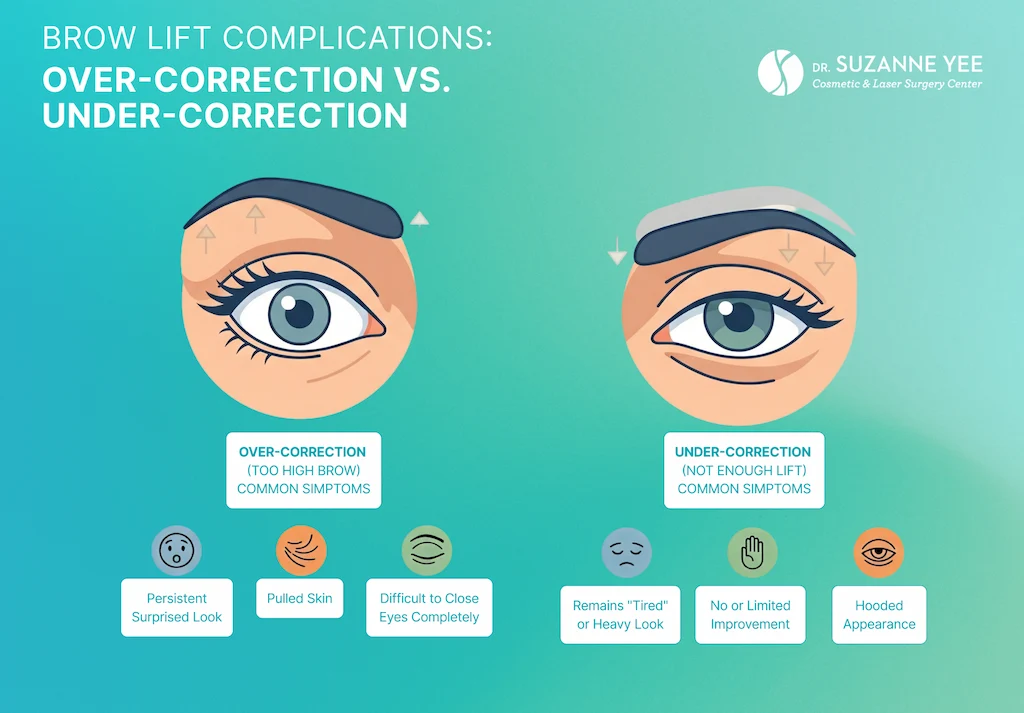
Now to the heart of the worry, telling a real problem apart from normal healing. Most of what looks alarming early on is temporary, but a few signs do deserve attention. Learning the difference lets you heal with far less anxiety.
The classic bad result is the over-lifted brow, the look of permanent surprise. It comes from raising the brows too far above their natural position, and in careful hands it’s uncommon. Early on, though, raised-looking brows are usually just swelling pushing everything upward.
Some early unevenness is expected as swelling and muscle tone settle side to side differently. Most of it resolves on its own, but unevenness that lingers well past the swelling phase is the cue to flag it with your surgeon.
The opposite problem is under-correction, where the brow doesn’t lift enough or settles back. A brow lift doesn’t stop the clock; you’ll keep aging, but you stay ahead of where your brow would otherwise be. A result that fully relapses early is different from gradual natural change and deserves a second look.
Daphne, a longtime patient who had a brow lift along with several other facial procedures, shared her experience:
“I have had a facelift, browlift, chin implant, fillers, breast lift and implants. I have only felt confidence and safety with every procedure. She makes you feel safe and secure every step of the way with each phone call when she checks on you and explains the process of what’s happening.”
So if so much of this is preventable, what actually prevents it?
How can you avoid a bad brow lift result?

Most of what protects your result comes down to choices you make before surgery. The biggest by far is who holds the instruments. Get that right, and you’ve removed most of the risk.
Choosing the right surgeon
Choose a board-certified surgeon who focuses specifically on facial procedures. Before anything else, look at their before-and-after photos of real brow lift patients, since results say more than any credential list. Dr. Yee is triple board-certified by the American Board of Cosmetic Surgery, the American Board of Otolaryngology–Head and Neck Surgery, and the American Board of Facial Plastic and Reconstructive Surgery. She also operates at her own AAAHC-accredited surgical center.
Your consultation and health check
A thorough consultation is your best safeguard, and it runs two ways. She evaluates your anatomy, and you evaluate her. Ask directly about her complication and revision rates, and which technique suits your face and hairline.
A careful evaluation also looks at your forehead height, skin laxity, and any history of dry eyes before recommending an approach. If you smoke, this is the time to step away from that habit, ideally six weeks before and after surgery. Smoking roughly doubles the odds of wound-healing problems.
Preparing and protecting your result
Good preparation carries you the rest of the way. You’ll usually pause blood-thinning medicines like aspirin and ibuprofen. It also helps to arrange a ride, line up help for the first day, and plan to rest with your head elevated.
To hold the lifted tissue in place, Dr. Yee uses Endotine(R) anchors, tiny absorbable supports that steady the brow while it heals. Made of lactic acid, they start dissolving around two months and are gone within a year, so nothing needs removing later.
Rather than reaching for home remedies if swelling or soreness flares, follow the personalized post-op plan from your care team and call with any concerns.
When you’re ready to map this out for your own face, schedule your personal consultation at the Little Rock office, or call (501) 493-3661.
Cost shouldn’t be the thing that stops you, and flexible financing is available through Cherry, Alphaeon Credit, CareCredit, PatientFi, and Alle.
What are your options if you’ve had a bad brow lift?
If you’re here because a past result disappointed you, take a breath, because most outcomes can be improved. Correction is a real, established field, and you have more options than it may feel like right now.
When the issue is significant, like a brow that’s clearly too high, surgical revision can reset the position. There’s even a reverse brow lift made specifically to bring an over-lifted brow back down. Revision also handles lasting asymmetry, problem scars, or eyelids that don’t fully close.
Not every imperfect result needs more surgery. Minor or dynamic asymmetry can often be softened with Botox or dermal fillers, relaxing an overactive muscle or balancing one side against the other.
Timing matters too. Surgeons generally suggest waiting until the tissues have fully healed and settled before correcting, so you’re working with the true final result. When you choose someone for this, the same rules apply, only more so, and Dr. Yee brings the methodical, corrective experience that careful revision work demands.
L.C., who chose her surgeon specifically for board certification and careful preparation, shared her experience:
“I had 2 cosmetic surgery procedures prior to choosing Dr. Yee for my recent surgery. She is Board Certified and many cosmetic surgeons are not, so be careful. I was most impressed with the detailed preparations she required and followed me through prior to the actual surgery.”
Conclusion
You came here carrying a specific fear that a brow lift could leave you looking permanently startled. What you have now is the fuller picture. The dramatic “gone wrong” results are uncommon, most side effects are normal healing, and the serious risks are rare and largely preventable.
When you’re ready, start by browsing real patient before-and-after photos that match your starting point, since nothing grounds expectations like real results. From there, a personal consultation fills in the details that photos can’t.
That honest, unhurried guidance is the heart of how Dr. Suzanne Yee cares for patients in Little Rock, where everyone deserves to feel heard, respected, and confident in their choices. Her philosophy is enhancement, not transformation, helping you look like a refreshed version of yourself. When it feels right, reach out to our team or call (501) 493-3661 to start the conversation.
Frequently asked questions
Can a brow lift cause permanent nerve damage or facial paralysis?
It can, but permanent nerve injury is very uncommon. Far more often, a nerve is temporarily bruised or stretched, causing brow weakness that recovers over weeks to months. A surgeon who carefully maps the facial nerves before operating is your best protection against a lasting problem.
Can a brow lift make it hard to close my eyes?
Occasionally, if the brow is lifted too aggressively or combined with eyelid surgery, the eyes may not fully close at first, a condition called lagophthalmos. It’s usually temporary and manageable, and the risk is lowered by conservative, well-planned surgery. This is one reason a careful surgeon evaluates your eyelids and brow together beforehand.
What does a startled or surprised look mean, and is it permanent?
A surprised look comes from over-elevating the brows past their natural position. In the early weeks, though, raised-looking brows are usually just swelling and tend to settle as it resolves. A truly over-lifted result is uncommon with a conservative surgeon, and when it does occur, it can often be corrected.
Is a Botox brow lift safer than a surgical brow lift?
A Botox brow lift is non-surgical, so it avoids the risks of surgery like scarring, infection, and lasting numbness. The trade-off is that its lift is subtle and temporary, lasting only a few months before it needs repeating. It’s a good option for mild concerns, while a surgical lift delivers more and longer-lasting change.
Can smoking affect my brow lift recovery and scar healing?
Yes, and significantly. Smoking constricts blood vessels and reduces blood flow to healing tissue, which roughly doubles the odds of wound-healing problems and worse scarring. Stepping away from nicotine for about six weeks before and after surgery meaningfully lowers your risk.
What should I do if I get a fever or sudden swelling after surgery?
Contact your surgeon right away, or seek emergency care if symptoms are severe. A fever, rapidly spreading redness, or sudden one-sided swelling can signal an infection or fluid collection that needs prompt attention. Acting quickly is what keeps a minor issue from becoming a serious one.
Will a brow lift change my hairline or cause hair loss?
It can cause minor, usually temporary hair thinning near the incisions, with regrowth over the following months. Some techniques can slightly raise the hairline, while hairline-based approaches are chosen specifically to preserve it. Your surgeon picks the technique that best protects your hairline and density.
Can a bad brow lift be fixed with revision surgery?
Yes, revision surgery can correct over-elevation, asymmetry, problem scarring, and eyelids that don’t fully close. Minor issues can sometimes be smoothed with Botox or fillers instead. The key is waiting until you’ve fully healed, then choosing a board-certified surgeon experienced in corrective facial work.
*Disclaimer: This content is for educational purposes only and does not constitute medical advice. A consultation with a qualified board-certified surgeon is required to determine the best treatment plan for your individual needs.