Instagram
 Facebook
 Tiktok
 Youtube
 X
 LinkedIn

 (501) 224-1044

Where a brow lift scar ends up is not left to chance; the technique decides it before the first incision. Scalp-based approaches hide the scar up in the hair, where it is hard to find even months later. Approaches that work closer to the brow or hairline trade that for a faint mark tucked into a crease or along the brow hairs. Choose the approach and you have largely chosen the scar.
That is genuinely reassuring, because it means the part people worry about most is also one of the most controllable. Placement, a careful closure, and steady aftercare together decide whether a scar stays barely there or turns stubborn.
At Dr. Suzanne Yee Cosmetic & Laser Surgery Center in Little Rock, the first practice in Arkansas to offer the endoscopic brow lift, incisions are planned to stay small and hidden from the start.
The brow lift is one of the most popular facial procedures in the world, with 524,386 performed globally in 2024. This guide covers where each technique places its incisions, what a scar looks like as it heals, how to keep it faint, and the professional options that can fade a stubborn one.
Key takeaways
If you only have a minute, here’s the short version of what this article covers about brow lift scars:
- Where your scar lands depends almost entirely on technique. Hair-hidden approaches keep it in the scalp; facial approaches tuck it into brow hairs or a forehead crease.
- Endoscopic brow lifts use three to five small incisions behind the hairline, which is why their scars are the hardest to spot.
- Fresh scars look pink and raised, then fade and flatten over many months. Full maturation can take a year or more.
- Silicone gel or sheets and daily sun protection are the two best-proven, at-home ways to keep a surgical scar flat and pale.
- If a scar stays raised or dark, professional options like laser resurfacing, steroid injections, and surgical revision can improve it.
Where are the incisions placed for each brow lift technique?
The answer to “will my scar show” starts with one question: which technique is used. A brow lift isn’t a single operation. It’s a family of approaches, and each one trades incision length and location for a different kind of lift. Feeling unsure about which leaves the least visible mark is natural, and it’s exactly what a good consultation sorts out.
Here’s how the six main techniques compare at a glance.
| Technique | Where the incision sits | How visible the scar tends to be |
|---|---|---|
| Endoscopic | 3 to 5 small incisions, behind the hairline | Very low, hidden in the hair |
| Temporal (lateral) | About 1 inch, within the temple hair | Low, hidden in the hair |
| Coronal (classic) | Ear to ear, behind the hairline | Hidden by hair, but longest incision |
| Hairline (trichophytic) | Right at the front hairline | Low if beveled so hair grows through |
| Direct | Just above the eyebrow, in the top brow hairs | On the face, camouflaged by brow hair |
| Mid-forehead | Inside a deep forehead crease | On the face, hidden in a natural line |
The incisions hidden in your hair
Four techniques keep the scar within hair-bearing skin. The endoscopic approach is the most discreet, using a few short openings an inch or two behind the hairline. The temporal lift is similar but smaller, with one incision tucked into the temple to raise the outer brow.
The coronal, or classic, lift hides its scar in the hair too, but uses one long incision running ear to ear. A systematic review found a 3.6 percent rate of noticeable scarring with this approach, slightly higher than the smaller techniques. The hairline lift sits right at the front of the hair, beveled so strands can grow up through the scar and screen it.
The incisions placed on the face
Two approaches put the incision on the forehead itself, which sounds alarming until you see where they go. The direct brow lift tucks a fine line into the top row of your brow hairs. A 50-patient study reported successful lifting in 98 percent of cases with low scar visibility. It’s often chosen when thick brows or deeper tissue make a hidden approach less reliable.
The mid-forehead lift hides its incision inside one of your existing forehead creases, staggered so it never reads as a straight line. Both facial approaches are usually reserved for specific situations, like a high or receding hairline that makes a scalp incision impractical.
To hold everything in its new position while you heal, Dr. Yee places Endotine® anchors, small absorbable supports made of polylactic acid. They begin to dissolve around two months and disappear completely within a year, so nothing has to be removed later. A triple board-certified cosmetic surgeon matches the technique to your hairline, brow shape, and goals rather than using one approach for everyone.
If you’re wondering which technique fits your face and would leave the faintest mark, that’s the heart of an in-person visit. You can schedule a consultation to map the right approach to your anatomy before you decide anything.
What will your brow lift scars look like as they heal?

Knowing the timeline ahead of time takes the worry out of those early weeks. A fresh incision rarely looks like the faint line it will become, and what you see at first is not the final result.
The first two weeks
In the first several days, incisions look pink or red, slightly raised, and a little swollen. Some tightness or a mild headache across the forehead is normal as everything settles. Most patients return to work in about 7 to 14 days, with bruising and swelling gradually fading over the first few weeks.
Surface healing usually finishes around day 14, when any sutures or staples come out. That’s a relief point for most people, when the incision starts looking less like a wound and more like a line.
Three to six months
This is when scars start to earn their reputation for fading. As the tiny blood vessels calm down and collagen reorganizes, the color shifts from pink toward your natural skin tone. By three to six months, your final brow position has settled, and the scars have softened considerably.
Full maturation
A scar isn’t truly finished maturing for a while longer. Full remodeling can take up to 12 to 18 months, and during that stretch the scar keeps softening, flattening, and fading. Patience genuinely pays off here, because what looks imperfect at month two often looks like almost nothing by month twelve.
Daphne, a Dr. Suzanne Yee Cosmetic & Laser Surgery Center patient who had a brow lift among her procedures, on feeling cared for through the whole process:
“I can not say enough good stuff about Dr. Yee and her staff. Everybody is so welcoming and kind. I have only felt confidence and safety with every procedure. She makes you feel safe and secure every step of the way, with each phone call when she checks on you and explains the process of what’s happening. Her level of care shows in everything she does.”
Your skin type and genetics
Genetics matter too, and it helps to know where you stand. Skin that runs thicker or oilier near the mid-forehead can scar a bit more visibly, and darker skin tones carry a higher chance of raised or darker scars. None of this means a poor outcome. It just means your surgeon will tailor the technique and aftercare to your skin. Most signs of trouble, like spreading redness or drainage, show up between days two and 14, so a quick call to the office is always the right move.
How can you minimize scarring and help your incisions heal?
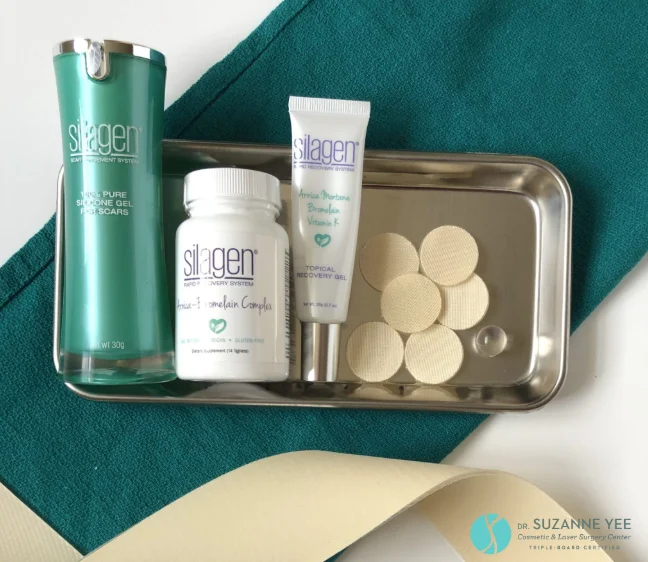
Feeling concerned about scarring is completely natural, and the good news is that a few simple, well-proven habits do most of the heavy lifting. None of it is complicated. Your surgeon will give you a personalized plan, but here is what the evidence consistently supports.
Timing your scar care
Timing matters more than most people expect. Topical scar care begins only once the incision is fully closed and the surface has healed over, usually a few weeks after surgery. Starting too early on an open wound does more harm than good, so wait for your surgeon’s go-ahead before applying anything.
Silicone, the gold standard
If there’s one product worth using, it’s silicone. A meta-analysis of randomized trials found that medical-grade silicone gel significantly reduces raised, thickened scarring. Silicone sheets or gel work by sealing in moisture and calming the collagen that builds up in a healing scar. They’re typically worn over the area for several months.
Sun protection and gentle care
A healing scar is especially vulnerable to the sun. UV exposure during the long maturation window can darken a scar permanently. So a mineral sunscreen of SPF 30 or higher over the area, once it’s closed, is one of the most valuable things you can do. Keeping the incision clean with gentle washing, then patting it dry, also helps prevent the irritation that can thicken a scar.
Scar massage
Once your surgeon clears it, light massage over a closed, healed scar can keep the tissue from building into a firm ridge. A common approach is a few minutes, a couple of times a day, using gentle pressure. It’s simple, it’s free, and done, consistently it makes a real difference in how soft the final scar feels.
Curious what well-healed results actually look like? You can browse real patient before-and-after photos to see how facial incisions settle over time.
What professional treatments can fade or revise a stubborn scar?
Sometimes a scar stays more stubborn than you’d like, raised, darker, or simply more noticeable than you hoped. That can feel discouraging after months of careful aftercare. A scar that won’t fade on its own is rarely the end of the story, because several in-office treatments can step in.
Fractional laser resurfacing
Fractional CO2 lasers treat a scar by creating thousands of microscopic columns in the skin, which prompt the body to rebuild smoother tissue. Studies of patients with raised scars show meaningful improvement after a few sessions spaced several weeks apart. At this Little Rock practice, laser scar treatment is offered on-site, an advantage of having an experienced laser surgeon and surgical care under one roof.
Steroid injections
For a scar that’s raised and firm, corticosteroid injections can flatten and soften it by easing the inflammation and dense collagen inside. They work best on mature scars and are usually given as a short series. It’s a quick, targeted option for the occasional scar that thickens despite good aftercare.
Chemical peels and microdermabrasion
For scars that are more about color and surface texture than height, chemical peels and microdermabrasion can even things out by resurfacing the top layers of skin. These gentler treatments are often used in combination, and they suit the fine, superficial marks that sometimes linger after healing.
Karla, a Dr. Suzanne Yee Cosmetic & Laser Surgery Center patient describing how natural her facial results turned out, shared her experience:
“I am 6 wks out of my lower facelift with Dr Yee. My results are so natural and took years off my appearance. This can be a scary experience, but Dr Yee and her staff put me at ease before and after the procedure. I will definitely be using Dr Yee for any future procedures, and highly recommend her.”
Surgical scar revision
When a scar heals poorly enough to bother you, surgical revision can reposition or refine it, but only after it has fully matured. A meta-analysis of more than 5,000 patients reported a pooled 78.6 percent satisfaction rate after scar revision. Knowing this option exists, even if you never need it, takes some of the pressure off the early healing months.
Conclusion
You came here trying to figure out where a brow lift scar would land and whether anyone would ever notice. The reassuring truth is simpler than it feels. With the right technique and careful aftercare, most brow lift scars fade into faint lines, tucked in your hair or hidden in a natural crease.
The most useful next step is to look at real results that match your own starting point. Browsing before-and-after photos shows you what healed incisions actually look like, and a visit fills in the details a photo can’t.
Every patient deserves to feel heard, respected, and confident in a decision this personal. That’s the heart of the practice’s promise of exceptional results and genuine care, enhancement rather than transformation. To talk it through with Dr. Suzanne Yee in Little Rock, request a consultation online or call (501) 224-1044.
Frequently asked questions
Are endoscopic brow lift scars completely invisible?
Not completely, but they come close. The incisions are tiny and tucked an inch or two behind the hairline, so once they heal, they’re usually very difficult to spot under your hair. No surgical scar is truly invisible, but the endoscopic approach produces some of the least noticeable scars of any brow lift technique.
Does a temporal brow lift leave scars in front of or behind the hairline?
Behind it. A temporal lift places its incision within the hair-bearing scalp at the temple, so the scar sits inside the hairline rather than out on the forehead. That’s a big part of why this technique is considered one of the more discreet options.
How long does it take for direct brow lift scars to fade?
Direct brow lift scars usually show significant fading and softening within three to six months. Full maturation, when the scar reaches its final, palest appearance, can take up to a year or more. Because the incision sits within the top row of brow hairs, it tends to blend in well as it settles.
Will a brow lift scar cause hair loss around my hairline?
Some temporary thinning around the incision can happen as hair follicles recover from surgery, a reaction sometimes called follicular shock. In most cases, the hair grows back within a few months. The endoscopic and beveled hairline approaches are designed specifically to protect the follicles and limit this.
Can smoking make my brow lift scars heal poorly?
Yes. Smoking narrows blood vessels and limits the oxygen a healing wound needs, which can delay healing and worsen scarring. If you smoke, this is the time to step away from the habit, ideally six weeks before and six weeks after surgery, to give your incisions the best chance to heal cleanly.
Can BOTOX® or dermal fillers help camouflage a forehead scar?
They can play a supporting role. BOTOX can relax the forehead muscles that pull on a healing scar, easing the tension that can widen it. Fillers can lift a depressed scar level with the surrounding skin. An experienced injector can advise whether either fits your situation during a consultation.
Can I wash my hair after a brow lift without irritating the scars?
Usually yes, gently, about 48 hours after surgery, using a mild shampoo and being careful around the incisions. After washing, apply a thin coat of ointment to the incisions so they don’t get dry and crusty. Always follow the specific instructions your surgeon gives you, since timing can vary by technique and how you’re healing.
Are staples or sutures better for closing hairline incisions?
For incisions inside hair-bearing skin, staples are often a good choice because they’re spaced individually and tend to spare the hair follicles. Sutures are excellent for finer closures elsewhere. Your surgeon chooses the method based on the incision’s location and your skin.
What are the signs of an infected brow lift scar?
Watch for swelling or redness that worsens after the first three to five days rather than improving, along with warmth, increasing pain, or drainage. A fever is another reason to call right away. True infections are uncommon, but reaching out promptly is always the safest step if something seems off.
How long after a brow lift can I wear makeup to cover scars?
Most patients can wear makeup over the area around two weeks after surgery, once the incisions have fully closed. Applying it sooner risks irritating a healing wound, so the exact timing is worth confirming at your personal consultation.
*Disclaimer: This content is for educational purposes only and does not constitute medical advice. A consultation with a qualified board-certified surgeon is required to determine the best treatment plan for your individual needs.