Instagram
 Facebook
 Tiktok
 Youtube
 X
X LinkedIn
 (501) 224-1044

You’ve kept up with the sunscreen, the retinol, the collagen supplements. And yet, when you tilt your chin down on a video call or catch yourself in a fitting room mirror, something about your lower face and neck just doesn’t match the effort you’ve put in. The jawline that used to hold its shape has blurred, and no serum is going to tighten what gravity and time have loosened.
Those changes have a biological explanation. After age 25, your skin loses roughly one percent of its collagen each year, and by your 40s and 50s, that gradual decline shows up as jowls, a softer jawline, and visible neck bands. A facial aging review found that the platysma muscle, the broad sheet running from your lower face to your chest, begins separating and banding in most people around their mid-50s.
At Dr. Suzanne Yee Cosmetic & Laser Surgery Center in Little Rock, a triple board-certified cosmetic surgeon has performed both lower facelifts and neck lifts since the 1990s, tailoring each approach to the patient’s anatomy and goals. This article compares these two procedures side by side, covering how each one works, who benefits most from combining them, and what candidacy and recovery look like.
Key takeaways
If you’re short on time, here’s what this comparison covers in a nutshell.
- A lower face lift repositions the SMAS layer beneath your skin to lift jowls and redefine the jawline, while a neck lift tightens the platysma muscle and removes excess skin and fat below the chin.
- Neck lift surgery typically takes one to two hours with incisions behind the ears and under the chin, while a lower facelift runs two to four hours with incisions along the hairline and around the ears.
- Combining both procedures is common when jowls and neck laxity coexist, with one study of 380 patients showing that 67.9 percent of facelift patients also received a neck lift for balanced results.
- Recovery follows a similar timeline for both: most people return to desk work within 10 to 14 days, with full activity resuming after four to six weeks.
- Both procedures keep you years ahead of natural aging, with results shaped by skin quality, lifestyle, and the technique used.
Why do jowls, neck bands, and a soft jawline develop with age?
The changes that blur a once-defined jawline don’t happen all at once. They build slowly across several layers of tissue, and understanding what’s shifting underneath helps explain why topical products can only do so much.
Your skin’s support network weakens first. Collagen and elastin, the proteins that keep skin firm and springy, degrade steadily after your mid-20s. That loss of elasticity means the skin covering your jaw and neck gradually stops snapping back the way it once did.
Beneath the skin, fat pads in the lower cheeks begin to descend through weakened connective tissue called the mandibular septum. That descent is what creates jowls, the pouches of fullness that hang below the jawline and soften your profile from the front and side. A cadaver study of 49 heads confirmed that jowl fullness sits directly over a specific ligament at the back of the jaw.
Then there’s the platysma. This thin muscle runs from your collarbone to your lower face like a curtain. With age, its center thins while its edges thicken and pull apart, forming the vertical bands that show up on your neck. Research in Aesthetic Plastic Surgery found that over 70 percent of people older than 50 develop visible platysma banding.
Most people notice their jawline softening in their 40s, with jowls becoming more pronounced in the 50s. Demand for solutions has grown steadily, with ISAPS reporting over 7.4 million cosmetic surgical procedures worldwide in 2024. Recognizing what’s happening at each layer can help you understand which procedure addresses which concern.
What does a neck lift target, and how does it reshape your profile?
A neck lift focuses specifically on the area below the jawline. As a neck band correction surgery, it addresses loose skin, excess fat under the chin, and those vertical platysma bands that can make you look older than you feel.
The procedure typically takes one to two hours. Your surgeon makes a small incision under the chin and additional incisions behind the ears, all placed in natural creases so scarring stays hidden. Through those openings, the platysma muscle is tightened using a technique called platysmaplasty, where the separated muscle edges are sutured together along the midline to smooth the neck and sharpen the neck-chin angle. If submental fat is contributing to fullness under the chin, liposuction can remove it during the same session.
The ideal neck-chin angle sits between roughly 105 and 120 degrees. A neck lift restores that definition by reinforcing the platysma, removing excess tissue, and redraping the skin for a smoother contour. For mild jowls in patients between 40 and 60, a neck lift alone can improve jawline definition by tightening the tissue that connects to the lower face. In more advanced cases, pairing it with a facelift delivers a more balanced result.
Dr. Yee uses a combination of liposuction, cervicoplasty, and platysmaplasty tailored to each patient’s anatomy to create natural-looking neck contours at her Little Rock office.
How does a lower face lift correct jowls and restore jawline definition?
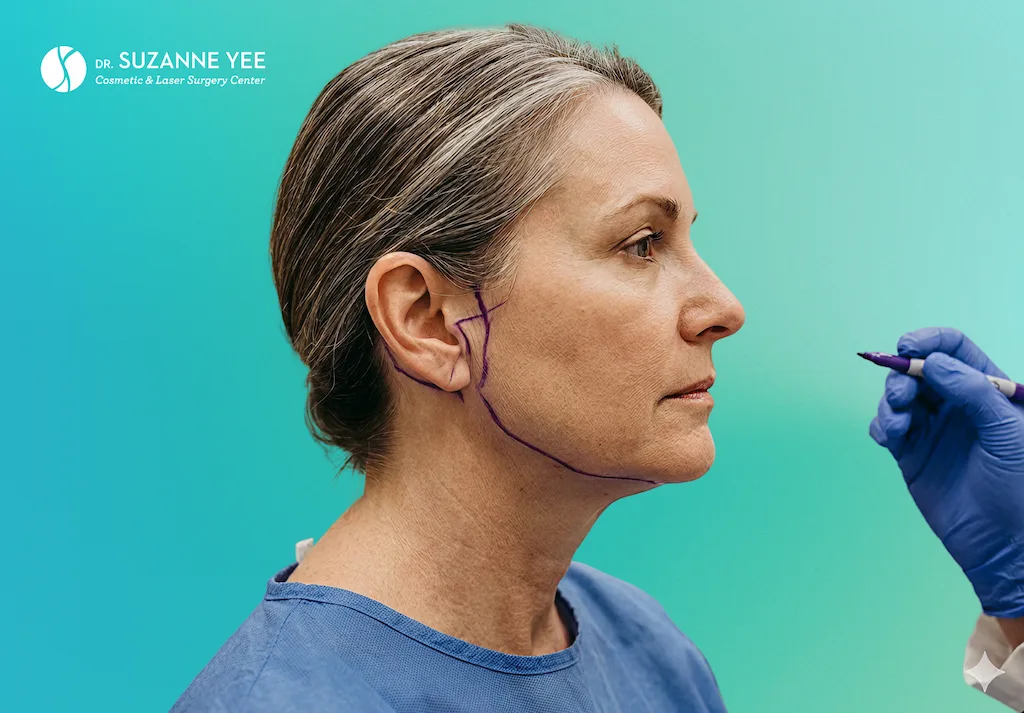
While a neck lift works below the jawline, a lower face lift targets the bottom third of the face itself, where jowls and sagging skin do the most damage to a defined profile.
A lower facelift relies on SMAS lift and facial recontouring, repositioning the fibrous network of tissue underneath the skin that supports your cheeks and jawline. As the SMAS descends with age, jowls form and marionette lines deepen. By lifting and securing this deeper layer, a lower facelift corrects sagging at its structural source rather than just pulling skin tight. That’s the difference between a result that looks natural and one that looks stretched.
Incisions run along the hairline and around the ears, similar to the neck lift but slightly more extensive to allow access to the lower cheek and jaw area. The procedure takes two to four hours and is performed on an outpatient basis. One study of 70 patients found significant jowl correction and marionette line reduction at nine months.
A lower face lift differs from a full facelift in scope. A full facelift also addresses the midface and deeper cheek structures, while a lower facelift concentrates on the jawline, jowls, and upper neck. If the jawline and jowls are your primary concern but your midface still holds up well, a lower facelift may be all you need. It can also include neck work, and your surgeon may recommend combining it with platysmaplasty for a comprehensive lower face and neck result.
Karla, who had a lower facelift at the Little Rock practice, shared their experience:
“I am 6 wks out of my lower facelift with Dr Yee. My results are so natural and took years off my appearance. This can be a scary experience, but Dr Yee and her staff put me at ease before and after the procedure. I will definitely be using Dr Yee for any future procedures, and highly recommend her and her staff.”
How do a lower facelift and neck lift compare for jawline results?
Now that you know what each procedure does on its own, the natural next question is how they stack up against each other.
The core difference comes down to where the aging is happening. A neck lift corrects issues below the jawline: skin laxity, platysma bands, and fat under the chin. A lower face lift corrects issues along and above the jawline: jowls, and marionette lines. Think of the jawline itself as the dividing line between their two territories.
| Feature | Neck lift | Lower facelift |
|---|---|---|
| Primary target | Neck skin, platysma bands, submental fat | Jowls, jawline, SMAS descent |
| Surgery time | 1-2 hours | 2-4 hours |
| Incision locations | Behind ears, under chin | Along hairline, around ears |
| Return to desk work | 1-2 weeks | 10-14 days |
| Results duration | 7-15 years | 7-15 years |
| Best for | Neck-dominant aging | Lower face-dominant aging |
Recovery timelines are similar. Both procedures allow a return to desk work within about two weeks, with strenuous exercise off the table for four to six weeks. Full results settle over six to 12 months as swelling resolves and tissues adjust to their new positions.
When is combining both the right call? When jowls and neck laxity coexist, which is common. A study of 380 patients found that 67.9 percent of those receiving a facelift also had a neck lift to create balanced, harmonious results across the entire lower face and neck.
Dr. Yee’s practice offers flexible financing through Cherry, Alphaeon Credit, CareCredit, PatientFi, and Alle to help make these procedures more accessible, regardless of whether you need one procedure or both.
Deciding between a lower facelift, a neck lift, or both starts with understanding your own anatomy, and that’s something only an in-person evaluation can determine.
Are you a good candidate for a neck lift, lower facelift, or both?
Candidacy depends on where your concerns are, your overall health, and the condition of your skin. Here’s how to think about it.
If your main concerns are neck bands, a double chin, or loose skin under the jawline, a neck lift is likely the better fit. Signs that point to a neck lift include vertical bands visible when you tense your neck, fullness under the chin that doesn’t respond to diet, or a blunted neck-chin angle.
If jowls are what bother you most, a lower facelift addresses that directly. Pronounced pouching along the jawline, deepening marionette lines, and a loss of definition from the front view are signs that SMAS descent is at play.
When both concerns exist together, combining the procedures creates a more complete result. Candidates going for a combined approach, typically show pronounced jowls alongside neck laxity. Good general health is a baseline requirement for either procedure, along with:
- Skin that still has enough elasticity to heal and redrape after repositioning
- Stable weight, since significant fluctuations can affect results
- A commitment to stop smoking at least six weeks before surgery, because nicotine impairs healing
- Specific goals about what you’d like to improve, which your surgeon can evaluate
Audrey, who consulted for both a neck lift and lower face lift in Little Rock, shared their experience:
“My journey with Dr Yee and her staff has been life changing. I have planned for years to get some work done before I turned 65 this coming January, so I finally to the leap. On my first consultation we talked about a neck lift, lower face lift and laser resurfacing. Dr Yees work surpassed mine and my family’s expectations.”
An in-person consultation is the only reliable way to determine which procedure, or combination, fits your anatomy and goals. Offering comprehensive cosmetic procedure options in Arkansas, Dr. Yee’s AAAHC-accredited private surgical center in Little Rock treats the consultation as a two-way conversation. She evaluates your skin elasticity, facial structure, and areas of concern while you evaluate whether her approach feels right for you. There’s no obligation and no pressure to decide that day.
What does recovery look like after a neck lift or lower facelift?
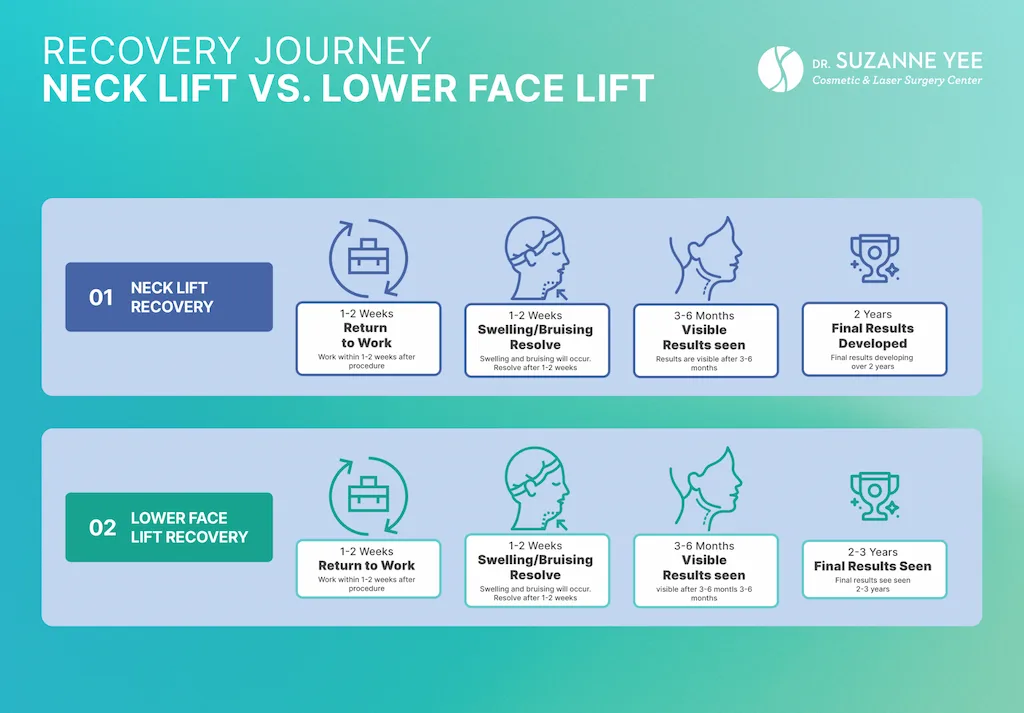
The first few days after either procedure are the most intense, and knowing what to expect can take some of the anxiety out of the process.

Swelling and bruising peak around days two through four, then gradually fade. Most bruising clears within two weeks, while deeper swelling takes longer to fully resolve. Your surgeon will provide compression bandages and may place small drains for one to two days to reduce fluid buildup.
| Recovery milestone | Neck lift | Lower facelift |
|---|---|---|
| Bruising fades | About 2 weeks | About 2 weeks |
| Return to desk work | 1-2 weeks | 10-14 days |
| Light exercise | 3-4 weeks | 4-6 weeks |
| Full results visible | 6-12 months | 6-12 months |
Returning to work is realistic within 10 to 14 days for desk jobs. Physical work takes longer. For the first several weeks, keep your head elevated, avoid bending your neck, and skip any heavy lifting or strenuous movement.
Managing discomfort is usually straightforward. Prescribed medication handles any soreness in the first few days, and most patients describe the sensation as tightness rather than sharp pain. That tightness eases as the tissues settle.
The results you see at the two weeks mark are just the beginning. Swelling continues to resolve for months, and the final contour typically takes six to 12 months to fully emerge. Scars from both procedures fade considerably over time because incisions are placed in natural creases, behind the ears, along the hairline, and under the chin.
The most common concern patients report isn’t the discomfort. It’s the impatience of wanting to see the final result before the healing is complete. That’s completely normal.
Conclusion
You came into this article trying to untangle two procedures that sound like they do the same thing — and now you know they don’t. A neck lift reshapes what’s below the jawline, a lower facelift corrects what’s along and above it, and combining both gives you a seamless result across the full lower face and neck. That clarity matters, because the better you understand your options, the more confident you’ll feel when it’s time to choose.
If you’re still in the exploring phase, browsing real patient photos from people who started where you are is one of the most grounding things you can do — it helps you move from “I think I want something” to “now I can see what’s possible.” And when you’re ready to go deeper, a personal consultation fills in everything photos can’t — how your skin, your anatomy, and your specific goals all come together into a plan that’s built around you.
At Dr. Yee’s Little Rock office, the belief is simple: every patient deserves to feel heard, respected, and confident in the choices they make. The goal is never to change who you are — it’s to help you look like the most refreshed, rested version of yourself.
Schedule your consultation or call (501) 224-1044 whenever you’re ready to start that conversation.
Frequently asked questions
Is a neck lift the same as a lower facelift?
No. A neck lift focuses on the neck area, addressing loose skin, submental fat, and platysma bands. A lower facelift targets the lower third of the face, specifically jowls, the jawline, and marionette lines. They address different zones, though they’re often combined when both areas need correction.
How much does a neck lift or lower facelift cost?
The cost varies depending on the extent of correction, the techniques involved, and whether procedures are combined. Because every patient’s anatomy and goals are different, the most accurate way to understand pricing is through an in-person consultation.
What’s the best age for a lower facelift?
There’s no single best age. Candidacy depends more on your skin quality, degree of aging, and overall health than on a number. Most patients considering a lower facelift are in their 40s to 60s, when jowls and jawline changes become noticeable enough that non-surgical options can no longer address them.
Can a neck lift fix jowls?
A neck lift can improve mild jowling by tightening tissue along the jawline, but it’s not designed to correct pronounced jowls. If jowls are a primary concern, a lower facelift addresses them more directly by repositioning the SMAS layer. Your surgeon can recommend the best approach based on your anatomy.
Will I have visible scars?
Scars from both procedures are well-hidden. Neck lift incisions sit behind the ears and under the chin, while lower facelift incisions follow the hairline and ear contours. These scars fade significantly over time and become difficult to spot once they’ve matured.
Can I combine a lower facelift with other treatments like fillers?
Yes. Many patients pair a lower facelift or neck lift with complementary treatments, including dermal fillers for volume restoration, a brow lift for the upper face, or fat transfer for added fullness. These options can be discussed during your consultation to create a cohesive plan.
What’s the difference between a mini facelift and a lower facelift?
A mini facelift, a less invasive cosmetic facial surgery, uses smaller incisions and targets early jowling with a shorter recovery, usually around one week. A lower facelift is more comprehensive, addressing deeper SMAS descent and more pronounced jowling with a longer surgery and slightly longer recovery. The right choice depends on the degree of aging you’re experiencing.
How does the deep plane technique differ from a standard lower facelift?
A deep plane facelift goes beneath the SMAS layer and releases the retaining ligaments that anchor facial tissue, repositioning the entire composite as a unit. This approach tends to produce longer-lasting results. Our complete guide to facelift surgery and natural results compares the deep plane approach with other techniques in detail.
*Disclaimer: This content is for educational purposes only and does not constitute medical advice. A consultation with a qualified board-certified surgeon is required to determine the best treatment plan for your individual needs and any questions you may have about a medical condition or procedure.