
 (501) 224-1044
You’ve read about implant types until the terms blur together. You’ve pictured the result, maybe more than once. But the surgery itself, the actual hour you spend in the operating room, is still a blank space.
That blank space is where most of the nerves live. It’s hard to feel ready for something you can’t picture. In one breast surgery outcomes study, patients reported satisfaction scores of 95.7% for surgical outcomes and 96.8% for information received on the BREAST-Q questionnaire. The procedure follows a careful, well-rehearsed sequence, and knowing that sequence tends to settle the unknown.
At Dr. Suzanne Yee Cosmetic & Laser Surgery Center in Little Rock, breast augmentation is one example of how cosmetic plastic surgery can improve your appearance, performed using precise, well-established techniques. This article guides you through the surgery process, from the moment you arrive to your first days of recovery. You’ll see how you’re prepared, what anesthesia is used, where the incisions go, how the implants are placed, and how everything is closed afterward.
Key takeaways
- The work starts well before surgery day. You’ll be asked to pause certain medications, step away ;lfrom smoking for a stretch, and line up someone to help you that first day.
- You’ll be fully asleep under general anesthesia, and the surgery itself usually takes around an hour from start to finish.
- The incision goes in one of three spots, most often the crease under the breast, and the right one depends on your anatomy and the type of implant you choose.
- Implants sit either beneath or above the chest muscle. Saline ones get filled once they’re in place, while silicone ones arrive already filled.
- Your final result isn’t something you see right away. Soreness eases over the first two to three weeks, and the implants gradually settle into their natural position over the course of about a year.
What happens before breast augmentation surgery begins?
Long before you change into a surgical gown, your personalized cosmetic enhancement plans are already taking shape. Preparation is its own quiet stage of the process, and it carries real weight.
It’s one of the most common cosmetic surgeries in the world, with ISAPS counting nearly 1.9 million performed in 2023. Most of that careful planning happens in the weeks before you ever reach the operating room.
In the weeks before surgery
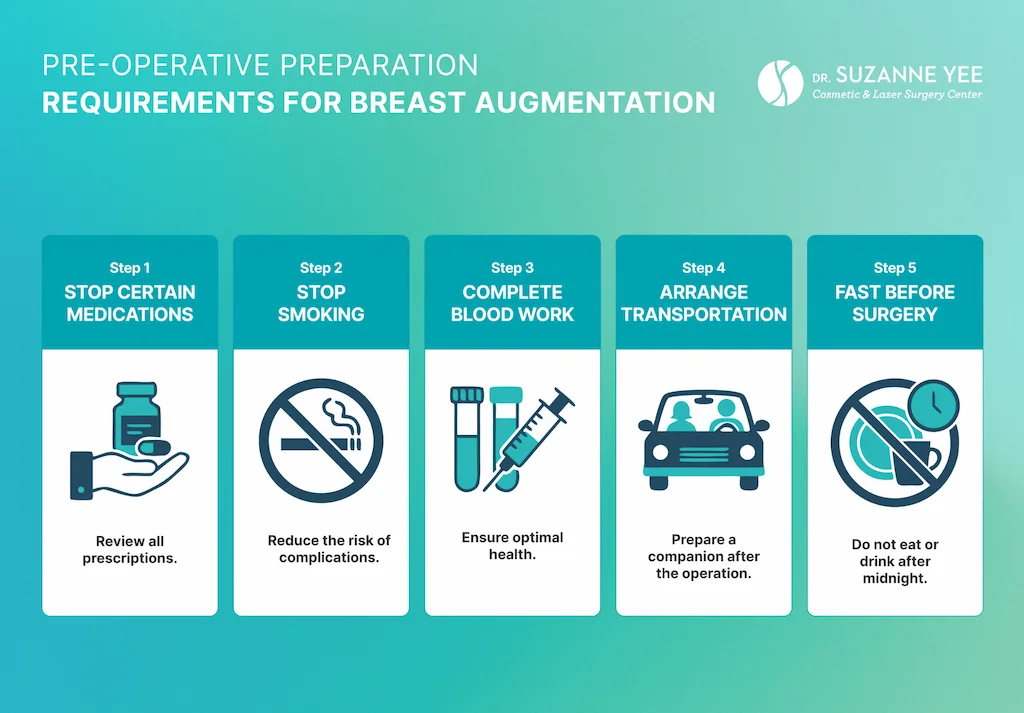
A lot of the groundwork happens at home. Your surgeon will hand you a personalized list of instructions, and sticking close to it is one of the simplest ways to set yourself up for a smoother day.
- Set aside aspirin, ibuprofen, and similar anti-inflammatories for about 2 weeks, since they can raise your bleeding risk.
- Stop drinking alcohol for two weeks before and two weeks after surgery, since alcohol can affect blood clotting and increase your bleeding risk.
- Get any blood work done that your surgeon asks for, and adjust your prescriptions exactly the way they tell you to.
- If you smoke, this is the moment to put it down. You must quit six weeks before and after surgery.
- Sort out a ride home, and have someone on hand to help you through the first day or two.
You’ll also be asked not to eat or drink after midnight, which keeps anesthesia safe. It’s natural to feel a flutter of nerves as the date gets closer. Ticking through a clear checklist gives that nervous energy somewhere useful to go.
Checking in on the day
On surgery day, you’ll arrive and change into a gown. A nurse checks your vital signs, and a urine pregnancy test, drug test, and nicotine test are standard before any procedure. Then you will wait for the part everyone remembers: meeting your surgeon right before surgery.
Final markings and pre-op review
Right before surgery, your surgeon will mark your skin while you’re sitting or standing up. The upright part really does matter. Gravity needs to be in the picture so your breasts settle into their natural position, and those markings show exactly where the incisions and implants should go.
Your surgeon also reviews your medical history, allergies, and medications one last time. All of this happens at an accredited surgical center, and most breast augmentation procedures take about an hour. Knowing the steps ahead of time is one of the simplest ways to feel calmer when walking in.
What kind of anesthesia is used for breast augmentation?
For most patients, the honest answer to “will I feel anything?” is a firm no. Breast augmentation is typically performed under general anesthesia, which means you’re fully asleep and won’t feel or remember the procedure. At Dr. Yee’s Little Rock practice, surgical procedures are performed under general anesthesia, a clinical standard chosen for control and comfort.
Some practices offer breast augmentation under IV sedation or local anesthesia with sedation instead. Those approaches keep you in a lighter, drowsier state rather than fully asleep. General anesthesia remains the most common choice for implant surgery because it gives the care team a calm, fully controlled environment.
You’re never alone with the medication. During surgery, you’re cared for by a team that includes:
- A Certified Registered Nurse Anesthetist (CRNA) who plans, administers, and monitors your anesthesia
- An operating room technician supporting the procedure
- Several registered nurses
Your surgeon and CRNA review your health history beforehand to keep your anesthesia as safe and smooth as possible. Afterward, it’s normal to feel groggy for a while, and some patients notice mild nausea that the team manages easily.
If anesthesia is the part that worries you most, that’s worth talking through out loud. You can schedule a consultation to ask every question before you commit to a date.
Once you’re comfortably asleep, the first thing your surgeon does is make the incision.
Where are breast augmentation incisions made, and why?
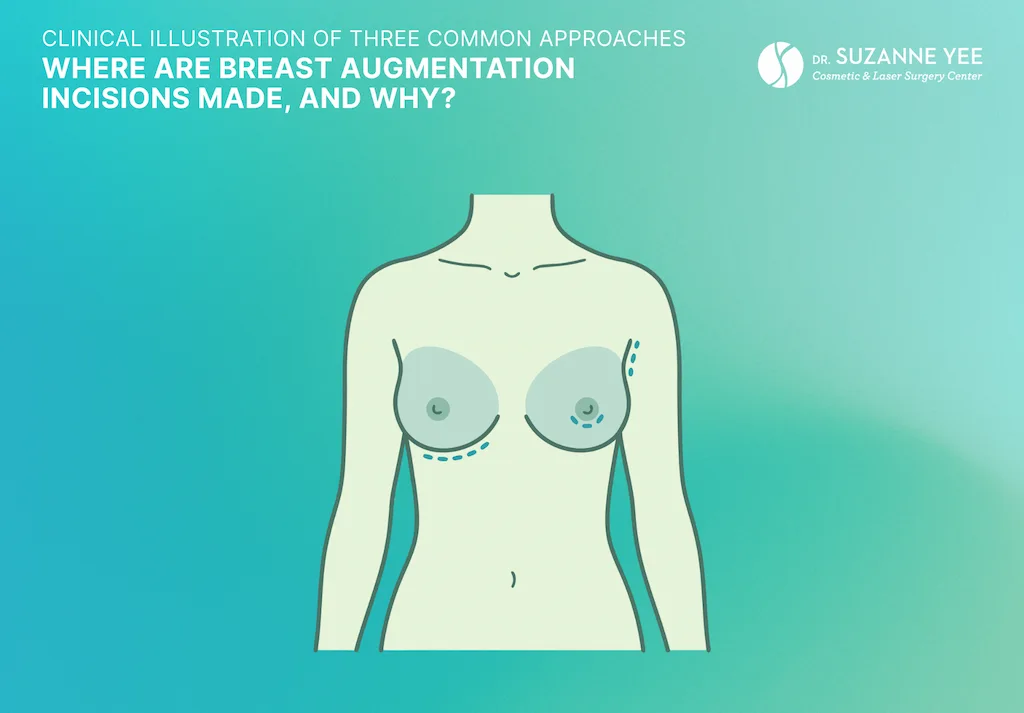
There are three main places an incision can go, and each one is a small, deliberate trade-off rather than a single best answer. The inframammary incision, made in the crease under the breast, is the most commonly used approach in breast augmentation because it gives surgeons direct and precise access to the implant pocket. It is also Dr. Yee’s preferred approach for most breast augmentations. Recent ASPS data show its use increased to about 80% of cases.
The other two options are the periareolar incision and the transaxillary incision. The periareolar incision sits at the lower edge of the areola, where the color change helps hide it. The transaxillary incision is tucked into the armpit, so there’s no scar on the breast itself.
| Incision location | Where it sits | Often chosen for |
|---|---|---|
| Inframammary | In the crease under the breast | Direct access and precise placement |
| Periareolar | At the lower edge of the areola | Camouflage along the natural color change |
| Transaxillary | In the armpit | Avoiding any scar on the breast |
Your anatomy, your implant type, and how your tissue is built all shape which one your surgeon recommends. Scarring is a fair thing to worry about, and knowing what to expect can ease some of that worry.
Incision scars fade over many months and are usually placed where a bra or swimsuit covers them. Periareolar incisions do carry a somewhat higher chance of changes in nipple sensation, with one of 1,222 patients showing nearly threefold higher risk compared to the inframammary approach. That can occasionally affect breastfeeding later, and placement under the muscle tends to make future mammograms easier to read. None of this is a reason for alarm, just useful context for the conversation with your surgeon.
How are breast implants placed and positioned during surgery?
Once the incision is made, your surgeon shapes a small pocket for the implant and eases it into position. This is really the heart of the procedure, and it’s the moment where a surgeon’s years of experience show up most clearly. A handful of choices get made right here, and each one quietly shapes how natural your result will look and feel later on.
Under or over the muscle
The implant ends up in one of two spots. With submuscular placement, it tucks partly beneath the chest muscle, which gives you more soft tissue covering it and tends to look the most natural. With subglandular placement, the implant sits above the muscle but still under your breast tissue, and that route often means an easier first week or two of recovery.
| Placement | Where it sits | Trade-offs |
|---|---|---|
| Submuscular | Partly under the chest muscle | Natural coverage, easier mammograms, longer early recovery |
| Subglandular | Above the muscle, under breast tissue | Quicker early recovery, slightly more rippling risk |
Neither is universally better. The right pocket depends on your anatomy and your goals, and that’s a genuine conversation, not a default.
Guiding the implant into place
The way an implant goes in really depends on which kind you’ve chosen. A saline implant gets placed empty and then filled with sterile saltwater once it’s settled into position, so your surgeon only needs a small opening to work through. A silicone implant is a different story. It arrives already filled with cohesive gel, so it has to be handled with extra care to keep the shell intact.
To make that easier, many surgeons reach for a no-touch funnel, which lets them slide a silicone implant into the pocket without ever directly touching it. Less handling usually means less stress on the surrounding tissue. It can also lower your chances of capsular contracture, the firm scar tissue that sometimes builds up around an implant over time. For a fuller rundown of implant types, sizes, and the decisions that go into them, see our complete breast augmentation guide.
Making both sides match
Symmetry is the quiet skill in all of this. Using the markings made before surgery and sizers placed during it, your surgeon checks that both implants are centered and balanced before closing. While symmetry is always the goal, it can’t be fully guaranteed, since no two sides of the body are perfectly matched to begin with. Dr. Yee’s approach leans on more than 20 years of experience and a philosophy of enhancement, not transformation. The goal is a result that looks like a fuller version of you.
Lisa, who had her breast augmentation in Little Rock, shared her experience:
“I had breast augmentation surgery with Dr. Yee. She made the entire process very easy, informative, and comfortable. She answered every question honestly and made sure I understood at every step along the way. She explained everything about the procedure and recovery in detail.”
Seeing how that careful work plays out is easier with real examples. You can browse real patient before-and-after photos to get a sense of what natural placement looks like.
How are the incisions closed, and what happens right after?
Closing an incision is more careful work than just a single line of stitches across the top. Your surgeon closes it in layers, placing dissolvable sutures deep under the skin to take the tension off the surface so it can heal cleanly. The outer skin usually gets closed with stitches set just below the surface, sometimes with a little surgical tape or skin glue added for support.
Most of those dissolvable sutures take care of themselves and never need to come out. If your surgeon uses any that aren’t dissolvable, those usually come out at your first follow-up visit, around a week later. Drainage tubes typically aren’t needed for a standard breast augmentation, which is genuinely a relief. That’s one less thing to manage at home while you’re trying to rest.
Then you wake up. You’ll spend a little time in a monitored recovery room while the anesthesia gradually wears off and the team makes sure you’re stable. It’s completely normal to feel foggy and a bit sore in this window, and that’s exactly what the recovery room is built for.
Before you head home the same day, the team makes sure you have what you need:
- Gauze dressings and a supportive surgical bra to protect healing and implant position
- Clear written instructions for the days ahead
- Your first follow-up visit, usually about a week out, already on the calendar
That first week of contact matters as much as the surgery itself. With the incisions closed and the support in place, the question most patients ask next is what they’ll see in the mirror.
What will you see right away, and what does early recovery look like?
You’ll see fuller breasts the moment you’re up and dressed, which is its own quiet relief after weeks of imagining it. But the version you see on day one isn’t the final result. Over roughly a year, the implants settle into a softer, more natural position as your tissue relaxes around them.
The first stretch of recovery asks you to slow down, and that can feel frustrating if you’re used to being independent. Expect soreness and tightness across the chest for about two to three weeks, with noticeable improvement by the one-month mark. You’ll also sleep on your back for four to six weeks to protect the implant position.
Activity comes back in stages rather than all at once, and a Rapid Recovery approach helps many patients move through them comfortably.
| Activity | Typical timing |
|---|---|
| Desk work | About 3 to 5 days with a Rapid Recovery approach |
| Light exercise | Around 1 to 2 weeks |
| Upper body workouts | About 2 weeks |
| Full activity | About 2 weeks for a standard augmentation (around 6 weeks if combined with a breast lift) |
Many patients are surprised by how quickly they feel like themselves again, some back to normal activities within about 24 hours. Most will tell you the hardest part was simply being patient. Wanting to feel comfortable in your own body is reason enough to get through that stretch.
What should you expect at your breast augmentation consultation?
Everything above becomes real at the consultation, and it helps to reframe what that visit is for. This isn’t only a chance for your surgeon to evaluate you. It’s equally your chance to evaluate the surgeon.
At an in-person consultation, Dr. Yee or Dr. Pournik performs a hands-on assessment that a screen can’t replicate. You also get to see the accredited surgical center where your procedure will happen. They ask about your daily routine, your work, and what you want to feel comfortable doing again. The plan fits your life, not a template, and nothing is rushed or off limits.
Cost comes up here too, and it should. The office offers flexible financing through Cherry, Alphaeon Credit, CareCredit, PatientFi, and Alle, so a payment plan can fit your budget. Patients drive in from Conway, Hot Springs, North Little Rock, and across Central Arkansas for this kind of unhurried, in-person care.
Kayli, who chose her cosmetic surgeon after researching practices across Arkansas, shared her experience:
“After three kids I was looking for a boost in my confidence to get a breast augmentation. I did my research on most of the surgeons in Arkansas and after careful consideration and recommendations I found Dr. Yee. I made the two-hour drive for my consultation and I knew it was the perfect fit.”
When you’re ready to see where you stand, you can schedule a consultation and start that conversation in person.
Conclusion
You started reading because the operating room was a blank space, and the not-knowing was doing most of the worrying for you. Now you can picture it. The preparation weeks, the check-in, the anesthesia, the incision, the careful placement, the layered closure, and the slow reveal over the year that follows.
One of the most grounding things you can do next is look through real patient before-and-after photos of people whose starting point looked like yours. When you’re ready, a personal consultation fills in the details a photo can’t show.
At Dr. Suzanne Yee Cosmetic & Laser Surgery Center in Little Rock, the goal is always natural-looking enhancement. Every patient should feel heard, respected, and confident in the choice they’re making. When the time feels right, you can schedule your personal consultation or call (501) 224-1044
Frequently asked questions
How long does breast augmentation surgery take?
The surgery itself usually takes about one hour, though this varies with technique and whether other procedures are combined. Plan to be at the facility longer than that, since check-in and monitored recovery add a few hours to your day.
Is breast augmentation done under general anesthesia?
Yes, in most cases. General anesthesia means you’re fully asleep and won’t feel or remember the procedure, and it gives the care team a controlled environment. Performed at an accredited surgical center with a CRNA administering your anesthesia, it’s the standard approach for implant surgery.
What’s the difference between saline and silicone implants?
Saline implants are filled with sterile saltwater after placement, so they need a smaller incision and show a clear, quick deflation if they ever rupture. Silicone implants come pre-filled with cohesive gel, which many patients feel reads as more natural to the touch. Your surgeon can help you weigh both against your anatomy and goals.
How painful is breast augmentation recovery?
Most patients describe soreness and tightness rather than sharp pain, most noticeable for about two to three weeks before improving by the one-month mark. A Rapid Recovery approach is designed to keep that discomfort manageable. Your surgeon will tailor pain management to you.
Can you breastfeed after getting breast implants?
Many people can breastfeed after breast augmentation, especially when the implant sits under the muscle and the incision avoids the areola. Both factors help protect the milk ducts and nerves involved in nursing. If breastfeeding later matters to you, raise it during your consultation so it can shape the plan.
How often should breast implants be checked or replaced?
Implants aren’t lifetime devices. The FDA recommends considering implant exchange versus full removal about every 10 years, or sooner if something changes. You should also keep up with routine monitoring, including regular mammograms and self breast exams, alongside an in-person check with a board-certified cosmetic surgeon who knows your history.
*Disclaimer: This content is for educational purposes only and does not constitute medical advice. A consultation with a qualified board-certified surgeon is required to determine the best treatment plan for your individual needs.




 Instagram
 Facebook
 Tiktok
 Youtube
 X
X LinkedIn