Instagram
 Facebook
 Tiktok
 Youtube
 X
 LinkedIn

 (501) 224-1044

Implants make breasts bigger. A lift makes them higher. If your breasts have both lost fullness and started to sag, one procedure alone usually can’t give you the shape you’re picturing.
That gap trips up a lot of women who assume implants will fix everything. Breast augmentation is one of the most common cosmetic procedures worldwide, with more than 1.6 million performed in 2024, according to ISAPS. Breast lifts are common too, and plenty of women turn out to need both.
At Dr. Suzanne Yee Cosmetic & Laser Surgery Center in Little Rock, Arkansas, a triple board-certified cosmetic surgeon with more than 35 years of experience helps women sort out exactly this question. This guide covers how the two procedures differ, how to tell which you need, why combining them can make sense, and how recovery, scars, and risks really play out.
Wanting to feel like yourself again after pregnancy, breastfeeding, or weight loss isn’t vanity. It’s a reasonable thing to want, and understanding your options is the first real step.
Key takeaways
Here’s the short version, so you have your bearings before the full breakdown.
- Implants restore lost fullness. A lift raises the breasts and repositions the nipple. Only a lift can fix true sagging.
- A quick self-check helps: if your nipples sit at or below the crease under your breast, a lift is usually part of the answer.
- Combining both in one surgery means a single recovery, and often a smaller, lighter implant, since tightening the skin is part of the shaping.
- A combined recovery tracks the more involved procedure, with most women back to desk work within days and strenuous activity around six weeks.
- Lift scars fade over roughly a year, and combining a lift with implants is a common, well-established approach for the right candidate.
How are breast augmentation and breast lift different?
The two procedures solve two different problems. One adds volume. The other changes position.
Breast augmentation uses a breast implant to restore or add size and fullness, especially in the upper breast that empties out after pregnancy or weight loss. It makes breasts larger and rounder. What it can’t do is lift stretched skin or move a nipple that has drifted downward.
A breast lift, or mastopexy, does the opposite job. It trims loose skin, tightens the breast, and raises everything to a higher, perkier position. Your surgeon also repositions the nipple so it points forward again.
| Breast implants | Breast lift | |
|---|---|---|
| What it adds | Size and upper fullness | A higher, tighter shape |
| What it moves | Nothing | Nipple and breast position |
| Best for | Lost volume, small size | Sagging, stretched skin |
| Can’t fix alone | Sagging | Emptiness or small size |
Here’s the part that surprises people. Filling a deflated breast is not the same as lifting a sagging one. A “breast augmentation, no lift” plan works well when your breasts are simply small or a little empty but still sit where they should.
With real sagging, though, implants alone can work against you. A large implant adds weight to skin that has already stretched, which can pull the breast lower and leave it looking bottom-heavy. If sagging is your main concern, your surgeon will usually talk about a lift rather than a bigger implant.
How do you know if you need a lift, implants, or both?
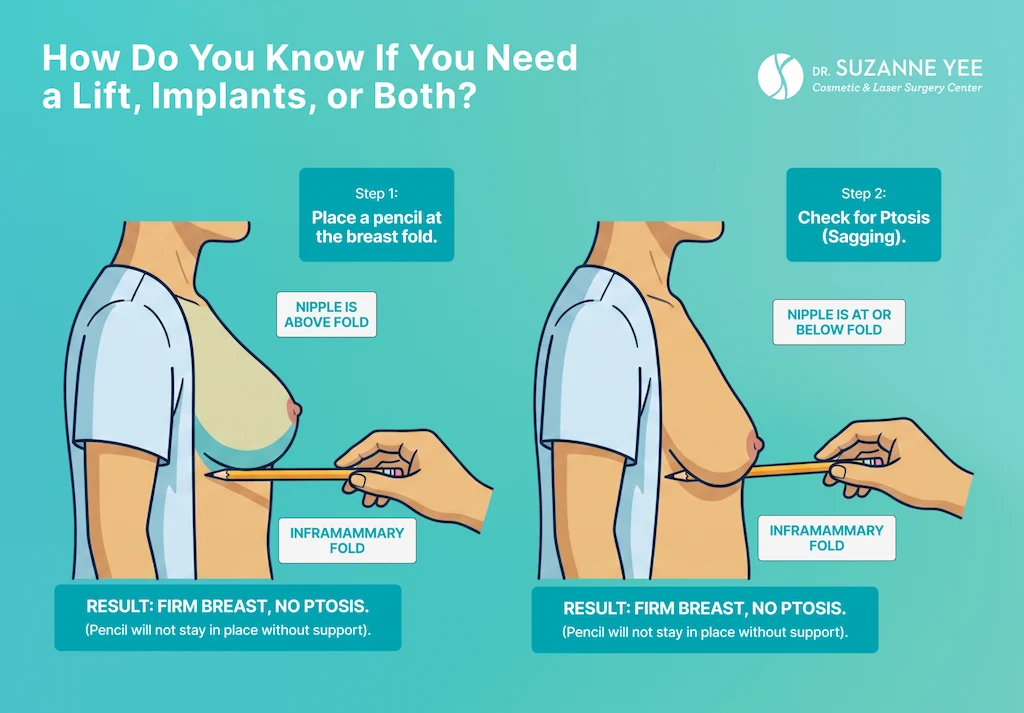
An in-person exam settles it, but there are real signs you can spot yourself first. It helps to know what you’re seeing in the mirror so the conversation feels less confusing.
Surgeons describe sagging, or ptosis, by where your nipple sits compared to the crease under your breast. The lower it sits, the more a lift enters the picture. A simple at-home check is the pencil test: tuck a pencil into the fold under your breast, and see where your nipple lands. If it rests at or below the pencil, a lift is usually part of the answer.
A few signs point toward needing both a lift and added volume:
- Your nipples point downward or sit at or below the crease.
- Your breasts look flat or empty on top but still hang low.
- Your skin feels loose or stretched after pregnancy, breastfeeding, or weight loss.
- You want to be fuller and higher, not just one or the other.
If a couple of those sound like you, that’s a normal place to be. It doesn’t mean anything went wrong; it’s simply what breasts do after a lot of living.
At Dr. Yee‘s Little Rock practice, this evaluation happens in person because skin quality, tissue, and how your breasts move all factor in. Only that kind of exam can confirm whether you need a lift, implants, or both.
Why combine a breast lift and implants in one surgery?
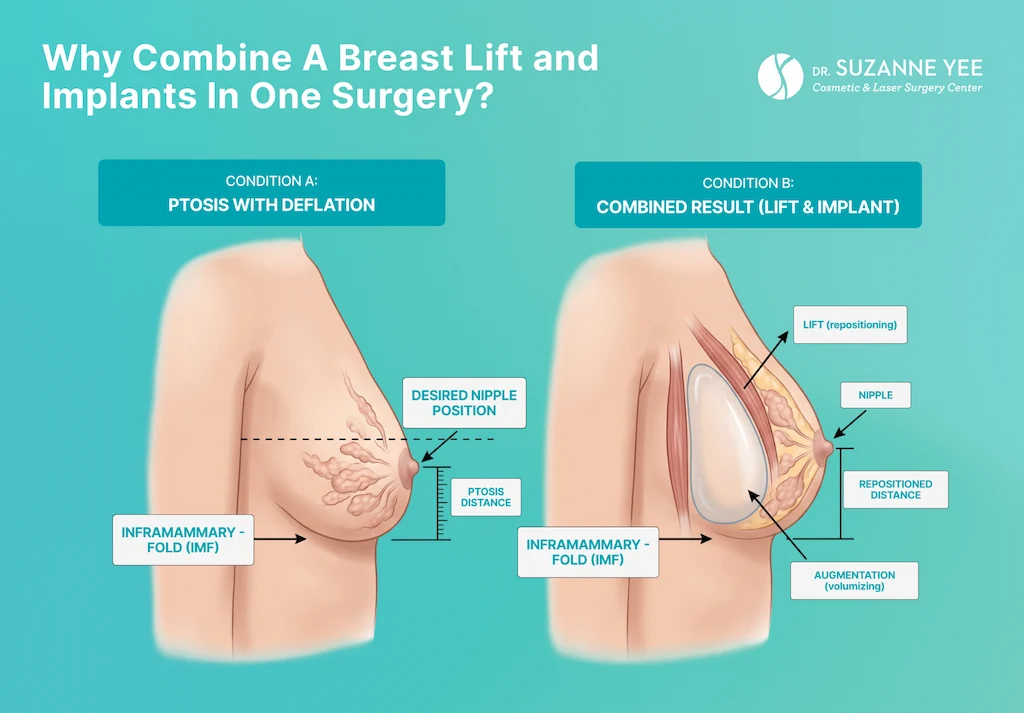
When you genuinely need both, doing them together is often the smoother path. Combining a lift and implants is a common, well-matched pairing, and the biggest advantage is simple: you go through recovery once instead of twice.
You also have one round of anesthesia and one set of aftercare. At the Little Rock practice, your quote bundles the surgeon’s fee, anesthesia, facility fees, and follow-up visits into one transparent total. You’re only responsible for your pre-op labs and any prescribed medications.
There’s a shaping advantage too. Because the lift tightens the skin first, your surgeon can often choose a smaller, lighter implant to create fullness, according to one review. The lift handles position, the implant handles volume, and together they tend to look more natural. A balanced result is always the goal, though symmetry can’t be guaranteed, since most people start with some natural asymmetry.
Your surgeon reshapes the tissue, repositions the nipple, and places the implant relative to your new shape in one coordinated plan. It’s also a pairing that fits naturally into a mommy makeover when other post-pregnancy changes are on your mind.
Daphne, a Dr. Suzanne Yee Cosmetic & Laser Surgery Center patient who combined a breast lift with implants, shared her experience:
“I have had a facelift..browlift..chin implant..fillers…ThermiVa…breast lift and implants. I have only felt confidence and safety with every procedure.”
What does recovery look like after a combined breast lift and augmentation?
Recovery from a combined procedure tracks the more involved of the two surgeries, so it asks a little more of you than implants alone. The upside is that it’s one recovery, and most women describe it as very manageable with a plan in place.
The first week
You should plan to rest at home for about a week. Swelling and bruising are a normal part of healing, and they can linger for a month or more. You’ll wear a supportive surgical bra to hold everything in position while you heal. The first few days can feel frustrating if you’re used to being on the go, but it’s important to allow your body to heal. Leaning on help at home matters, too.
Returning to activity
Many women return to desk work within a few days, helped by the Rapid Recovery Method your surgeon uses. Light activity comes back gradually, while heavy lifting and strenuous exercise wait until at least six weeks. Giving your body those weeks is what protects the result you just invested in.
Your final results
Your breasts won’t look their final shape right away, and that’s expected. Over the following weeks, the implants settle into a softer, more natural position. This process is often called “drop and fluff.” Final results can take up to a year as swelling fades and everything relaxes into place.
For managing swelling or discomfort, your surgeon gives you personalized instructions to follow rather than generic home remedies. When you’re planning for a combined procedure, flexible financing through Cherry, Alphaeon Credit, CareCredit, PatientFi, and Alle can spread the cost.
What about scars, risks, and revision with a combined procedure?
Scarring is one of the most common worries with a lift, and it’s a fair one. Knowing what the scars look like and how they fade can help take a lot of the fear out of it. The trade-off for a lift is more scarring than implants alone, because it involves tightening skin.
Choosing your incision
Your incision pattern is matched to how much sagging you have, so you don’t get more scar than is necessary. For mild sagging, a circular incision around the areola may be enough. More significant sagging calls for additional incisions, often extending down and along the breast fold.
Your surgeon can often place the implant itself through an incision in the crease, which heals discreetly. Only smooth implants are used, never textured ones, because textured surfaces carry a rare risk of BIA-ALCL, a form of cancer of the immune system.
Risk of combining
This is where a lot of women hesitate, so it’s worth being clear. Combining a lift with implants is a routine, well-established approach for the right candidate. Research on single-stage augmentation-mastopexy finds that, with careful patient selection, complication and reoperation rates are acceptably low and comparable to the procedures done on their own.”
The real trade-offs are practical: a bit longer in surgery and one larger recovery. Whether it makes sense for you depends on your overall health, confirmed at your consultation.
Scar maturation
Scars change a lot over the first year. They start pink and slightly raised, then flatten and fade toward a thin, pale line as the collagen remodels over roughly three to twelve months. Feeling nervous about scarring is completely natural, and knowing this timeline tends to ease it. Sometimes a small revision is done later as the breast settles, which is normal fine-tuning, not a sign anything went wrong.
Lisa, a Dr. Suzanne Yee Cosmetic & Laser Surgery Center patient who wanted to understand every step, shared her experience:
“She made the entire process very easy, informative, and comfortable. She answered every question honestly and made sure I understood at every step along the way. She explained everything about the procedure and recovery in detail.”
Conclusion
Implants alone will not fix everything, and knowing when you also need a breast lift is the whole decision. Implants restore fullness, a lift restores position, and sagging with lost volume usually calls for both.
The most useful next step is seeing real results that match your starting point, so browse the before-and-after photos of women with similar concerns. When you’re ready, a personal, in-person visit fills in the details photos can’t show.
At Dr. Suzanne Yee Cosmetic & Laser Surgery Center in Little Rock, the goal is enhancement, not transformation. Every patient deserves to feel genuinely heard from consultation through recovery, the “Exceptional Results. Genuine Care.” thread.
When you’re ready, schedule your personal consultation or call (501) 224-1044.
Frequently asked questions
Will a combined surgery increase my overall recovery time?
You recover once instead of twice, which is a real advantage of combining. The timeline tracks the more involved procedure, so most women return to desk work within days and are cleared for strenuous activity around six weeks.
Will a breast lift make my implants look smaller?
A lift repositions and tightens rather than shrinks, so it won’t make an implant smaller. Because tightening the skin does part of the shaping, many women can choose a smaller, lighter implant and still get the fullness they want.
What does the pencil test tell me about my breast sagging?
Tuck a pencil into the fold under your breast, and notice where your nipple lands. If it sits at or below the pencil, you probably have enough sagging that implants alone won’t fix. It’s a helpful preview, not a diagnosis.
Will combining a breast lift and implants leave worse scars?
A lift does add scars that implants alone wouldn’t, since it involves tightening skin. The incision pattern is matched to how much lift you need, so mild sagging means less scarring. Scars fade toward a thin, pale line over roughly a year.
Can I get a breast lift now and get implants later?
Yes, the two don’t have to happen at the same time. Some women choose a lift first and add implants in a later, separate procedure if they decide they want more volume. Your surgeon can walk you through the trade-offs.
How long after breastfeeding should I wait to have this combined surgery?
It’s best to wait until you’re finished breastfeeding and your breasts have stabilized for a few months. Pregnancy and nursing change your breasts, so operating too soon can affect your results. Many surgeons also suggest waiting until you’ve completed your family.
Are breast implants or fat transfer better for a combined procedure?
Implants give reliable, predictable volume, especially in the upper breast, which is why they pair so naturally with a lift. Fat transfer adds a more limited amount of volume using your own fat and suits subtler goals.
*Disclaimer: This content is for educational purposes only and does not constitute medical advice. A consultation with a qualified board-certified surgeon is required to determine the best treatment plan for your individual needs.