
 (501) 224-1044
How much information do you truly need before deciding to undergo breast augmentation with confidence? You probably have a search bar full of open tabs, or you’ve been reading late at night and realize there’s still “a lot” to know and understand.
Questions like: Saline or silicone? Under or over the muscle? What does recovery really feel like? These terms start to blur together as you dig deeper into your search across many websites.
Breast augmentation, often called a boob job, is a surgical procedure that uses implants or transferred fat to increase breast size, restore lost volume, or improve symmetry between the two sides. ISAPS recorded 1,658,615 of these procedures performed globally in 2024. Thus, the questions you are sitting with are ones many people are working through, too.
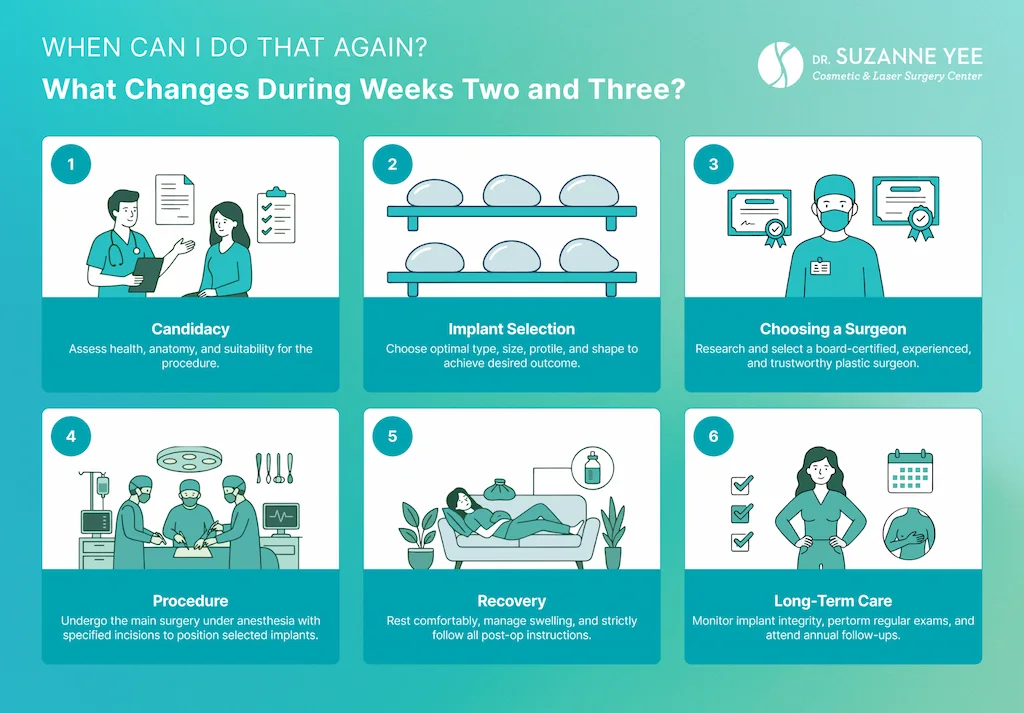
At Dr. Suzanne Yee Cosmetic & Laser Surgery Center in Little Rock, what to expect from plastic surgery in Little Rock is shaped by a triple board-certified cosmetic surgeon who has spent more than 35 years guiding patients through every stage of this decision. This guide walks you through candidacy, implant options, choosing a surgeon, the procedure itself, recovery, and the risks to understand. By the end, those blurry terms should feel like a set of choices you can weigh.
Key takeaways
- Good candidates are healthy adults at a stable weight with realistic expectations. Augmentation adds volume and improves symmetry, but it does not significantly lift sagging breasts on its own.
- There are two FDA-approved implant materials, saline and silicone. The popular “gummy bear” implant is a highly cohesive type of silicone, not a separate third category.
- Smooth implants carry no known BIA-ALCL risk, whereas that rare lymphoma has been linked to textured implants. Shape and profile are personal choices.
- Before-and-after photos, board certification, procedure volume, and an accredited facility are the key indicators when choosing a surgeon. The consultation works both ways.
- The procedure takes about one to two hours under general anesthesia, with the implant placed under or over the chest muscle through a discreet, well-hidden incision.
Am I a good candidate for breast augmentation?
It’s one of the first questions almost everyone asks, and it deserves more than a yes-or-no answer. The short version is that good candidates are healthy adults with stable life circumstances. The fuller picture comes down to a handful of factors:
- Overall health. Ideal candidates are physically healthy, at a stable weight, and free of conditions that complicate healing, like active infection, untreated cancer, or uncontrolled diabetes. Autoimmune conditions, bleeding disorders, and heart conditions don’t automatically rule you out, but they do call for a careful review with your surgeon first.
- Timing matters, especially around pregnancy and breastfeeding. Both significantly change breast tissue, so if you’re planning a family, waiting until after protects your results and ensures accurate sizing. If your goals are tied to post-pregnancy changes, restoring your pre-baby body shape by pairing augmentation with other procedures may be discussed in your consultation.
- A stable weight. Holding a steady weight for several months before surgery helps avoid surprises in your final result.
- Age and maturity. The FDA approves saline implants for cosmetic use starting at age 18 and silicone implants at 22, with no upper age limit as long as you’re healthy. Our wellness guide by decade outlines the changes during different life stages.
Dr. Yee and Dr. Pournik emphasizes enhancement rather than transformation, guiding these conversations toward a natural, fuller, more balanced look. Doing your research before deciding is always a smart move.
If you’re still wondering where you fit into all of this, a hands-on evaluation is the only way to know for sure. You can reach out for an honest conversation about your health history and what your goals are before deciding anything.
What types of breast implants should you consider?
With the candidacy question answered, the next step is choosing the right implant profile. There are a few main types to weigh, each with its own look, feel, and lifespan, and the best one for you isn’t always the most popular one.
Saline and silicone implants
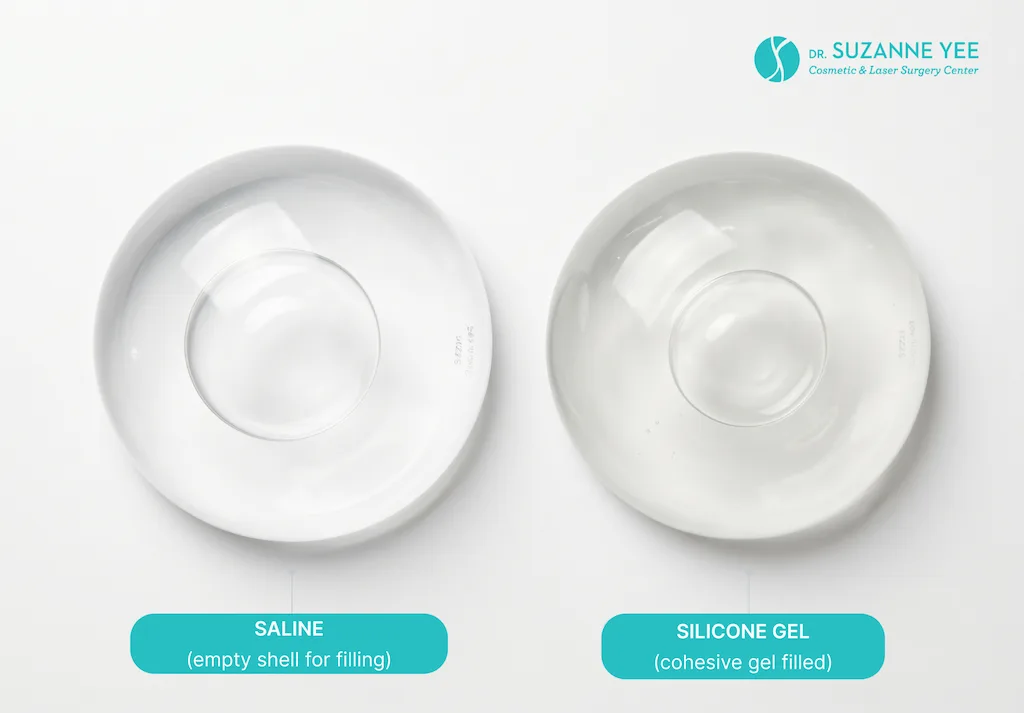
There are two FDA-approved implant materials: saline and silicone. Saline implants are filled with sterile saltwater after the shell is placed, allowing for a smaller incision. A rupture is easy to spot because the implant deflates and your body safely absorbs the fluid.
Silicone implants are pre-filled with cohesive gel that feels closer to natural breast tissue. That softer, more natural feel is why many people prefer them.
You may also see “gummy bear” implants discussed as a third category. They are not. A gummy bear implant is a type of silicone implant, specifically one with a highly cohesive, form-stable gel that holds its shape and resists rippling. The choice is still saline versus silicone, with gummy bear implants falling within the silicone family.
| Feature | Saline | Silicone |
|---|---|---|
| Fill | Saltwater, added after placement | Cohesive gel, pre-filled |
| Feel | Firmer, can ripple with little tissue coverage | Softer, closer to natural tissue |
| If it ruptures | Deflates within hours, fluid absorbs safely | Gel usually stays contained and can be silent |
| FDA age approval | 18 and older | 22 and older |
| Variants | One option | Includes highly cohesive gummy bear gel |
Shape, profile, and projection
Beyond material, implants come in round or teardrop shapes and in low, moderate, or high profiles. Round implants add fullness across the upper breast, while teardrop shapes mimic a natural slope. Research has found no clear aesthetic winner between them, but because teardrop implants are textured, and textured surfaces carry the rare BIA-ALCL risk covered below, Dr. Yee uses round, smooth implants. The profile describes how far an implant projects from the chest, and it is matched to your chest width to keep the result proportionate.
Smooth versus textured surfaces
Implant shells are either smooth or textured, and this matters for one specific reason. A rare lymphoma called BIA-ALCL has been linked to textured implants, with an estimated risk of 1 in 3,000 for textured devices, according to ASPS. Smooth implants carry no known BIA-ALCL risk, and many surgeons now favor them for that reason.
Fat transfer as an alternative
If you’re seeking a modest enhancement and prefer to avoid implants, fat transfer augmentation involves moving fat from another part of your body to your breasts. It is suitable for small adjustments, since only a limited amount of fat can be added at one time, typically around a hundred milliliters per breast. Dr. Yee usually has patients return after about six months to reevaluate and add more fat if needed. If you would prefer not to use your own fat, she can also discuss an injectable allograft alternative that is placed directly from a syringe.
The tradeoff is having less control over the final size, so consider this in relation to your goals. During a consultation, ask whether implants align with your desired outcome or if a fat transfer might be better for a subtler change.
How do you choose a surgeon and prepare for surgery?
If choosing an implant feels overwhelming, remember that picking the right person to do it is even more important. Here’s the key idea to keep in mind: the consultation isn’t just about the surgeon assessing you; it’s also your opportunity to see if they’re the right fit for you.
Checking your surgeon’s credentials
Begin by choosing a board-certified surgeon. These surgeons have completed years of supervised training, passed demanding exams, and stay updated through ongoing education at accredited centers. Surgeons who perform more breast augmentations each year generally have lower complication rates, so don’t hesitate to ask how many procedures they do annually.
Dr. Suzanne Yee is a triple board-certified cosmetic surgeon. She holds certification from the American Board of Cosmetic Surgery in two areas, facial cosmetic surgery and body, breast, and extremity surgery, plus the American Board of Facial Plastic and Reconstructive Surgery. Bring your own questions too: whether you can see before-and-after photos of similar patients, training, procedure volume, facility accreditation, and how complications are handled.
L C, a patient who chose her surgeon after weighing other options, shared her experience:
“I had 2 cosmetic surgery procedures prior to choosing Dr. Yee for my recent surgery. She is Board Certified and many cosmetic surgeons are not, so be careful. I was most impressed with the detailed preparations she required and followed me through prior to the actual surgery. I am extremely pleased with the results of her knowledge and skilled hands!”
Inside the consultation
A thorough consultation is hands-on and in person. Your surgeon evaluates your anatomy and skin quality, measures your breasts, and reviews your full health history, including any family history of breast cancer. From there, the conversation turns to implant options, incision locations, and what to expect during recovery.
At this Little Rock practice, that visit happens at an AAAHC-accredited surgical center, so you can see the facility where your procedure would take place. Nothing is rushed, and questions that feel small or embarrassing are still fair game.
Understanding cost and financing
Cost isn’t usually just a single number. It varies based on your implant type, the surgical approach, and whether additional procedures are involved. The most helpful thing is to understand exactly what’s included in a quote.
Here at our practice in Little Rock, a quote includes the surgeon’s fee, anesthesia, facility charges, and follow-up visits as a clear total. However, pre-op labs and prescribed medications are excluded from the quotation. Furthermore, insurance doesn’t cover cosmetic augmentation. To make it work for you, flexible financing options are available through Cherry, Alphaeon Credit, CareCredit, PatientFi, and Alle, allowing you to spread the cost into manageable payments.
Preparing for surgery
Once you’ve set a date, most of the prep is pretty straightforward. Expect to get some blood work done, and you might need to tweak certain medications. It’s also a good idea to arrange for a ride home and some help during the first day or two. If you’re over 40 or have a family history, a baseline mammogram is usually recommended.
If you smoke, it’s required to quit around the time of surgery, ideally six weeks before and after, as it significantly aids healing. Feeling overwhelmed by these details is normal, and that’s precisely what the consultation is for. You can book a personal session to discuss everything in a relaxed and no-pressure environment.
What happens during the breast augmentation procedure?
After all the planning, the surgery itself is often shorter and more straightforward than people expect. Most breast augmentation procedures take about one to two hours and are done on an outpatient basis, so you go home the same day.
During the procedure, you will be fully asleep and comfortable under general anesthesia, meaning you won’t feel anything. While some practices may offer IV sedation instead, Dr. Yee’s Little Rock practice always conducts breast augmentation under general anesthesia. This is administered by a Certified Registered Nurse Anesthetist (CRNA) as part of an experienced surgical team, ensuring your safety and comfort are continuously monitored.
Your surgeon makes a subtle incision in one of several spots chosen based on your anatomy. The most common is the inframammary incision, which is tucked in the fold beneath your breast. This approach is now used in about 80% of cases. Another option is a periareolar incision, made around the lower edge of the areola.
Next is placement. The implant can be positioned either submuscular, beneath the chest muscle, or subglandular, above the muscle and beneath the breast tissue. Submuscular placement is now more popular because it often results in a more natural appearance and facilitates mammogram readings. After creating the pocket, the implant is inserted, and the incisions are closed with layered sutures.
Sometimes, a breast lift is combined with augmentation, the procedure that increases volume while repositioning the breast tissue and nipple. This approach is ideal if sagging is present, as implants add fullness but do not lift the breasts on their own. Your surgeon will advise whether one or two procedures are necessary to achieve your goals. In any case, you will notice an immediate change, although the final shape will take some time to stabilize.
What is breast augmentation recovery like?
Many people quietly worry about recovery, particularly if they are accustomed to being active and independent. The good news is that, with the right approach, recovery can be more manageable than some of the worst-case stories imply.
At our Little Rock practice, we offer a Rapid Recovery Method, an advanced protocol built around a refined surgical technique that minimizes muscle trauma. For many patients, it also means non-narcotic pain management and gentle early movement to speed healing.
The first days
Expect to experience soreness and tightness in your chest during the first two to three weeks, with notable improvement by approximately one month. Using the Rapid Recovery Method, many patients resume normal activities within 24 hours, and most return to desk work in three to five days. You will need to wear a supportive surgical bra or garment continuously for several weeks to aid healing and ensure correct implant positioning.
Returning to activity
Pacing yourself helps protect your results. Usually, light exercise can start after two or three weeks, but for upper body workouts, it’s better to wait four to six weeks. You can usually get back to full activity around six weeks. For the first four to six weeks, you’ll also need to sleep on your back to help your implants settle evenly. It might be frustrating to slow down, but remember, this period is short. Rushing through it is what often causes setbacks.
Settling and final shape
Your breasts may continue to change even after you feel recovered. Implants slowly settle into a softer, more natural position, and the full results might take up to a year to become visible. Follow-up care is important during this process. Dr. Yee usually schedules your first visit around a week after surgery, and the team proactively checks in instead of waiting for you to contact them.
Jamie, a Little Rock patient who described the recovery experience, shared:
“Dr. Yee and her staff provided exceptional care, from my initial consult, through the surgery process, recovery, and follow-up appointments. From the moment I walked in, your surgery center has had such a welcoming and positive vibe. Your staff made me feel comfortable and at ease.”
Seeing how results actually look for real patients can make the timeline feel less distant. You can check out before-and-after photos of real patients to get a better idea of what to expect based on real outcomes.
What are the risks and long-term effects of breast implants?
Every surgery involves some risk, and our aim is to inform you without causing fear. Most breast augmentation patients recover smoothly and remain happy with their results. Being aware of potential concerns allows you to ask more informed questions and understand what is typical.
Short-term concerns
During the initial healing period, common concerns include minor bruising, temporary swelling, and rarely, infection. Serious complications are very uncommon, affecting only a small percentage of patients, and skilled surgeons using meticulous techniques reduce these risks further. Most sensations felt in the first few weeks are typical parts of healing, not signs of problems.
Capsular contracture
Your body naturally creates a thin scar tissue capsule around any implant. In some patients, this capsule may tighten and become firm, a condition known as capsular contracture, which can impact breast sensation and shape. Using submuscular placement, gentle surgical techniques, and antimicrobial care can reduce the risk of capsular contracture. If it does develop, it is manageable through treatment.
Rupture and implant longevity
Implants are durable but not lifetime devices, lasting on average 10 to 15 years or longer. Saline ruptures are obvious because the implant deflates, while silicone ruptures can be silent, which is why periodic imaging is recommended.
If an implant ruptures, or you simply want a change later, breast implant removal surgery options can usually address it in a single procedure. Any related concern, like capsular contracture, can often be addressed at the same time.
Breast implant illness and BIA-ALCL
Two terms come up often in online research. Breast implant illness, or BII, describes a range of systemic symptoms some patients report, though a direct causal link has not been proven.
BIA-ALCL is a rare lymphoma associated specifically with textured implants, with 733 cases reported to the FDA as of 2020. Choosing smooth implants removes the known BIA-ALCL risk entirely.
Breastfeeding and mammograms
Most women can continue breastfeeding after augmentation, particularly with submuscular placement and an inframammary incision, which preserve the milk ducts. Mammograms remain effective, although the technician may take extra views to examine around the implant. Being aware of this in advance usually helps alleviate two of the most common long-term concerns.
Conclusion
You came to this guide the way most people do, with a search bar full of open tabs and terms that all started blurring into one. You wanted to know what breast augmentation really involves before deciding anything. Now you have the bigger picture, from who makes a good candidate to what recovery feels like and which risks are worth understanding up front.
So where do you go from here? A helpful next step is to browse the breast augmentation photo gallery, which shows you genuine results of bodies that have undergone the same procedure. When you’re ready to learn more, a hands-on evaluation is the best next move to get information tailored to your specific anatomy and goals.
Dr. Suzanne Yee believes every patient deserves to feel heard, respected, and genuinely confident in their choices, whether they’re coming from Little Rock, Conway, Hot Springs, or North Little Rock. That’s exactly what her enhancement-focused approach really means in practice. When you’re ready to talk things through in person, you can reach out to our team or call (501) 289-5460. Your decision deserves a real conversation, and that’s where it begins.
Frequently asked questions
Does breast augmentation hurt a lot?
Most patients experience soreness and chest tightness for the first two to three weeks, with noticeable improvement by about one month. A Rapid Recovery approach allows many people to manage discomfort with non-narcotic pain relief rather than strong medication.
What size implants should I get?
Size is measured in cubic centimeters, not cup sizes, and the ideal size matches your chest width, tissue, and proportions. During a consultation, you can try different volumes with sizers worn in a bra. Our deeper guide to choosing the right implant size and shape walks through how CCs translate to your frame.
Can I get a natural-looking result?
Yes. Achieving natural-looking results involves matching the implant’s size, profile, and placement to your body, along with the skill of an experienced surgeon’s artistic perception. The focus is on enhancements that create a fuller, balanced appearance rather than obvious transformation. Viewing before-and-after photos of similar patients is the best way to assess this.
Do I need a breast lift, too?
You may, if your breasts have significant sagging, because augmentation adds volume but does not lift on its own. Mild sagging can sometimes be improved with implants alone, while more pronounced ptosis is better addressed with a combined augmentation and lift to tighten and elevate breast tissue. A hands-on evaluation of your skin elasticity gives you a clear answer.
Will my nipple sensation change?
You may notice temporary changes in nipple sensation as nerves settle after surgery, and most of these resolve within several months to a year. Permanent changes are uncommon.
*Disclaimer: This content is for educational purposes only and does not constitute medical advice. A consultation with a qualified board-certified surgeon is required to determine the best treatment plan for your individual needs.



 Instagram
 Facebook
 Tiktok
 Youtube
 X
X LinkedIn