Instagram
 Facebook
 Tiktok
 Youtube
 X
X LinkedIn
 (501) 224-1044

Facelifts have changed a lot. In the past, people looked “pulled” or too tight. Today, a good facelift doesn’t change who you are. It just restores a younger version of you. New methods (like Deep Plane or High-SMAS) don’t just pull the skin tight. Instead, they move the deeper layers, muscle and fat, back to where they used to be.
In 2023, ISAPS reported that surgeons worldwide carried out more than 646,000 facelift surgeries, up 19.4% from the previous year. Rhytidectomy, or facelift surgery, continues to be highly popular because it targets the underlying structural changes that creams, serums, and non-invasive treatments cannot effectively address.
At Dr. Suzanne Yee Cosmetic & Laser Surgery Center in Little Rock, patients across Central Arkansas have relied on triple board-certified cosmetic surgeon, Dr. Yee, for over 20 years to achieve natural, durable facelift results. This article discusses who is a good candidate, the various types of facelifts, the process during and after surgery, preparation tips, and what genuine recovery entails.
Key takeaways
- Most facelift patients are in their 40s to 60s, but candidacy depends more on skin quality, health, and goals than on a specific age.
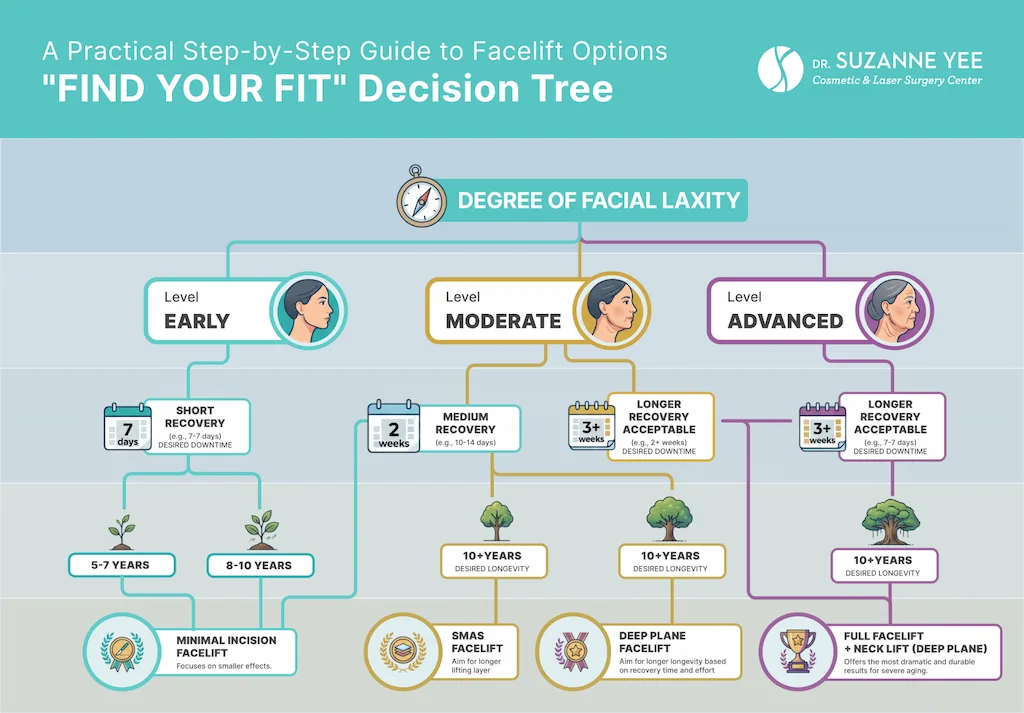
- Several facelift techniques exist, from mini facelifts for early signs of aging to deep plane facelifts that tend to keep you about 10 years ahead of natural aging, and the right one depends on your anatomy and degree of aging.
- The surgery typically takes two to four hours under general anesthesia or sedation, with incisions placed along the hairline and around the ears to keep scarring hidden.
- Most patients return to daily activities within 10 to 14 days, though full results continue developing for up to a year.
- A facelift addresses sagging, jowls, and deep creases but won’t stop future aging or treat surface-level concerns like fine lines and sunspots, which may require complementary treatments.
Who is a good candidate for facelift surgery?
A facelift works best if you’re in good overall health and are bothered by sagging skin, jowls, deep creases, or a loss of jawline definition. If non-surgical treatments haven’t been able to fix what you see in the mirror, surgery may be worth exploring. But candidacy involves more than a visual check.
Researching carefully before making such a personal decision is exactly the right approach. Most people start considering a facelift in their 40s to 60s, when gravity, sun exposure, and natural collagen loss become harder to ignore. There’s no magic number.
Large-scale research indicates that the average facelift patient is around age 59. That said, younger patients between 35 and 55 now account for about 32 percent of procedures, with satisfaction rates above 97 percent among those under 50.
Your health matters just as much as your age. Conditions like uncontrolled diabetes, high blood pressure, bleeding disorders, or autoimmune conditions can raise surgical risks and may need to be managed before moving forward. Smoking is one of the biggest red flags, as nicotine restricts blood flow and slows healing considerably. If you smoke, your surgeon will ask you to quit well before surgery.
Skin elasticity also plays a role. Your skin needs enough natural flexibility to settle smoothly after repositioning. Severe sun damage or very thick skin can limit what a facelift can achieve, which is why an in-person evaluation is the only reliable way to know where you stand.
One thing a facelift cannot do is stop the clock entirely. It resets the visible signs of aging by several years, but the aging process continues afterward. Knowing that upfront helps you set goals that leave you genuinely satisfied.
L C, a patient who made board certification a deciding factor in choosing a cosmetic surgeon, shared:
“I had 2 cosmetic surgery procedures prior to choosing Dr. Yee for my recent surgery. She is Board Certified and many cosmetic surgeons are not, so be careful. I was most impressed with the detailed preparations she required and followed me through prior to the actual surgery. Dr. Yee holds more than a Medical Doctorate and Board Certification in Cosmetic Surgery, she also holds a Doctorate in Pharmacy. This was definitely a benefit to me at pre-surgery and recovery time regarding medication. My recovery was faster than expected with less bruising than expected. I am extremely pleased with the results of her knowledge and skilled hands!”
What types of facelift procedures are available?
Not all facelifts are created equal. The term “facelift” encompasses several distinct surgical techniques, each tailored to different degrees of aging and specific areas of the face. It’s completely normal to feel overwhelmed by the options, and that’s exactly what the consultation is for.
Understanding the differences helps you have a more informed conversation with your surgeon about which approach fits your anatomy and goals.
| Type | Best for | Incision size | Typical longevity |
|---|---|---|---|
| Mini facelift | Early jowling, mild lower-face laxity | Shorter, near ears | 5-7 years |
| SMAS facelift | Moderate mid and lower face aging | Standard, hairline to ears | 5-10 years |
| Deep plane facelift | Advanced aging, mid-face volume loss | Standard to extended | 10-15 years |
| Mid-facelift | Cheek descent, ages 30-40 | Small, within the hairline | Varies |
Traditional and mini facelift
When people think of a “facelift,” they typically imagine one of two methods. The traditional approach is more extensive, whereas the mini version is suitable for those beginning to see early signs of change.
A traditional facelift uses facial lifting techniques to address moderate-to-severe aging in the mid- and lower-face with longer incisions and more extensive tissue work. It’s the right choice when sagging, jowling, and creasing have progressed beyond what minimal intervention can correct.
A mini face lift targets early signs of aging, such as mild jowling and lower-face laxity, using shorter incisions near the ears and enabling a recovery of roughly seven to 10 days. If you’re in your 40s or early 50s and not ready for a full procedure, this may be a comfortable starting point. The trade-off is more modest improvement compared with what deeper techniques can achieve.
SMAS facelift
The SMAS, or superficial musculoaponeurotic system, is a layer of tissue beneath your skin that serves as scaffolding for your face. Think of it as the support structure that holds everything in place. As this layer weakens over time, the visible sagging and jowling that bother you most begin to appear.
A SMAS facelift goes beyond skin tightening alone, repositioning this structural layer through plication (folding and suturing) or dissection (separating and repositioning). A study of 1,000 patients found that SMAS techniques achieved an 87.8% satisfaction rate. This approach suits moderate aging with visible jowling and sagging along the jawline.
Deep plane facelift
A deep plane facelift is the most comprehensive approach available. Rather than working only on the surface layers, this technique addresses the structural foundation of facial aging, which is why it produces some of the longest-lasting results.
The surgeon goes beneath the SMAS layer to release the retaining ligaments and reposition the deeper facial tissues, including the malar fat pads in your cheeks. Results show 94.4% satisfaction, according to a meta-analysis of nearly 2,900 patients.
If you’re experiencing significant midface volume loss, this option tends to produce the most natural-looking results. Here’s what that means for you: the results look like a refreshed version of who you already are, not like a different person.
Mid-facelift and combination procedures
A mid-facelift targets specific concerns in the midface, particularly the cheeks. If you’ve noticed your cheeks starting to flatten or droop while your jawline still looks sharp, this approach addresses exactly that without the scope of a full facelift.
A surgical cheek lift repositions the fat pad over the cheekbone. It’s often recommended if you’re in your 30s or 40s and notice cheek descent but don’t yet have significant sagging of the lower face. Many people also benefit from combining a facelift with neck lift cosmetic surgery to address banding and loose skin under the jawline. Research indicates that about 24% of facelift recipients opt for a concurrent neck lift. An endoscopic brow lift is another common pairing, using a few small incisions to lift a heavy or low brow and refresh the upper third of the face.
Less invasive alternatives
Not everyone is ready for a surgical facelift, and that’s perfectly fine. If you’re exploring your options and want something with less downtime, several alternatives can still deliver noticeable improvement.
Thread lifts and MACS (minimal access cranial suspension) lifts offer shorter procedures and quicker recovery. The trade-off is that results are shorter-lived, typically lasting two to five years, with a higher chance of relapse compared to surgical techniques.
Non-surgical options like Renuvion®, which uses radiofrequency and helium plasma for skin tightening through tiny incisions, may also be worth exploring if you have mild to moderate skin laxity and want to avoid traditional surgery. Understanding what each option offers helps you choose what aligns with your timeline and comfort level.
What happens during the facelift procedure?
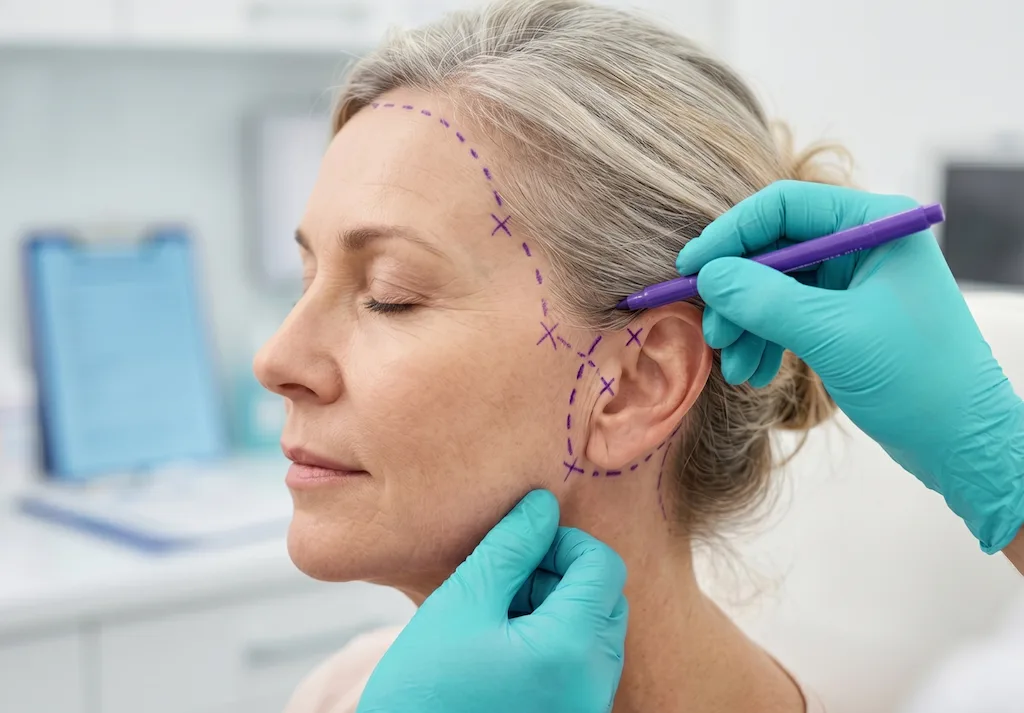
Knowing what to expect on the day of surgery can take a lot of the uncertainty out of the experience. If you’re feeling nervous about what actually happens in the operating room, that’s completely natural. Here’s a step-by-step look at how a facelift typically unfolds.
Anesthesia and comfort
One of the first questions people ask is whether they’ll feel anything during surgery. The short answer: you won’t. Anesthesia is tailored to keep you completely comfortable throughout the procedure.
Most facelifts are performed under general anesthesia, which keeps you fully asleep. Your surgeon and anesthesia team will recommend the safest approach based on the scope of your procedure.
As a National Education Faculty member who trains other physicians, Dr. Yee brings both teaching-level expertise and meticulous technique to every procedure she performs.
Incision placement
Scarring is one of the most common concerns people have, and the good news is that incision placement is specifically designed to keep scars hidden. Your surgeon plans every incision with concealment in mind.
For a traditional facelift, incisions typically begin in the hairline near the temples, curve down and around the front of the ear, continue behind the earlobe, and end in the lower scalp behind the ear. This placement allows the scars to blend naturally into the hairline and the contours of the ear.
A mini facelift uses a shorter version of the same incision path, focused on the area around the ears. If neck work is included, a small incision may also be made beneath the chin.
Lifting and tightening
This step is the heart of the procedure, where the repositioning occurs. It’s what differentiates a natural-looking facelift from one that appears overly performed. After making the incisions, the surgeon carefully separates the skin from the underlying tissue.
The deeper layers, including the SMAS, are then lifted, tightened, and anchored higher. Fat may be sculpted, removed, or redistributed to restore lost volume. Excess skin is redraped over the tightened framework and trimmed. This layered technique ensures a natural result, avoiding the “pulled’ look many fear.
Combining procedures
If you have more than one concern you’d like to address, combining procedures in a single session can save you both time and an additional recovery period. Many people find this approach appealing.
A facelift can be performed alongside other facial procedures in the same session. Common additions include a brow lift, eyelid surgery, or fat grafting to restore volume in the cheeks and temples.
A study of over 11,300 patients found that 57.4% underwent at least one additional procedure alongside their facelift. Blepharoplasty is one of the most popular add-ons for a more balanced facial result.
Scar management
Scarring after a facelift is a valid concern, and the good news is that modern techniques are specifically designed to minimize visible marks. What you do after surgery also plays a meaningful role.
Your surgeon takes several steps to keep scars as discreet as possible. Incisions follow natural creases and the hairline, and closure techniques like layered suturing reduce tension on the skin surface. Over time, most facelift scars fade to thin, barely visible lines.
Following your surgeon’s aftercare instructions, particularly keeping incisions clean and protected from sun exposure, makes a meaningful difference in how scars heal.

How should you prepare for facelift surgery?
Preparation starts well before the day of surgery and involves both medical readiness and practical planning. Taking the time to prepare thoughtfully is one of the best things you can do for yourself. The better you prepare, the smoother your experience and recovery tend to be.
Your consultation
A consultation isn’t a sales pitch. It’s the foundation of the entire process, and it’s a two-way conversation. It’s your opportunity to evaluate your surgeon just as much as it’s their opportunity to evaluate you.
During your visit to the Little Rock AR cosmetic surgery center, Dr. Yee will examine your facial structure, skin quality, and areas of concern in person. She’ll review your medical history, discuss your aesthetic goals, and explain which techniques would work best for your specific anatomy. You’ll also have time to ask any questions, from recovery timelines to what results you can expect.
An in-person assessment is something a screen simply can’t replicate. You’ll also tour the AAAHC-accredited surgical center firsthand, which is where your procedure would take place.
To help make your goals more accessible, the practice offers flexible financing through Cherry, Alphaeon Credit, CareCredit, PatientFi, and Alle, so you can choose a payment plan that fits your budget.
If you’re ready to take the first step, schedule your consultation with Dr. Yee or call (501) 224-1044.
Jamie., a patient who appreciated the welcoming atmosphere throughout her surgical experience, shared her experience:
“Dr. Yee and her staff provided exceptional care, from my initial consult, through the surgery process, recovery, and follow-up appointments. From the moment I walked in, your Surgery center has had such a welcoming and positive vibe. Your staff made me feel comfortable and at ease.”
Medical preparation
Getting your body ready for surgery is about giving yourself the best possible foundation for healing. A few adjustments in the weeks leading up to it can make a meaningful difference in your results.
Your surgeon will ask about your full medical history, including any medications, supplements, and prior surgeries. Blood-thinning medications like aspirin and certain supplements such as vitamin E or fish oil, typically need to be paused two weeks before surgery to reduce bleeding risks.
If you smoke, you’ll need to stop at least four to six weeks before your procedure. Nicotine significantly restricts blood flow and slows healing, which raises the chance of poor outcomes.
Planning your recovery at home
The more you set up in advance, the more you can focus on resting during those first few days. A little planning now pays off when all you want to do is heal comfortably.
Arrange for someone to drive you home and stay with you for at least the first 24 hours. Stock up on soft foods, your surgeon’s prescriptions, and comfortable clothing that doesn’t need to go over your head.
You’ll want to fast for at least eight hours before surgery if general anesthesia is being used. Your surgeon’s team will provide specific instructions tailored to your procedure.
What are the risks and safety concerns of facelift surgery?
Like any surgical procedure, a facelift carries potential risks, though serious complications are uncommon when performed by an experienced, board-certified cosmetic surgeon. Feeling concerned about safety is completely natural, and knowing what to expect can ease some of that worry.
The most common side effects are swelling, bruising, and tightness, all of which are normal parts of healing and resolve within the first couple of weeks. You may also notice temporary numbness around the ears and jawline as sensory nerves settle, which typically improves over several weeks to months.
More serious but rare concerns include a hematoma, a collection of blood beneath the skin that may need to be drained. Research involving over 11,300 facelift patients found an overall hematoma rate of just 1.1%, with a total major complication rate of 1.8%.
So what does that mean for you? The vast majority of people heal without any serious issues.
Infection is possible but rare when aftercare instructions are followed carefully. Temporary or, in rare cases, permanent changes to facial nerve function can occur, though experienced surgeons minimize this through meticulous technique and knowledge of facial anatomy.
Hair loss along incision lines is another concern you might be wondering about. This is typically temporary, and careful placement of incisions within the hairline helps protect hair follicles.
The single most effective step you can take to reduce risk is choosing a surgeon who is board-certified by a recognized certifying board. Look for someone who operates in an accredited facility and has significant experience performing facelifts. Following your surgeon’s pre- and post-operative instructions closely is the second most important factor.
What does facelift recovery look like week by week?
Recovery is where patience pays off. The first days can feel uncomfortable, but each week brings visible improvement. Wanting to know exactly what to expect week by week is one of the smartest things you can do before committing. Here’s what a typical timeline looks like.
The first week
The first week is the most intensive part of recovery, and it’s the stage where most people feel the least like themselves. That’s completely normal and temporary.
Expect swelling, bruising, and a feeling of tightness across your face. Your surgeon will provide pain medication to keep you comfortable, and keeping your head elevated, even while sleeping, helps minimize swelling.
You’ll typically have dressings and any drains removed within the first few days. A follow-up appointment ensures your incisions are healing as expected and gives you a chance to ask any questions that come up.
Weeks two through four
This is when you start to see real progress, and that can feel genuinely exciting after a tough first week. Your reflection in the mirror begins matching your expectations more closely each day.
Bruising fades noticeably during this period, and swelling continues to decrease. Most people feel comfortable returning to work and light daily activities within 10 to 14 days, though you’ll still want to avoid anything strenuous.
Exercise, heavy lifting, and anything that significantly raises your heart rate should wait at least four to six weeks. Bending over and straining can increase swelling and put unnecessary pressure on healing tissues.
Months two through twelve
This is where your results really start to shine, and most people say this phase is when the investment truly feels worth it. Each month brings subtle refinement that adds up to a meaningful difference.
Early improvements are visible around the four- to six-week mark, and you’ll have a good sense of your final result by the six-month mark. It can take up to a full year for all residual swelling to resolve and tissues to fully settle into their new position.
During this time, protecting your skin from sun exposure is important. UV rays can darken scars and affect how evenly your skin heals.
Kelli., a facelift patient who found the full process exceeded her expectations, shared her experience:
“The whole process was amazing from the initial consultation to the follow up appointments. I felt comfortable and truly cared about from all of the staff. Dr. Yee is incredibly skilled and I’m grateful for her expertise. I’m so very pleased with the results and it has changed my life in so many positive ways.”
Conclusion
Modern facelift surgery has evolved from the unnatural, pulled look of earlier times. Today, techniques like deep plane and high-SMAS focus on repositioning the underlying facial structures instead of just tightening the skin. This approach yields a more refreshed appearance that respects each patient’s unique anatomy while maintaining their individual character.
Moreover, a facelift performed by an experienced surgeon provides a durable and natural appearance. Nonetheless, choosing to undergo facial rejuvenation requires careful evaluation of your candidacy, the surgical approach, and recovery expectations. Examining genuine before-and-after photos and booking a comprehensive consultation are crucial steps to assess if a facelift fits your goals.
For those seeking a surgeon who prioritizes enhancement over transformation, Dr. Suzanne Yee provides individualized care at her Little Rock practice. If you’re ready to take the next step, schedule your consultation or call us at (501) 224-1044 to discuss your unique needs in a professional, respectful, and informed setting.
Frequently asked questions
How much does facelift surgery cost?
The cost of a facelift varies based on the technique used, the extent of correction needed, whether additional procedures are performed, and anesthesia and facility fees. Because every plan is personalized, the most accurate way to understand pricing is through a consultation.
Will I have visible scars after a facelift?
Incisions are placed along the hairline and in the natural creases around the ears, making them difficult to spot once healed. With proper care, scars continue to fade over the first year, and most patients find they’re easily concealed by their hair.
Can I combine a facelift with eyelid surgery?
Yes, many patients opt for a facelift alongside blepharoplasty to address drooping eyelids or under-eye bags in the same session. Combining procedures reduces overall downtime and helps achieve a more balanced, cohesive result across the face.
What’s the difference between surgical and nonsurgical facelifts?
A surgical facelift physically repositions the deeper layers of facial tissue, producing results that keep you years ahead of natural aging, depending on the technique. Nonsurgical options such as thread lifts or radiofrequency treatments offer modest improvement with less downtime, but the results are temporary and typically last one to three years.
Do facelifts look natural or pulled?
Modern facelift techniques focus on lifting deeper tissue structures rather than simply pulling the skin tight. This layered approach produces natural-looking results rather than the “windswept” look sometimes associated with older methods. A board-certified cosmetic surgeon with experience in facial anatomy is the best safeguard against an overdone appearance.
Is a facelift painful?
Most people describe the discomfort after surgery as tightness and mild soreness rather than sharp pain. Prescription pain medication keeps you comfortable for the first few days, and most people transition to over-the-counter options within a week. The experience is much more manageable than you might expect going in.
How do I choose a qualified facelift surgeon?
Look for a surgeon who is board-certified by recognized certifying boards such as the American Board of Cosmetic Surgery (ABCS) or the American Board of Facial Plastic and Reconstructive Surgery (ABFPRS). Review their before-and-after gallery to assess the consistency and quality of their outcomes. An in-person consultation lets you evaluate the surgeon’s approach, communication style, and facility firsthand.
Can facelifts fix under-eye bags?
A facelift primarily addresses the mid and lower face, including the jawline, jowls, and neck. Under-eye bags are treated with a separate procedure called blepharoplasty surgery, or eyelid surgery, which can be performed alongside a facelift for comprehensive facial rejuvenation.
Does insurance cover a facelift?
Facelift surgery is considered a cosmetic procedure and is not typically covered by health insurance. Many practices offer financing through providers such as Cherry, Alphaeon Credit, CareCredit, PatientFi, and Alle to help patients access the care they want with flexible monthly payment plans.
At what age is best for a first facelift?
There’s no single ideal age. Most patients consider a facelift in their 40s to 60s, when sagging and deep creases become more pronounced. Younger patients in their late 30s may benefit from a mini facelift to address early jowling. Patients in their 70s and beyond can still see meaningful improvement as long as their overall health supports surgery. Our guide on whether a mini facelift suits younger patients digs into that decision in more depth.
*Disclaimer: This content is for educational purposes only and does not constitute medical advice. A consultation with a qualified board-certified surgeon is required to determine the best treatment plan for your individual needs and any questions you may have about a medical condition or procedure.