
 (501) 224-1044
The earliest sign isn’t always dramatic. A favorite top no longer fits the same way. A bra has to do more work than it used to. Breasts sit lower than they used to, and look less full at the top, even when the actual size hasn’t changed. A breast lift, or mastopexy, is the procedure built for exactly that — restoring shape and position without altering size.
Globally, surgeons performed over 141,000 breast lift procedures in 2024 alone, according to ISAPS. That number reflects a consistent demand from women looking to address sagging caused by pregnancy, weight changes, aging, or genetics. With proper aftercare, results can stay ahead of the natural aging curve for years.
At Dr. Suzanne Yee Cosmetic & Laser Surgery Center in Little Rock, patients considering a breast lift receive guidance from skilled plastic surgeons serving Little Rock, grounded in empathy and experience. Triple board-certified cosmetic surgeon Dr. Suzanne Yee understands that the decision to pursue surgery often starts with a quiet frustration, not a sudden impulse. This article covers who qualifies for a breast lift, the different techniques available, what happens during and after surgery, and how to take the next step when you’re ready.
Key Takeaways
- A breast lift repositions sagging tissue and nipples to restore a firmer, more youthful shape without necessarily changing breast size.
- Four main techniques range from the minimal crescent lift to the comprehensive anchor approach. The degree of sagging determines which one your surgeon recommends.
- Surgery takes roughly one and a half to three hours under general anesthesia as an outpatient procedure. Most patients return to desk work within one to two weeks.
- Scarring is permanent but fades over one to two years. Serious surgical concerns like infection or bleeding occur in fewer than 2% of patients.
- Results stay ahead of the natural aging curve for years when you maintain a stable weight, wear supportive bras, and avoid smoking.
Am I a Good Candidate for a Breast Lift?

Breast sagging, clinically called ptosis, happens to nearly everyone over time. Pregnancy, breastfeeding, weight loss, aging, and even gravity gradually stretch the skin and supportive tissue that hold your breasts in place. A study of 132 women found that age, significant weight loss, higher BMI, larger bra cup size, number of pregnancies, and smoking were all linked to a higher chance of sagging.
Your body usually gives you a few clear signs. Here’s what to look for:
- The “pencil test.” Place a pencil under your breast where it meets your chest (this fold is called the breast crease). If your nipple sits below the pencil when you’re not wearing a bra, your breasts have started to sag.
- Nipples pointing downward. Instead of facing forward, your nipples or the darker skin around them (the areolas) aim toward the floor.
- A flatter, longer shape. Your breasts may look stretched out or deflated rather than round and full.
- Uneven sides. One breast may sit noticeably lower than the other.
- Less fullness up top. The upper part of your breasts looks empty or loose, while the weight settles at the bottom.
If you notice one or more of these changes, it may be a sign that a breast lift could help restore a firmer, more youthful shape.
Not everyone is a good fit for mastopexy right away. Your surgeon may recommend waiting if you’re planning future pregnancies, since the hormonal and volume changes of pregnancy can reverse a lift’s results. Active smokers face higher complication rates, and most guidelines recommend quitting for at least six weeks before surgery. A stable weight also matters, because significant fluctuations can undo the reshaping.
Breast size does not disqualify you. Ptosis occurs across all sizes, though larger breasts are more prone to it due to increased tissue weight. A mastopexy alone may reduce the appearance of volume by roughly one cup size as excess skin is removed.
| Good Candidate | May Need to Wait |
| Breasts sag below the natural crease | Planning future pregnancies |
| Nipples point downward or areolas are enlarged | Currently smoking |
| At a stable, healthy weight | Experiencing significant weight fluctuations |
| In good general health | Untreated breast conditions |
| Finished having children | Under 18 (or under 21 for lift with implants) |
If you’re seeing signs that match the left column, reach out to schedule a consultation and discuss whether a breast lift fits your goals.
What Are the Different Types of Breast Lift Procedures?
Not all breast lifts look the same on the operating table. The technique depends on how much your breasts have sagged, where your nipples sit relative to the crease, how much excess skin needs to go, and what shape you’re hoping to achieve. Your cosmetic surgeon evaluates your anatomy individually and tailors the approach to match your specific degree of ptosis and aesthetic goals.
| Technique | Best For | Incision Pattern | Scarring Level |
| Crescent | Minimal sagging | Half-circle above areola | Least visible |
| Peri-areolar (donut) | Mild sagging | Circle around areola | Minimal |
| Vertical (lollipop) | Moderate sagging | Around areola + vertical line down | Moderate |
| Anchor (inverted T) | Severe sagging | Around areola + vertical + along crease | Most extensive |
Crescent Lift
The crescent lift addresses only minor sagging. Your surgeon makes a small, half-moon incision along the upper edge of the areola, the darker skin around your nipple, and removes a thin crescent of skin to raise the nipple by one to two centimeters. This technique produces the least scarring and is often performed alongside saline and silicone implant options for patients who want both a subtle lift and added volume.
Peri-Areolar (Donut) Lift
For mild ptosis, the donut lift uses a circular incision all the way around the areola. It corrects mild sagging, reduces areola size if needed, and raises the nipple-areolar complex up to two centimeters. The scar follows the natural border of the areola, making it one of the more discreet options.
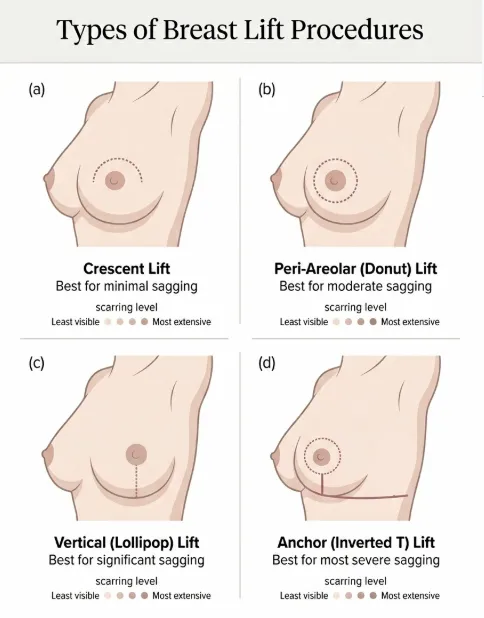
Vertical (Lollipop) Lift
The lollipop technique handles moderate sagging by adding a vertical incision from the bottom of the areola down to the breast crease, the fold where your breast meets your chest. This gives your surgeon more access to reshape the breast tissue and provides long-term stability. A review of 2,235 breasts found that vertical techniques showed less ptosis recurrence over time compared to other approaches.
Anchor (Inverted T) Lift
For significant sagging, the anchor lift adds a horizontal incision along the breast crease beneath the vertical one. This is the most comprehensive option, allowing maximum tissue removal and reshaping. It’s the standard approach for lifting and reshaping sagging breasts, using an anchor-shaped incision running from the bottom of the areola to the base of the breast and along the crease.
Combining a Lift with Other Procedures
A breast lift can be performed alongside augmentation for patients who want both a lift and added volume. A lift alone carries a complication rate around 1.15%, while combining it with implants raises that rate modestly to 1.86%.
If you’re interested in how a lift-only approach compares, our guide to a breast lift without implants for small to medium breasts covers candidacy, techniques, and what to expect.
What Happens During Breast Lift Surgery?
Knowing what the operating room experience involves can take some of the uncertainty out of the decision. The procedure is performed as an outpatient surgery at an AAAHC-accredited private surgical center in Little Rock, which means you arrive and go home the same day. AAAHC accreditation is an independent stamp of approval confirming the facility meets strict safety and quality standards.
Before surgery, your surgeon will order lab tests and a baseline mammogram (a routine breast X-ray taken before surgery to establish a reference point, so any future changes can be compared against it), review your medications, and ask you to stop smoking and taking anti-inflammatory medications like aspirin at least six weeks in advance. You’ll also need to arrange for someone to drive you home and help you during the first day or two of recovery.
On the day of surgery, you’ll receive general anesthesia so you’re comfortable and won’t feel anything. The procedure typically takes one and a half to three hours depending on the technique and complexity.
Your surgeon lifts the underlying breast tissue and reshapes it, repositions the nipple-areolar complex higher on the breast, and removes excess skin. Incisions are closed with layered sutures, skin adhesives, or surgical tape. Liposuction, a body reshaping surgery for problem areas, may also be used to fine-tune the surrounding contours.
Once the incisions are closed, your breasts are wrapped in gauze and a surgical support bra. You’ll spend a short time in recovery before heading home with detailed aftercare instructions.

What Is Breast Lift Recovery Really Like?

Recovery is one of the biggest question marks for patients considering any surgery. Here’s what the research and patient experience show for mastopexy.
Pain and Discomfort
Most patients describe the discomfort as moderate and manageable. A study of 106 vertical mastopexy patients reported an average pain rating of 4.5 out of 10, with soreness and tightness resolving within about two weeks. Prescription pain medication handles the first few days, and most patients transition to over-the-counter options fairly quickly.
Getting Back to Your Routine
Plan to rest at home for about a week, avoiding any bending or straining of the chest. Light activities and desk work are usually possible within one to two weeks. Strenuous exercise, heavy lifting over 10 pounds, and upper body workouts are off-limits for at least six weeks to give your tissues time to heal properly.
| Timeline | What to Expect |
| Days 1–3 | Surgical bra 24/7, rest at home, prescription pain medication |
| Week 1 | Gentle walking, light daily tasks, swelling and bruising visible |
| Weeks 2–3 | Return to desk work, transition to soft support bra |
| Weeks 4–6 | Begin light exercise, sports bra without underwire |
| 6–8 weeks | Resume regular bra use and full physical activity |
| 6–12 months | Final results visible, scars continue to fade |
Support Garments
You’ll wear a surgical support bra around the clock for the first three to four days, then switch to a soft support bra for three to four weeks. Sports bras without underwire work well during weeks four through six. Your surgeon will let you know when it’s safe to return to your regular bras based on how your healing progresses.
Scar Care
Scars are part of any surgical procedure, and they follow the incision pattern used during your lift. They’ll start out red and raised, then gradually soften and fade to a thin white line over one to two years. Silicone gel or tape and consistent sun protection can help scars heal more smoothly. At Dr. Suzanne Yee Cosmetic & Laser Surgery Center, patients are typically guided toward Silagen, a medical-grade silicone scar treatment, to support this process.
Jamie, a patient at Dr. Suzanne Yee Cosmetic & Laser Surgery Center, shared:
“Dr. Yee and her staff provided exceptional care, from my initial consult, through the surgery process, recovery, and follow-up appointments. From the moment I walked in, your Surgery center has had such a welcoming and positive vibe. Your staff made me feel comfortable and at ease.”
If you’re curious about what breast lift results look like in practice, browse the photo gallery to see real patient outcomes.
What Are the Risks and Potential Complications of Mastopexy?
Like any surgical procedure, a breast lift carries potential concerns worth understanding before making your decision. The good news is that serious issues are genuinely uncommon. A large analysis of over 73,000 cosmetic breast procedures found that major concerns in mastopexy alone, including hematoma (pooling of blood under the skin), infection, and blood clots, occurred in just 1.2% of cases. Pooled data across multiple studies show that infection, bleeding, and fluid collection each stay below 2% individually.
Scarring is permanent but manageable, and its visibility depends on the technique used. Periareolar scars (those that follow the natural border of the darker skin around the nipple) tend to blend in well, while anchor incisions are more noticeable at first but typically fade significantly over time. Your surgeon may recommend silicone scar products and sun protection to support optimal healing.
Changes in nipple sensation are possible. A survey of mastopexy patients found that about 2.9% experienced persistent nipple-areolar issues. For most patients, any temporary numbness resolves as nerves settle during healing.
Mild asymmetry can occur in a small number of cases, with published data showing tissue-related unevenness in roughly 2.9% of patients. If significant asymmetry develops, a minor revision can often correct it.
Breastfeeding ability may be affected depending on whether milk ducts or nerves are involved in the surgery. If you’re planning to have children and breastfeed in the future, your surgeon can discuss which techniques are most likely to preserve that function.
Smoking has a measurable impact on surgical outcomes and significantly increases the odds of wound-healing complications. Quitting at least six weeks before and after surgery is one of the most effective steps you can take to lower your personal risk
What Results Can You Expect and How Long Do They Last?
The initial results of a breast lift become visible shortly after surgery, and while swelling and shape continue to improve over the first several months, the long‑term appearance, including how incisions heal and scars fade, generally becomes more apparent around three to six months as healing progresses, with continued improvement over the rest of the year.
Most breast lift results hold up for years, though the exact timeline varies from patient to patient. How long your results hold up depends on a few key factors: the technique your surgeon uses, your skin’s natural elasticity, your age at the time of surgery, and how well you care for your results afterward. It’s important to understand that your breasts will continue to age after surgery — gravity doesn’t stop, and skin elasticity naturally decreases over time. The difference is that you’re aging from a significantly improved starting point, so even years later, your breasts will still look lifted and more youthful than they would have without the procedure.
One of the biggest factors within your control is weight stability. Significant fluctuations of more than 10 to 20 pounds can stretch the skin and reverse a portion of the lift within just one to two years. Maintaining a steady weight, along with wearing a supportive bra and protecting your skin from sun damage, helps preserve your results for as long as possible.
Before-and-after photos offer a helpful reference point for setting expectations. The most useful comparisons come from patients with a similar body type and degree of sagging. You can view real patient results in the breast lift gallery, which includes multiple cases showing outcomes from different techniques.
Kelli, a Dr. Suzanne Yee Cosmetic & Laser Surgery Center patient who valued the care throughout her experience, shared their experience:
“The whole process was amazing from the initial consultation to the follow up appointments. I felt comfortable and truly cared about from all of the staff. Dr. Yee is incredibly skilled and I’m grateful for her expertise. I’m so very pleased with the results and it has changed my life in so many positive ways.”
What Should You Expect During a Breast Lift Consultation?
This isn’t just a chance for your surgeon to evaluate you. It’s equally your chance to evaluate her, the facility, and the team.
During an in-person consultation at the Little Rock office, your surgeon assesses your breast anatomy, skin quality, and overall health as they relate to the procedure. She reviews your medical history and discusses your aesthetic goals in an open, no-pressure conversation guided by a philosophy of enhancement, not dramatic change.
From there, she explains the available techniques based on your anatomy and creates a personalized treatment plan covering the recommended approach, expected outcomes, and recovery timeline. No question is off the table, and there’s no expectation to commit during the visit.
The consultation takes place at the AAAHC-accredited private surgical center, so you can see the facility where your procedure would be performed during the same visit. That hands-on, face-to-face assessment is something a screen simply can’t replicate.
To help make your goals more accessible, the practice offers financing through Cherry, Alphaeon Credit, CareCredit, PatientFi, and Alle, so you can choose a payment plan that fits your budget. Breast lifts are not covered by insurance, but financing allows many patients to move forward on a timeline that works for them.
If you’re ready to start the conversation, schedule your consultation or call (501) 224-1044.
Conclusion
Your breasts have carried you through pregnancies, weight changes, and years of gravity’s effects. A breast lift doesn’t erase your history, it restores a shape that feels naturally yours again: firmer, lifted, and in harmony with the body you live in today.
Whether addressing sagging from pregnancy, weight shifts, aging, or genetics, the procedure is tailored to your unique anatomy, from subtle refinements to comprehensive reshaping. The results speak for themselves, with patients consistently reporting high satisfaction and natural‑looking outcomes.
At Dr. Suzanne Yee in Little Rock, the focus isn’t on dramatic change. It’s a thoughtful enhancement that looks and feels authentic because it’s designed specifically for you. Every consultation begins with listening, and every plan is built around your goals.
Take the first step toward your refreshed shape. Request your personal consultation or call (501) 224-1044 today.
Frequently Asked Questions
Does a breast lift change breast size?
A breast lift reshapes and repositions existing tissue without adding or removing significant volume. Your breasts may appear slightly smaller because excess skin is removed, or slightly fuller because the tissue is lifted into a more projected position. If you want a noticeable size change, augmentation or reduction can be combined with the lift.
Can I breastfeed after a breast lift?
Many women breastfeed successfully after mastopexy. The likelihood depends on the technique used and whether milk ducts or nerves were affected during surgery. If breastfeeding is a priority, discussing this with your surgeon before choosing a technique helps preserve that function as much as possible.
How much does a breast lift cost?
Breast lift cost depends on the technique, anesthesia, facility fees, and whether other procedures are combined. Since every patient’s plan is different, the most accurate way to understand pricing is through a consultation. The practice offers financing through Cherry, Alphaeon Credit, CareCredit, PatientFi, and Alle to help make the investment more manageable.
What is the recovery time for breast lift surgery?
Most patients return to desk work within one to two weeks and resume full physical activity by six weeks. The initial soreness and tightness typically resolve within the first two weeks, and final results become visible over six to twelve months as swelling resolves and scars mature.
Will I have visible scars after mastopexy?
Scars are permanent, but they fade significantly. They start out red and raised, then flatten to a thin white line over one to two years. The visibility depends on your incision type and how well you care for the scars with silicone products and sun protection. Most scars are easily concealed by bras or swimwear.
Can I combine a breast lift with implants?
Yes. Augmentation mastopexy, combining a lift with implants, is a common procedure for patients who want both a lift and added volume. Complication rates are slightly higher than with a lift alone, so your surgeon will evaluate whether a single-stage or two-stage approach makes more sense for your situation.
Is breast lift surgery painful?
Discomfort after a breast lift is moderate, with published data showing average pain ratings around 4.5 out of 10. Prescription medication manages the first few days, and most patients transition to over-the-counter relief quickly. Tightness and soreness improve noticeably during the second week.
When can I wear a regular bra again?
A surgical support bra is worn for the first three to four days, followed by a soft support bra for several weeks. Regular underwire bras can typically be worn again after six to eight weeks, once the tissues have healed enough to handle the structure without irritation.
How do I choose the right cosmetic surgeon for a breast lift?
Look for a surgeon who is board-certified by a recognized certifying board and has specific experience with breast procedures. Reviewing before-and-after photos of patients with similar anatomy is one of the best ways to evaluate a surgeon’s skill. Scheduling an in-person consultation lets you assess whether the approach and communication style fit your goals.
Will insurance cover a breast lift?
Breast lifts are classified as cosmetic procedures and are not covered by most insurance plans. If sagging causes documented medical issues like chronic skin irritation or back pain, some insurers may cover a portion, though this is uncommon. Financing through Cherry, Alphaeon Credit, CareCredit, PatientFi, and Alle can help bridge the gap.
*Disclaimer: This content is for educational purposes only and does not constitute medical advice. A consultation with a qualified board-certified surgeon is required to determine the best treatment plan for your individual needs and any questions you may have about a medical condition or procedure.




 Instagram
 Facebook
 Tiktok
 Youtube
 X
X LinkedIn