
 (501) 224-1044
You finally did the thing you’d been thinking about for years, the thing that gave your shoulders relief, let you breathe a little deeper, and made getting dressed in the morning feel simple again. And then the bandages came off. Instead of the celebration you’d imagined, you found yourself standing in the mirror, studying a few pink lines, and quietly wondering: will they always look like this?
That gap, between the relief you already feel and the marks you’re not sure about yet, is where a lot of breast reduction patients land. It doesn’t mean something went wrong. It means you’re in the middle of the process, not at the end of it. And here’s the part worth holding onto: scars are one of the most manageable parts of this whole journey. How they end up looking depends a great deal on what happens in the months ahead, and most of that is in your hands.
In one scar-treatment study reported in the ISAPS newsletter, 86 percent of patients said silicone gel visibly faded their scars within about four months. That kind of result is the rule, not the exception, when scars are cared for well.
At Dr. Suzanne Yee Cosmetic & Laser Surgery Center in Little Rock, among the top plastic surgeons in the Little Rock area, we walk patients through scar care as carefully as the surgery itself. This article covers the scar each technique leaves and how scars change month by month. You’ll also see what helps at home, the options for stubborn scars, how to lower keloid risk, and what shapes your final result.
Key takeaways
Here’s the short version of how breast reduction scars work and what helps, so you can dig into the sections that matter most to you.
- The scar pattern you get (anchor, lollipop, donut, or nearly scarless liposuction) is matched to your anatomy and how much tissue is removed, not chosen from a menu.
- Scars heal in phases and tend to look their worst between one and three months before flattening and fading, with full maturation taking 12 to 24 months.
- Silicone sheets or gel are the most evidence-backed at-home treatment, sun protection for the first year is non-negotiable, and vitamin E oil has little proven benefit.
- Stubborn raised scars respond to in-office options, including laser therapy, steroid injections (sometimes combined with 5-FU), and, as a last resort, surgical revision.
- Your surgeon’s technique and how little tension sits on the incision is the biggest controllable factor, while skin tone and genetics influence keloid risk and make early prevention important.
What types of scars does breast reduction surgery leave?
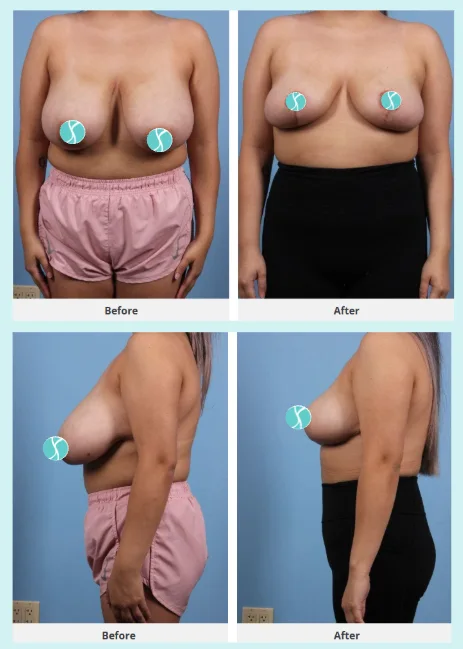
The scar you end up with depends on the surgical technique. The technique, in turn, depends on how much tissue needs to come out and how much lift your breasts need. There are three main incision patterns, plus a nearly scarless option for the right candidate.
It helps to picture where each one sits, since the pattern is matched to your anatomy, not picked off a menu.
| Scar pattern | Incisions | Best suited for | Visibility |
|---|---|---|---|
| Anchor (inverted-T) | Around the areola, down to the crease, along the fold | Larger reductions, significant sagging | Most extensive, but the fold scar hides under a bra |
| Lollipop (vertical) | Around the areola and down to the crease | Moderate reductions | Less scarring, no horizontal line |
| Periareolar (donut) | A single circle around the areola | Small reductions with a subtle lift | Least visible, hides at the areola border |
| Liposuction-only | Tiny cannula openings, often under the arm | Mostly fatty tissue, good skin elasticity | Nearly scarless |
Anchor (inverted-T) scar
The anchor pattern uses three connected incisions that form an upside-down T. It’s the most common choice for larger reductions because it gives your surgeon the most access to reshape the breast. The horizontal portion runs along the crease beneath the breast, where it stays tucked out of sight.
It looks like the scariest on paper, and that can feel intimidating. A matched cohort study found anchor and vertical techniques had comparable complication rates over three years, so a longer scar does not mean a riskier surgery.
Lollipop (vertical) scar
The lollipop technique skips the horizontal fold incision. That leaves one line around the areola and one running down to the crease. It’s the preferred approach for moderate reductions, and it leaves noticeably less scarring than the anchor.
Periareolar (donut) scar
This pattern uses a single circular incision around the edge of the areola. It produces the least visible scar of the three, because the line sits right at the natural color change of the areolar border. It’s reserved for smaller reductions with a gentle lift.
Liposuction-only reduction
For patients whose breasts are mostly fatty tissue with good skin elasticity, a liposuction-only reduction can avoid the visible incision patterns altogether, working through tiny, easy-to-hide openings.
This is the route Dr. Yee prefers when a patient is a good fit, using the tumescent liposuction method for reducing breast volume for a more comfortable fit with minimal scarring. When breasts are mostly glandular tissue, a traditional reduction with well-hidden incisions is the better call.
So you can’t simply order the scar you want, but you can choose a surgeon who places incisions thoughtfully. If you’re weighing which approach suits you, schedule a consultation to talk it through in person.
How do breast reduction scars change and heal over time?
If your scars look worse a month after surgery than they did the week you went home, you have not done anything wrong. Scars heal in predictable phases, and the middle of that process worries people most.
Your body moves through three overlapping stages. A brief inflammatory phase, a months-long phase where it floods the wound with collagen, and a long remodeling phase where that collagen softens.
| Timeframe | What you’ll likely see | What’s happening underneath |
|---|---|---|
| First 2 to 6 weeks | Red to purple, slightly raised lines | Skin has sealed; early healing |
| 1 to 3 months | Firmer, darker, sometimes itchy and raised | Collagen is being deposited |
| 3 to 12 months | Softening, flattening, redness fading to pink | Collagen remodeling |
| 1 year and beyond | Paler, thinner, silvery lines that blend in | Final remodeling and maturation |
That harder, redder, itchier window between one and three months is the proliferative phase. It’s a sign your body is working, not failing. Red, raised, and itchy scars are normal early features. Most scars keep fading for 12 to 24 months. Knowing the timeline takes the panic out of month two, which makes it far easier to stay consistent with the care that actually helps.
What can I do at home to minimize my breast reduction scars?
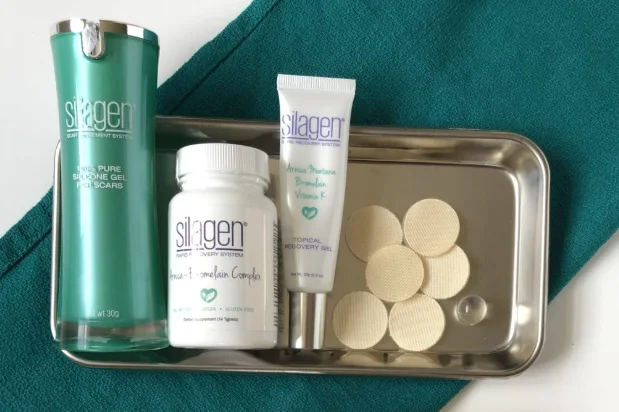
Here’s the good news. The most effective scar care is simple, inexpensive, and in your hands once your incisions have closed. Most patients are back to non-strenuous work within a day or two, and to normal activities within about two weeks.
The catch is consistency, so think of these as small daily habits over the first several months, not a one-time fix.
Silicone sheets, gels, and tape
Silicone is the gold standard, and the one step worth prioritizing if you only do a few. A meta-analysis of six trials found that topical silicone significantly reduced scar height, color, and pliability, with the biggest gains after six or more months.
Sheets and gels work about equally well, so pick whichever you’ll stick with. Silicone tape is convenient for the breast and adds gentle support. Start once your surgeon confirms your incisions are fully closed, usually a few weeks in.
Scar massage
Once your incisions have healed and your surgeon clears you, usually around three to four weeks, gentle massage helps keep scar tissue soft and flat. Firm circular motions with a plain moisturizer for a few minutes a day are enough. If anything feels tender, ease off and check in.
Sun protection
This one is non-negotiable for at least the first year. Healing scars have little defense against UV light, and sun exposure can darken them permanently. Keep new scars covered, or under a broad-spectrum SPF 50 or higher whenever they might see daylight.
Your surgical bra
Wearing the surgical or compression bra your surgeon recommends does more than make you feel secure. Steady support takes tension off the healing incisions, which helps scars stay flat, and it eases early discomfort. Your surgeon will tell you how long to keep it on.
Topicals, vitamin E, and lifestyle
It’s tempting to reach for vitamin E oil, since everyone seems to recommend it. The evidence does not back it as a scar treatment, and it can irritate the skin. Save your effort for silicone instead.
Your daily habits matter too. Staying hydrated, eating enough protein, and not smoking all help your body build healthy collagen. If you smoke, this is the time to step away from that habit, ideally six weeks before and after surgery.
Cindy, a breast reduction patient who felt supported from consultation through recovery, shared her experience:
“From consultation to recovery for breast reduction surgery, they have surpassed all my expectations. Dr. Suzanne Yee provided me with expert surgical care that was patient focused, thorough and thoughtful. I’m very pleased with my new size and shape.”
Stick with these habits, and most scars fade beautifully on their own. For the smaller number that stay stubborn, there are professional options worth knowing.
What professional treatments are available for stubborn or raised scars?
Sometimes a scar stays raised, red, or thicker than you’d like despite doing everything right, which can feel discouraging. The reassuring news is that scars like these are common enough to have a whole toolkit of in-office treatments.
Your surgeon matches the treatment to the type of scar, how long you’ve had it, and your skin. The approach often starts conservatively and steps up only if needed.
Laser therapy
Lasers can soften both the color and the texture of a raised scar by targeting redness and stimulating fresh collagen underneath. Pulsed dye and fractional lasers show meaningful improvement across clinical studies, with results building over several months.
At Dr. Yee’s Little Rock practice, in-office laser scar therapy can reduce visible scarring with laser technology, using the Aerolase Neo or IPL for raised, reddened scars. It can be used safely on all skin tones, including very light and very dark skin. Most patients need a short series of sessions with little downtime.
Steroid injections
For scars that are thick and raised, corticosteroid injections calm the overactive tissue and flatten the scar over a few sessions. When a scar is especially stubborn, your surgeon may combine the steroid with a medication called 5-FU. A meta-analysis found that pairing is noticeably more effective than steroids alone.
Surgical scar revision
When injections and other measures haven’t done the job, surgically revising the scar is an option. It’s rarely a standalone fix for keloids, since cutting one out on its own brings a high chance of it returning. Revision is usually paired with steroids or other follow-up and reserved for scars that resist everything else.
Curious what realistic results look like? Browse real patients’ before-and-after results to see how breast reduction scars settle over time.
How can I prevent keloid or hypertrophic scarring after breast reduction?
If you’ve had a thick, raised scar before, or it runs in your family, it makes sense to worry about it happening again. The encouraging part is that prevention starts well before a problem scar forms, and much of it is in your control.
A keloid is a scar that grows beyond the original wound. A hypertrophic scar stays raised but within the wound’s borders. Knowing your risk and acting early is the heart of prevention.
Who’s at higher risk
Some people are simply more prone to thick scarring, and that’s worth knowing honestly rather than fearing. Hypertrophic scarring is the most common scar concern after reduction, affecting about 9 percent of patients in one review.
Keloids are more common in people with darker skin tones and a family history. Higher incision tension and slower-healing wounds raise the odds too.
Early warning signs to watch for
In the first one to three months, keep a casual eye out for any spot that becomes increasingly red, thick, firm, or stubbornly itchy beyond normal healing. Catching an overactive scar early, while it’s still forming, makes it far easier to treat than waiting.
Starting prevention early
Good prevention is layered. Tension-reducing surgical technique lays the foundation, and silicone, plus early injections when appropriate, does the rest. A Cochrane review found silicone gel sheeting lowered abnormal scarring in high-risk people, which is exactly why starting silicone early matters most if you’re prone to keloids.
Keloid or hypertrophic: why the difference matters
The two scars call for different game plans. Hypertrophic scars often calm down on their own and respond well to silicone or steroids. Keloids don’t regress on their own and tend to return if simply cut out, so they need a combined approach from the start. Either way, telling your surgeon early gives you the most options.
What factors beyond aftercare affect how my breast reduction scars will look?
You can do everything right at home and still wonder why some people heal with a faint line, and others don’t. Several factors outside your daily routine shape the result, and the biggest one is decided before you ever pick up a tube of silicone.
Your surgeon’s technique and incision tension
How your surgeon places and closes incisions is the single most controllable factor in how your scars turn out. When closures carry too much tension on the surface, scars tend to widen and thicken. Deep, layered suturing that offloads that tension produces finer, flatter lines. A meta-analysis comparing patterns even found differences in healing complications depending on the technique used.
This is where experience earns its keep. With over 35 years in cosmetic surgery, Dr. Yee plans incisions to sit in naturally hidden places and closes them to keep tension off the skin. Choosing a skilled, board-certified cosmetic surgeon is the most powerful scar-prevention decision you’ll make.
Monique, a breast reduction patient who chose her practice carefully, shared her experience:
“I got breast reduction surgery along with an under arm lipo. From start to finish Dr Yee and her staff were very welcoming. I am extremely pleased with the results of the surgery. My back and neck already feel so much better, 3 weeks post op. I highly recommend Dr. Yee!”
Your skin tone and genetics
Your biology has a say, too. Darker skin tones carry a higher chance of hyperpigmentation and keloids. A 2025 study identified 26 genetic regions linked to keloid risk, confirming that how you scar is partly inherited. None of this is your fault, and all of it can be planned around with the right surgeon.
Tissue removed, health, and age
Larger reductions involve longer incisions, and overall health plays a role, since diabetes and smoking slow healing. An in-person consultation is where these personal factors get weighed, and where you get to evaluate whether the surgeon is the right fit for you, not just the other way around.
To make your goals more accessible, view flexible financing options through Cherry, Alphaeon Credit, CareCredit, PatientFi, and Allē, so cost doesn’t stand between you and a result you feel good about.
Conclusion
You came here looking at a few pink lines and wondering whether they’d define your result. Now you know they’re a temporary chapter, not the ending. Consistent silicone, sun protection, patience through the proliferative phase, and the occasional professional treatment carry most scars to soft, faint lines.
Looking at real patient before-and-after photos is one of the most grounding things you can do next. When you’re ready for specifics, a personal conversation fills in what photos can’t. If you’re still deciding whether surgery is the right path, our look at whether non-surgical breast reduction actually works can help you weigh the alternatives.
Every patient deserves to feel heard, respected, and confident in their choices. That’s the philosophy behind Dr. Suzanne Yee’s Little Rock practice, where the goal is always enhancement and genuine care, not a dramatic makeover. Schedule your personal consultation or call (501) 224-1044 to talk through your scar care and your goals.
Frequently asked questions
Do breast reduction scars ever go away completely?
Not entirely, since any incision through the skin leaves a permanent mark. The realistic goal is to make scars fade until they’re soft, flat, and pale enough to blend in. With good care, most reduction scars become hard to notice.
How long does it take for breast reduction scars to fade?
Most scars take 12 to 18 months to fade significantly, with subtle improvement continuing up to two years. The redness usually settles first, followed by flattening and lightening, and the middle months can look worse before they look better.
How soon after surgery can I start using silicone sheets or gel?
Silicone is typically started a few weeks after surgery, once your incisions are fully closed and your surgeon gives the go-ahead. Starting too early on an open incision can do more harm than good. Your surgeon will confirm the right timing for you.
When is it safe to start massaging my breast reduction scars?
Scar massage usually begins around three to four weeks after surgery, once incisions are healed and you’ve been cleared. Gentle, firm circular motions with a plain moisturizer are all you need. If anything feels tender or looks irritated, hold off and check with your surgeon.
What is the difference between a hypertrophic scar and a keloid?
A hypertrophic scar is raised but stays within the boundaries of the original incision, and it often improves over time. A keloid grows beyond the wound’s borders and doesn’t tend to regress on its own. Keloids usually need a combined treatment approach, so flag any spreading scar to your surgeon early.
Can I get a tattoo to cover up my breast reduction scars?
Yes, but only after the scar is fully mature, which usually means waiting at least a year. Tattooing an immature scar can interfere with healing and won’t take ink evenly, so ask your surgeon to confirm your scar is ready first.
What do I do if my scar is getting thick and itchy?
A scar that’s becoming increasingly thick, raised, and itchy may be turning hypertrophic, so it’s worth seeing your surgeon promptly. Caught early, these scars respond well to silicone, steroid injections, or in-office laser treatment.
*Disclaimer: This content is for educational purposes only and does not constitute medical advice. A consultation with a qualified board-certified surgeon is required to determine the best treatment plan for your individual needs.




 Instagram
 Facebook
 Tiktok
 Youtube
 X
X LinkedIn