Instagram
 Facebook
 Tiktok
 Youtube
 X
 LinkedIn

 (501) 224-1044

You’ve made a significant decision with your breast augmentation. But what you might not realize is that there’s an important choice behind the scenes that quietly influences your final outcome. The main decision is between saline and silicone implants, with the popular “gummy bear” implant falling within the silicone category as a highly cohesive gel option.
That might be overwhelming to consider, and most online research either pushes you toward a single choice or hides the differences in jargon. The key point is: the best implant isn’t necessarily the most popular one, but it’s the one that matches your anatomy, your goals, and how you want to feel in your own skin years from now.
Breast augmentation was the third most popular surgical procedure worldwide in 2024. That said, many people are going through the same questions.
At Dr. Suzanne Yee Cosmetic & Laser Surgery Center in Little Rock, a practice focused on cosmetic plastic surgery, these questions come up every single day. This article covers saline implants and the silicone family (including gummy bear cohesive gel). You’ll get a side-by-side comparison, shape and texture choices, and a clear path from research to consultation.
Key takeaways
A brief summary of the topics covered in this article:
- Saline implants are filled with sterile saltwater after the shell is placed, allowing a smaller incision and immediate detection of rupture. Still, they may feel firmer and show more visible rippling.
- Silicone implants are pre-filled with cohesive gel and typically feel closer to natural breast tissue, with a softer drape and less rippling than saline implants.
- Gummy bear implants are a type of silicone implant, specifically a highly cohesive, form-stable gel that retains its shape under pressure and has the lowest rippling rate.
- All FDA-regulated breast implants have age requirements that vary by fill type: 18+ for saline and 22+ for silicone (including gummy bear cohesive gel).
- Implants aren’t lifetime devices; most last 10-15 years or longer, and follow-up imaging helps detect silent ruptures in cohesive gel implants over time.
- Your journey begins with understanding your unique body and goals, making an in-person consultation more meaningful than any online comparison.
What are saline breast implants?

Saline implants are the original modern breast implant and remain a strong choice for many patients seeking body contouring and chest enhancement. The shell is silicone, and the inside is filled with sterile saltwater after your surgeon places the empty shell.
What’s inside
The fill consists of sterile saline, similar to IV fluids. As the implant is filled during surgery, your surgeon can adjust the volume on the procedure day. The FDA approves saline implants for cosmetic enhancement for individuals aged 18 and above.
Pros: smaller incision and easy rupture detection
Inserted empty and filled in place, saline implants require a smaller incision than pre-filled silicone implants. That often means less visible scarring. Another benefit is rupture detection. When a saline implant fails, the shell deflates within minutes or hours, and the saline is safely absorbed.
Cons: feel and rippling
Saline implants tend to feel firmer than silicone, resembling a water balloon more than natural tissue. This difference is especially noticeable in patients with limited existing tissue coverage. Rippling is another consideration: in some positions, saline can shift and create visible ridges, particularly in individuals with minimal tissue padding. To increase accessibility for any implant type, your surgeon’s office can assist you in exploring flexible financing options through Cherry, Alphaeon Credit, CareCredit, PatientFi, and Allē.
What are silicone breast implants, including gummy bear?
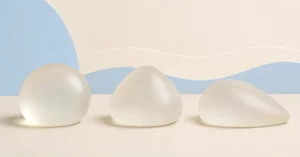
If saline feels like a water balloon, silicone is the softer cousin. Silicone implants are pre-filled with a cohesive gel that mimics the natural give of breast tissue. This category includes the popular “gummy bear” variant, which is simply silicone with a thicker, more cross-linked gel inside the same shell.
What’s inside
The shell is made of silicone, similar to saline. The main difference lies in the fill: a viscous silicone gel with different levels of cohesivity, which describes how tightly the gel molecules stick together. Modern silicone gel implants are approved by the FDA for cosmetic augmentation in individuals aged 22 and above.
Traditional cohesive gel vs gummy bear (highly cohesive gel)
All silicone implants use cohesive gel, though the degree of cohesivity varies. Traditional silicone uses a softer, more flowable gel that mimics the natural give of breast tissue. The “gummy bear” variant uses a thicker, highly cross-linked cohesive gel that retains its shape under pressure, even if the shell is compromised. Cut a gummy bear in half, and the gel holds together like soft, dense candy.
Triple board-certified cosmetic surgeon Dr. Suzanne Yee has over 35 years of experience with breast implant technology. During consultations, she personally explains the feel of different gel types, using hands-on comparisons that often clarify the choice more effectively than words.
A more natural feel and drape
Silicone implants sit higher in the chest and are typically undetectable to the touch in patients with adequate tissue coverage. The drape, the way the implant settles, also tends to look more natural in clothing and in motion. Rippling is less common with silicone than with saline, and the gummy bear variant has the lowest rippling rate of any silicone option.
Rupture detection and monitoring
Silicone implants do not deflate like saline ones. If the shell breaks, the cohesive gel usually remains in place, though it might gradually migrate. The form-stable gummy bear gel is least likely to move after a rupture because it maintains its shape inside the pocket. This is why the FDA advises MRI or ultrasound screening for “silent” ruptures beginning about five to six years post-surgery and then every two to three years.
Does this sound like a lot? It’s mainly a peace-of-mind check rather than an emergency protocol. Most ruptures are silent and handled during a scheduled visit.
How do saline and silicone implants compare side by side?
After reviewing each type individually, it’s useful to compare them in a single view. Here’s a comparison of the two main implant categories based on the factors patients inquire about most. The highlighted gummy bear cohesive gel in the silicone column indicates where its behavior varies.
| Factor | Saline | Silicone (including gummy bear) |
|---|---|---|
| Fill material | Sterile saltwater | Cohesive silicone gel (traditional or highly cohesive “gummy bear”) |
| Feel | Firmer, water-balloon | Soft, close to natural tissue (gummy bear slightly firmer with more shape retention) |
| Rippling risk | Higher | Lower (lowest with gummy bear) |
| Incision size | Smallest (filled in place) | Slightly larger (pre-filled) |
| Rupture detection | Immediate (deflation) | Silent, via MRI/ultrasound |
| FDA age minimum | 18+ | 22+ |
A few things jump out. Saline wins on incision size and easy rupture detection. Silicone wins on feel and rippling for patients with thinner coverage, with gummy bear cohesive gel taking the lowest rippling risk and best shape retention.
At Dr. Yee’s Little Rock practice, we understand that the cost includes more than just the implant. Your quote covers the surgeon’s fee, anesthesia, facility charges, and follow-up visits, all bundled into a clear, single total. The only additional costs you’d need to worry about are pre-op labs and any medications your doctor prescribes.
Lisa, who had her breast augmentation at the Little Rock office, described how the choice unfolded:
“I had breast augmentation surgery with Dr Yee in January 2019. She made the entire process very easy, informative, and comfortable. She answered every question honestly and made sure I understood at every step along the way. She explained everything about the procedure and recovery in detail.”
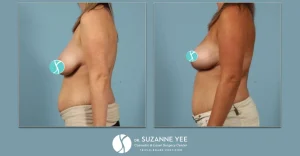
Comparison tables are helpful, but they can’t replace the experience of holding two different implants and feeling how each one fits on your body. Want to see how the differences truly look on an actual person? Looking at real patient before-and-after photos sorted by procedure type is one of the most valuable steps you can take in your research.
What implant shapes and textures should you consider?

Beyond fill material, every implant has a shape and a surface. Both shape how your result looks and ages, and both are decided during your consultation.
Round vs. teardrop shape
Round implants are symmetrical: full at the top and at the bottom. They give a fuller upper-pole look and remain popular because rotation doesn’t change their appearance. Teardrop, or anatomical, implants are shaped to mimic the natural slope of breast tissue, with less fullness at the top and more at the bottom. They can deliver a more natural contour but must remain correctly oriented.
Smooth vs. textured surface
Smooth implants are the standard, with a uniformly smooth shell that rotates freely. Textured implants have a roughened surface designed to “grip” surrounding tissue, originally used to keep anatomical implants oriented.
However, textured implants have been linked to a rare type of cancer called BIA-ALCL, a non-Hodgkin lymphoma of the immune system, and certain designs were recalled by the FDA.
The practical takeaway: many cosmetic surgeons today no longer use textured implants for routine augmentation. Smooth implants, paired with careful surgical technique, handle most cosmetic goals just as well.
Profile: low, moderate, or high
Profile describes how far the implant projects forward from the chest wall:
- Low profile: widest base, least projection. Suited to wider chests.
- Moderate profile: balanced base width and projection. The most common starting point.
- High profile: narrower base, more forward projection. Suited to narrower chests or noticeable cleavage.
A high-profile implant on a wide chest can look unnatural; a low-profile implant on a narrow chest can look flat. Choosing the right profile for your chest dimensions is where surgical experience really shows.

How do you choose the right breast implant for your body and goals?
This is the point where all comparison articles reach a limit. A blog can list options, but only an in-person consultation can match them to YOU. The decision becomes easier when you can hold sizes and view real photos of your starting point.
Anatomical factors your surgeon evaluates
Your surgeon looks at several factors before recommending an implant type, shape, or size:
- Existing breast tissue volume and skin elasticity
- Chest wall width, height, and shape
- Body frame and proportions
- Lifestyle and activity level
- Personal aesthetic goals, from subtle to noticeable
- Long-term plans, including pregnancy and weight changes
No template fits everyone, which is exactly why a careful consultation matters more than a viral “best implant” post.
Questions worth asking your surgeon
Bring a list. The best consultations are unhurried, with no question too small. Worth asking:
- What implant types do you most often recommend for my anatomy, and why?
- Can I see before-and-after photos of patients with similar starting points?
- What incision approach will you use, and where will the scar fall?
- Will my implants be placed above or below the chest muscle, and why?
- What does follow-up imaging look like over the next 10 years?
- What happens if I’m not satisfied with the result?
The answers tell you as much about the surgeon as about the procedure. A surgeon who treats your questions seriously is the same surgeon who’ll treat your recovery the same way.
A personalized consultation up close
At Dr. Suzanne Yee Cosmetic & Laser Surgery Center, the consultation is not a sales pitch. Before suggesting an implant, your surgeon inquires about your daily routine, hobbies, work, and what you want to be able to do comfortably afterward.
The visit takes place in person at the Little Rock office. It features a hands-on anatomical assessment, an opportunity to feel sizer implants in various profiles, viewing before-and-after photos of patients with similar anatomy, and a 3D imaging simulation through Crisalix that lets you preview a personalized model of your potential results. You will also visit the AAAHC-accredited surgical center where your procedure will be performed. The process is unhurried.
Emily, who walked through this exact decision, shared what the experience felt like:
“From my very first consultation, Dr. Yee and the entire team made me feel so comfortable and supported. They were all incredibly friendly and informative, answering all my questions and making sure I felt confident in the choices that I wanted every step of the way.”
Thoroughly researching before making such a personal decision is the correct approach. When you’re prepared to transition from comparing options to determining what suits your body best, schedule a consultation at the Little Rock office.
Conclusion
You came here trying to sort through implants that each promised to feel, look, and last a little differently. Now you’ve learned how saline and silicone differ, where the gummy bear cohesive gel fits within the silicone options, and how shape and texture influence the outcome you’ll experience. There’s no one-size-fits-all answer, only what is best for you.
Looking at real patient photos for breast augmentation can be a useful first step. However, a personal consultation offers details that photos alone cannot provide. And if a different breast procedure is on your mind, our week-by-week breast reduction recovery guide walks through what that healing looks like.
Here’s what it really comes down to. Every patient deserves to feel heard, respected, and fully confident in the choices they make about their own body. That’s what Dr. Suzanne Yee’s Little Rock practice was built around: exceptional results paired with genuine care, and an approach rooted in enhancement, not transformation.
When you’re ready to take that next step, request your consultation or call (501) 224-1044. Your decision deserves a real conversation, and that’s exactly where it starts.
Frequently asked questions
Do silicone implants feel more natural than saline?
Most patients find silicone feels closer to natural breast tissue than saline. Saline can feel firmer and more like a water-filled sphere, especially in patients with thinner tissue coverage. The best way to compare is to hold both during a consultation.
Is a gummy bear implant the same as silicone?
Yes. A gummy bear implant is a type of silicone implant, specifically one with a highly cohesive, form-stable gel inside the silicone shell. Both are FDA-regulated and fall within the silicone category, with the difference being gel cohesivity rather than a separate material.
Which implant type works best for patients with less tissue coverage?
Silicone implants are usually the more forgiving option when soft-tissue coverage is limited. The cohesive gel is less prone to rippling than saline, which can show ridges through thinner tissue. Submuscular placement can further smooth the result.
What are the signs of implant rupture?
With saline implants, the clearest indication is quick deflation, where the breast volume decreases within hours. Silicone implants may show more subtle signs, such as a change in shape, a firm area or lump, or swelling. Any of these symptoms warrants scheduling a check-up.
Which implant has the smallest incision?
Saline implants generally allow the smallest incision because they’re filled with sterile saltwater after placement. Silicone implants (including the gummy bear variant) are pre-filled and need a slightly larger opening.
*Disclaimer: This content is for educational purposes only and does not constitute medical advice. A consultation with a qualified board-certified surgeon is required to determine the best treatment plan for your individual needs.