Instagram
 Facebook
 Tiktok
 Youtube
 X
 LinkedIn

 (501) 224-1044
The breast augmentation result you will live with is not the one you see in the mirror during the first week after surgery. Right after your procedure, your breasts sit high, feel firm, and look tighter than you expected. That’s not the final result. It is simply where the healing begins.
Your real result takes shape over months, as swelling fades and the implants settle. The final result depends less on the size you choose and more on the body you are starting with. That surprises many people. Understanding it from the beginning is one of the biggest differences between a happy patient from a disappointed one.
With more than 1.6 million performed globally in 2024, breast augmentation is considered one of the most common cosmetic procedures in the world, according to ISAPS. That means there is no shortage of real patient results to learn from, along with a well-studied understanding of how those results develop over time.
At Dr. Suzanne Yee Cosmetic & Laser Surgery Center in Little Rock, every result is planned around your proportions, not a template. That planning starts with an honest conversation about what your body can realistically achieve. Triple board-certified cosmetic surgeon Dr. Suzanne Yee has spent more than 20 years helping patients set expectations they can actually meet. Those three certifications come from the American Board of Cosmetic Surgery, for both Facial and Body, Breast and Extremity Surgery, and from the American Board of Facial Plastic and Reconstructive Surgery. In this article, you will learn how breast augmentation results settle over time, what a realistic outcome looks like on your frame, how lifestyle and aging shape the long-term result, and the maintenance realities worth understanding.
Key takeaways
If this is the only section you read, here’s what realistic breast augmentation results really come down to, from the first swollen days through the years that follow.
- Your final result isn’t visible right away. Implants sit high and tight at first, then descend and soften over roughly three to six months in the “drop and fluff” phase, with full settling taking up to a year.
- The same implant looks different on every body. Your chest width, existing breast tissue, and frame shape the outcome far more than the volume number you choose.
- A natural result respects your proportions. The most preferred profile keeps a little more fullness in the lower half of the breast, not a tight, top-heavy roundness.
- Pregnancy, major weight changes, and aging continue to reshape augmented breasts over time, the same way they reshape natural ones.
- Implants aren’t lifetime devices. Most last 10 to 15 years or longer, and planning for an eventual exchange is part of a realistic long-term picture.
How do your breast augmentation results develop and settle over time?
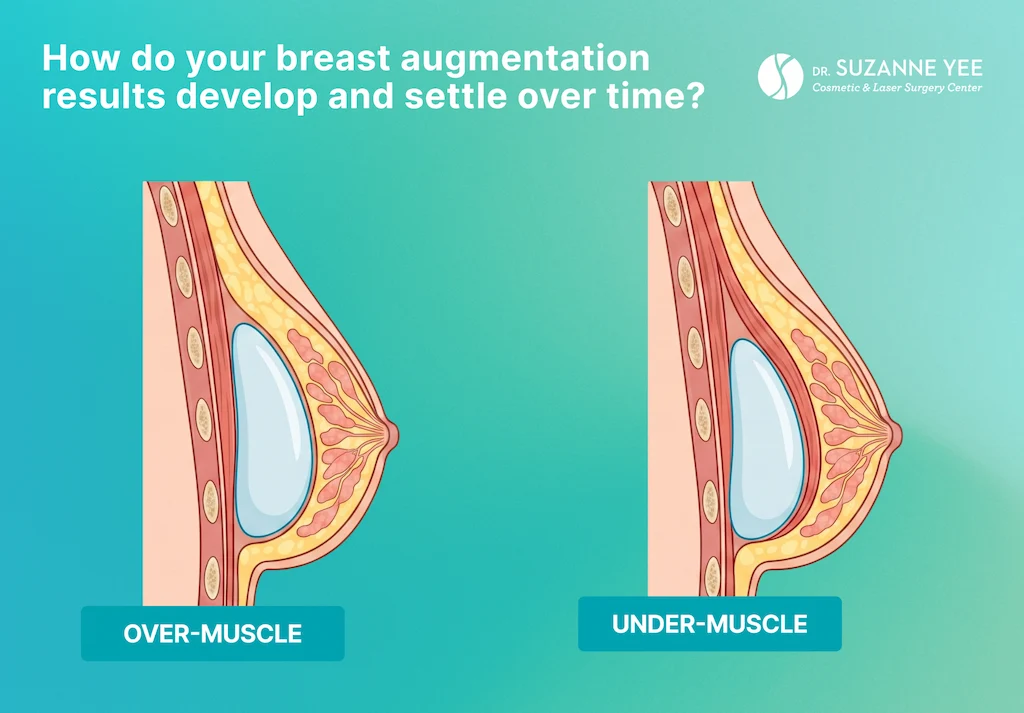
If your breasts look surprisingly high and tight during the first week, nothing has gone wrong. That early appearance is one of the most misunderstood parts of the whole process, and knowing what to expect takes much of the worry out of it. Your breast augmentation results unfold gradually, not overnight.
The first days: high and tight
In the beginning, swelling and tight chest muscles hold the implants high on your chest. Your skin has not relaxed yet, and the muscles are still adjusting to the implants beneath them. This is why newly augmented breasts can look firmer and rounder at the top than you expected.
It can feel a little alarming if no one warns you. Most patients feel soreness and tightness during the first two to three weeks, with noticeable improvement by one month. What you are seeing is a body mid-adjustment, not a finished result.
The drop and fluff phase
“Drop and fluff” is the friendly name for what happens next. As the swelling recedes and the muscles loosen, gravity gently pulls the implants down into a lower, more natural position, while the lower breast fills out and softens. A 2014 PLOS One study using 3D breast scans confirmed that shape and volume keep shifting for months before stabilizing.
Implants placed under the muscle usually take a bit longer to settle than those over it. Here is the reassuring part. This phase is a sign things are working, not a sign something is off.
Your final shape
Most of the change happens in the first three to six months, when your breasts start to look and feel like yours. Full tissue softening and the truly final shape can take up to a year. Your surgeon tracks this settling at your follow-up visits.
Patience is part of the result here. The breasts you judge at week two are not the breasts you will have at month eight.
Scar fading
Every incision leaves a scar, and each follows its own timeline. Fresh scars often look pink or raised at first before gradually flattening and lightening over the following year. It is completely natural to feel concerned about scarring, and knowing what to expect makes the process much easier to handle.
Incision choice affects where the scar will be, whether in the fold under the breast, around the areola, or in the armpit. As those lines quietly fade, the focus shifts to the bigger question: what should a realistic result actually look like?
What do realistic breast augmentation results actually look like?

A realistic result is not a magazine cover. It is a version of your own body that looks proportionate, balanced, and true to you. This is the heart of the practice’s philosophy of “enhancement, not transformation,” and it is why well-planned breast augmentation results are often known for looking natural.
Proportion over perfection
The goal is not the biggest possible implant. It is the one that flatters your frame and moves naturally with your body. A natural-looking result usually has a gentle slope from the upper to the lower breast, rather than sitting round and tight high on the chest.
That is worth remembering when looking at photos online. Realistic breast implants are the ones that mimic a natural breast shape, not the ones that draw attention to themselves. While balance and symmetry are always the goal, they cannot be guaranteed because most people naturally begin with some degree of asymmetry between the two breasts.
Same implant, different result
Two people can choose the exact same implant and end up with very different results. Your chest width, height, skin thickness, and the amount of natural breast tissue you already have all influence how a given implant volume looks on your body. A realistic boob job result is designed around those measurements, not around a friend’s outcome.
Emily, who had her breast augmentation with Dr. Yee, described how closely her outcome matched what she pictured:
“I couldn’t be happier with my breast augmentation results! From my very first consultation, Dr. Yee and the entire team made me feel so comfortable and supported. They were all incredibly friendly and informative, answering all my questions and making sure I felt confident in the choices that I wanted every step of the way. The results look exactly like I pictured in my head and exactly what I hoped for.”
Natural versus over-augmented
An over-augmented look often happens when an implant is too large for the tissue and frame supporting it. Beyond appearance, oversized implants can place more strain on your skin and tissue over time. A boob job result that ages well usually starts with a size your body can comfortably support.
If sagging is part of your starting point, an implant alone will not lift the breast, and that is an important limitation to understand. In those cases, a breast lift may be paired with augmentation to reposition the tissue and add fullness together. Seeing this on real bodies helps more than any description can. Browse real patient before-and-after photos and look for starting points that resemble your own.
How do lifestyle and aging affect my results in the long run?
Breast implants do not freeze your body in time. Your augmented breasts will continue to respond to pregnancy, weight changes, exercise, and aging, much like natural breasts do. Thinking about that long-term picture now helps you choose a result you will still love later.
Pregnancy and breastfeeding
Pregnancy and breastfeeding do not change the implants themselves. What changes is the breast around them, as the tissue expands with milk and then settles afterward, sometimes leaving looser skin or a bit of deflation. Many patients choose to wait until they finish having children before surgery for exactly this reason, though it is a personal decision, not a rule.
If a future pregnancy shifts things, a revision or a mommy makeover can restore the look later. There is no single right sequence, only the one that fits your life.
Weight, exercise, and gravity
Significant weight gain or loss changes breast volume, and implants do not prevent those changes. Large weight fluctuations can stretch the skin or change how the breasts sit on your chest. Maintaining a stable weight is one of the simplest ways to help preserve your results.
High-impact activity plays a role too. Over years, unsupported bouncing during exercise can stretch the tissue and ligaments that hold the breast in position. A supportive sports bra is a small habit that pays off long-term.
Aging, the same as always
Skin loses elasticity with age whether or not you have implants. Your augmented breasts will soften and settle further over the decades, and that is normal, not a failure of the surgery. You will keep aging naturally, just from a fuller starting point than before.
None of this means your result is fragile. It simply means your breasts are still living tissue. That naturally leads straight into the practical side: what long-term maintenance actually involves.
What are the long-term maintenance and revision realities?
Here’s an honest truth many glossy sources skip: breast implants are not lifetime devices. Planning for eventual maintenance is not a warning sign. It is simply part of understanding what you are choosing. Knowing this now helps prevent unpleasant surprises later.
Implant lifespan
Modern saline and silicone implants are durable, and many last 10 to 15 years or longer before they need attention. They do not have a fixed expiration date, but they are not designed to last forever either. Routine monitoring helps you and your surgeon keep track of how they are holding up.
Many patients eventually choose to replace their implants to refresh the look or update the size. It is helpful to plan for that possibility from the start, much like you would with any long-term investment.
Capsular contracture and rupture
Your body naturally forms a thin capsule of scar tissue around any implant. Occasionally, that capsule tightens and becomes firm. This is called capsular contracture, a well-known complication that can affect breast’s shape or comfort. It is one of the most common complications after breast augmentation, occurring in roughly 8–10% of patients. It is also one of the most common reasons for revision surgery and is generally treatable when it occurs.
Ruptures are uncommon and behave differently by implant type. A saline implant deflates noticeably within hours, while a silicone one may show no obvious signs, which is why routine imaging matters. In a 2018 FDA study of nearly 100,000 patients, these events were the exception rather than the rule, and your surgeon monitors for any changes over time.
Screening and revision
Once you have implants, regular mammograms and self-exams stay important, with a specialized technique used so the implant does not obscure the image. If an exchange or breast implant revision is ever needed, the old implant can often be removed and a new one placed in the same procedure. Staying on top of this is straightforward once it’s part of your routine.
None of these realities should scare you away. They are simply the fine print of a decision you’re clearly taking seriously.
What should you expect at your consultation?
A consultation is not a sales pitch, and it is not only a chance for a surgeon to evaluate you. It is equally your chance to evaluate the surgeon, the results, and whether the plan on the table actually fits your goals. The best decisions here are two-way.
At the Little Rock office, that starts with a hands-on, in-person assessment. Your surgeon reviews your anatomy, measures your frame, and looks at your existing tissue, because those details drive what’s realistically possible. You will also see before-and-after photos of patients with similar starting points and can “try on” different sizes with inserts to preview how a volume might look on you. You can also view a 3D simulation of your breasts using Crisalix imaging, which shows how different implant sizes could look on your frame. It is a preview rather than a promise of your final result, and it works alongside the hands-on assessment rather than in place of it.
Kaitlin, a Dr. Yee patient who valued how natural her results felt, shared her experience:
“Dr. Yee and her staff are the very best! I got a breast augmentation and love my results. They’re exactly what I wanted and they look and feel so natural. Dr. Yee and her staff make you feel like a friend and treat you like family. She made herself available 24/7 for any questions and concerns. You can tell she really cares about her patients.”
Nothing is rushed and nothing is off limits, including the questions that feel small or embarrassing. Your procedure would take place under general anesthesia at an AAAHC-accredited surgical center. A Certified Registered Nurse Anesthetist (CRNA) handles that anesthesia as part of the experienced surgical team, so you’re comfortable throughout.
To keep your goals within reach, the office offers flexible financing through Cherry, Alphaeon Credit, CareCredit, PatientFi, and Alle. Cost should never be the reason you hold back your questions. When you are ready, schedule your personal consultation in Little Rock or call (501) 224-1044 to start the conversation.
Conclusion
The breast augmentation result worth judging is the one that arrives months after surgery, not the one in the mirror during the first week. Results take time to develop, your natural proportions play a bigger role than any single implant size, and a natural-looking outcome comes from thoughtful planning rather than chance. Having that understanding helps you make decisions with confidence and sets the stage for greater satisfaction with your results.
One of the most helpful next steps is to browse before-and-after photos of patients whose starting point is similar to yours. When you’re ready, an in-person consultation can answer the questions that photos and online research simply can’t, allowing you to explore your options at a pace that feels comfortable for you.
At Dr. Suzanne Yee Cosmetic & Laser Surgery Center in Little Rock, the focus is on helping every patient feel heard, respected, and confident throughout the decision-making process. Exceptional results begin with honest conversations and personalized care. If you’d like to learn more or discuss your options, the team is here to help. You can reach the office at (501) 224-1044.
Frequently asked questions
Can I choose my exact bra cup size before surgery?
Not precisely, because cup sizes aren’t standardized across bra brands. Implant volume is measured in cubic centimeters, and how a given volume reads depends on your frame and existing tissue. Your surgeon helps you preview options with sizers and Crisalix 3D imaging so the goal is realistic for your body.
Will breast implants prevent my breasts from sagging?
Implants add volume, but they don’t lift significantly sagging tissue on their own. If skin laxity is a concern, a breast lift is often paired with augmentation to reposition the breast and restore fullness together. A consultation is the best way to learn which approach fits you.
How much does a breast augmentation cost?
The total depends on your implant type, technique, and whether other procedures are combined, so a personalized quote comes from your consultation. Your quote bundles the surgeon’s fee, anesthesia, facility fees, and follow-up visits into one transparent total, and you’re only responsible for pre-op labs and any prescribed medications. Financing is also available to spread the cost over time.
When is it safe to resume heavy exercise after getting implants?
Light activity typically resumes in about two to three weeks, while upper-body and higher-impact workouts usually wait about four to six weeks. Most patients are back to full activity by around six weeks. Your surgeon gives you a personalized timeline based on your healing.
Does breast augmentation increase the risk of breast cancer?
Breast implants do not cause breast cancer and don’t raise your risk of developing it. Textured implants have been linked to a rare cancer called BIA-ALCL, a lymphoma of the immune system. That’s why only smooth implants are used here, never textured ones, and routine mammograms stay important after augmentation.
Can I still breastfeed after getting breast implants?
Many patients breastfeed successfully after augmentation, especially with placement and incisions that spare the milk ducts and nerves. Pregnancy and nursing can change how your breasts look afterward, which is why some patients wait until their family is complete. Your surgeon can walk you through what to expect for your situation.
Will I lose sensation in my nipples after a breast augmentation?
Some temporary changes in nipple sensation are common as the nerves settle, and most of it returns over the weeks and months that follow. Lasting changes are less common and vary by individual anatomy and incision choice. It’s a good topic to raise directly at your consultation.
What happens to my implants if I gain or lose a significant amount of weight?
Big weight changes affect the breast tissue around your implants, not the implants themselves. Gaining or losing a lot can stretch the skin or shift how the breasts sit, which may soften your result over time. Keeping a stable weight helps protect the outcome, and your surgeon can discuss options if your body changes down the road.
Disclaimer: This content is for educational purposes only and does not constitute medical advice. A consultation with a qualified board-certified surgeon is required to determine the best treatment plan for your individual needs.