Instagram
 Facebook
 Tiktok
 Youtube
 X
 LinkedIn

 (501) 224-1044

Breast augmentation can do a lot for your shape and your confidence, but it can’t do everything. The honest answer to “is it right for me?” comes down to the trade-offs just as much as the results.
Implants add fullness and balance. They also come with upkeep, screening, and the fact that they aren’t lifetime devices. Weighing both sides before you ever sit down for a consultation is the smartest move you can make.
It’s also one of the most common cosmetic surgeries in the world. In fact, breast augmentation was the third most popular surgical procedure globally in 2024, according to ISAPS. But popular doesn’t mean right for everyone, which is really the whole point of thinking it through.
At Dr. Suzanne Yee Cosmetic & Laser Surgery Center in Little Rock, breast augmentation is treated as enhancement. The goal is a natural-looking result that suits your frame, not a whole new body. This guide walks you through the real benefits, the risks worth understanding, how the options stack up, who makes a good candidate, and what the years afterward tend to look like.
Key takeaways
Here’s the short version of what this guide covers, so you can skim now and dig into whichever sections matter most to you.
- Breast augmentation reliably improves size, balance, and proportion, and studies point to high patient satisfaction. That said, it enhances what you already have rather than correcting sagging, which may call for a lift.
- The main trade-offs: surgical risks that stay uncommon, capsular contracture as the most frequent implant issue, and the fact that implants aren’t lifetime devices, so some patients need a revision down the road.
- You’ve got two implant materials, saline and silicone (gummy bear is simply a highly cohesive type of silicone), plus fat transfer as an implant-free option that adds a more limited amount of volume.
- Good candidates tend to be in stable health, finished having children, non-smokers, and clear-eyed about what surgery can and can’t do. The FDA also sets a minimum age of 18 for saline and 22 for silicone.
- A rapid-recovery approach lets many people get back to desk work within days, though implants still call for ongoing monitoring, supportive bras, and routine imaging to protect both your health and your result.
What are the real benefits of breast augmentation?
If you’re considering breast augmentation, you probably already have a picture in your mind of how you want to feel in a swimsuit or a favorite top. The good news is that the benefits are real and well documented.
A nationwide study of more than 14,000 patients using the BREAST-Q reported high satisfaction and real gains in quality of life, according to one study. The most common reasons patients pursue it come down to size, balance, and proportion.
Implants can restore fullness lost after pregnancy, breastfeeding, or weight changes, and they can even out two breasts that were never quite matched to begin with. Symmetry is always the goal, even though it can’t be guaranteed. Most people start with some natural asymmetry, and a little usually remains afterward.
Then there’s the part that’s harder to put a number on. A lot of patients describe feeling more like themselves and less self-conscious in the moments that used to nag at them. Wanting to feel at home in your own body is reason enough to look into your options, and it’s not something you owe anyone an explanation for.
That’s where an experienced surgeon comes in. As a triple board-certified cosmetic surgeon, Dr. Yee focuses on choosing an implant and approach that complements your figure instead of overpowering it. Doing your homework, the way you are right now, is exactly how the happiest patients tend to start.
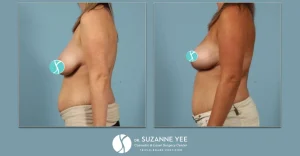
Seeing real outcomes tells you more than any description can. Browse real patient before-and-after photos to get a feel for what natural-looking results look like across different starting points.
What are the risks and downsides of breast implants?
No honest pros and cons list skips this part. Understanding the downsides is what lets you decide with confidence instead of anxiety. First, the reassuring part: the vast majority of patients come through breast augmentation without any serious problems. Still, it’s surgery, and a few things are worth knowing.
Surgical risks
Like any operation, breast augmentation carries a small risk of infection, bleeding, or a pocket of blood collecting under the skin as you heal. These are uncommon, and careful surgical technique keeps them that way. Serious infection, for example, shows up in well under 1 percent of cosmetic breast augmentations. Most bumps in the road are the ordinary kind, a little swelling and soreness that settle down with time.
Capsular contracture
Your body naturally forms a thin layer of scar tissue around any implant. In some patients that capsule tightens and firms up, which can change how the breast looks or feels. It’s the most frequent implant-related issue, reported in roughly 10% of cases. When it does become bothersome, it’s treatable, so it’s a manageable concern rather than a reason to walk away.
Implant rupture
Implants can leak or deflate over time, and the two materials behave differently when they do. Saline implants deflate quickly and visibly, while silicone ruptures are quieter and usually caught through routine imaging.
Short-term data from a large FDA postapproval study found rupture rates of about 2.5% for saline implants compared with 0.5% for silicone implants. Either way, a ruptured implant gets removed or replaced, often in a single procedure.
Rare long-term concerns
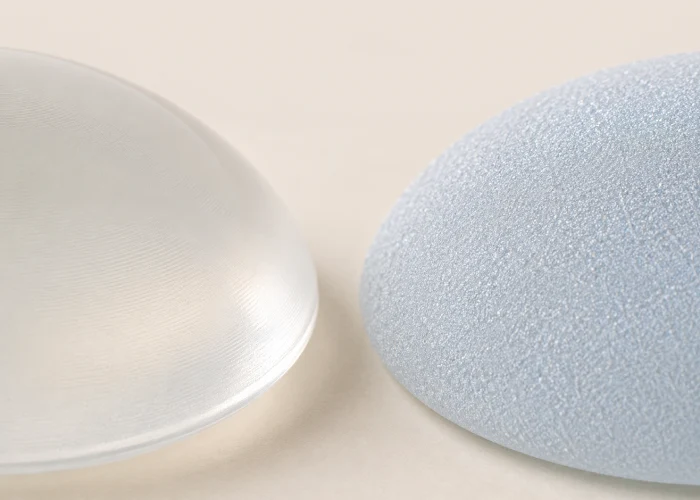
Two rarer topics come up in the research and deserve a straight answer. BIA-ALCL is a rare cancer, a lymphoma of the immune system, and a 2025 review linked it specifically to textured-surface implants. Smooth implants, which are what most patients receive, avoid that association.
Breast implant illness, or BII, refers to a cluster of symptoms like fatigue and joint aches that some patients report. It’s still an active area of study, and your surgeon can walk through it honestly with you.
Revision surgery
Here’s the honest headline: implants aren’t lifetime devices. Some patients will need a revision at some point, whether to address a change or simply to refresh their result.
It doesn’t mean something went wrong. It’s just part of choosing a device that lives in your body for years, and knowing that upfront helps you plan. If you ever do need it, implant revision and removal is a routine part of a full-service practice.
How do the breast augmentation options compare?
Once the benefits and risks make sense, the next question is usually about the choices themselves. There are more of them than most people expect, and a consultation is designed to sort through them with you. Two decisions shape most of it: what the implant is made of, and how it’s placed.
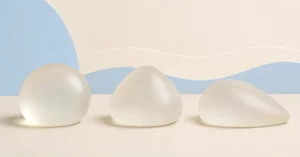
There are two implant materials, and everything else is a variation on those two.
| Feature | Saline | Silicone |
|---|---|---|
| Fill | Sterile salt water | Cohesive silicone gel |
| Feel | Soft, can feel firmer | Closest to natural tissue |
| Rupture | Obvious, quick deflation | Quiet, found on imaging |
| Rippling | More likely with thin tissue | Least, in the gummy bear type |
| Incision size | Smaller | Slightly larger |
Saline and silicone
Saline implants are filled with sterile salt water after they’re already in place, so they need a smaller opening. And if one ruptures, your body simply absorbs the fluid.
Silicone implants come pre-filled with a cohesive gel that many patients say feels closest to natural breast tissue. Gummy bear implants aren’t a separate category, by the way. They’re a highly cohesive, form-stable type of silicone that holds its shape especially well and ripples the least.
Fat transfer
If the idea of an implant gives you pause, fat transfer is worth a look. Your surgeon uses liposuction to harvest your own fat, then injects it to add volume, which appeals to patients who want a subtle, implant-free change.
The trade-off is that it adds a more limited amount of volume, and not all of it sticks around. A 2025 systematic review found pooled fat retention of about 64% at one year, which is why results are re-evaluated a few months out.
Placement and incisions
Implants can sit under the chest muscle, which tends to look more natural and makes mammograms easier to read, or above it. The incision itself can be tucked into the fold under the breast, around the edge of the areola, or in the armpit.
The practice favors the inframammary fold incision for the most natural result and uses smooth implants only, never textured ones, because of that BIA-ALCL association. Your surgeon will walk you through which combination fits your anatomy and your goals.
Kaitlin, a Dr. Suzanne Yee Cosmetic & Laser Surgery Center patient who chose implants for a natural result, shared her experience:
“I got a breast augmentation and love my results. They’re exactly what I wanted and they look and feel so natural. Dr. Yee and her staff make you feel like a friend.”
The material and technique you choose affect cost, so it’s fair to bring up money here too. To keep your goals within reach, the office offers flexible financing through Cherry, Alphaeon Credit, CareCredit, PatientFi, and Alle.
Are you a good candidate for breast augmentation?
This is the section that turns a general topic into a personal one. A good candidate is usually someone in stable overall health, at a steady weight, and free of any active infection or untreated breast concern.
Age plays a role too. The FDA sets a minimum of 18 for saline implants and 22 for silicone. Beyond the physical checklist, the strongest candidates tend to share a mindset:
- You’re bothered by your size, shape, or balance enough that it affects your daily comfort.
- You’re finished having children, since pregnancy and breastfeeding can change your result.
- You understand what implants can and can’t do, including that they won’t lift significantly sagging breasts on their own.
- You’re doing this for yourself, not to meet someone else’s expectation.
That last point matters more than any measurement. If sagging is part of the picture, augmentation alone won’t fix it, and a breast lift may be the better route. Pairing a lift with implants is common and often a great fit. Your surgeon will confirm at your consultation whether doing both together makes sense for you.
An in-person consultation is where all of this gets personal, and it works both ways. It isn’t only a chance for your surgeon to assess you. It’s your chance to decide whether the fit feels right.
During your visit at the practice’s AAAHC-accredited surgical center in Little Rock, your surgeon examines your anatomy in person and asks what you want to feel comfortable doing again after surgery. You’ll also see a Crisalix 3D simulation, a preview of where your result could land. Nothing is rushed, and no question is off limits.
A few practical preparation details come up here too. The surgery is done under general anesthesia in the accredited facility, so you’re comfortable and won’t feel a thing. That anesthesia is administered by a Certified Registered Nurse Anesthetist (CRNA) as part of an experienced surgical team.
A mammogram is required before breast surgery, and you’ll need pre-op labs ahead of time. If you smoke, this is the moment to step away from it, ideally for six weeks before and after surgery. And since alcohol can thin the blood and affect clotting, plan to pause it for about two weeks on either side as well.
What do recovery and the years after look like?

The first stretch of recovery is where people tend to worry most, especially if you’re used to being active and independent. Here’s the reassuring part: with a rapid-recovery approach, many patients are back to normal light activity before long. The hardest part is usually just slowing down long enough to heal well. The recovery details below reflect the practice’s approved guidance, and your own timeline gets personalized at your follow-ups.
Downtime and getting back to life
Most people are back to desk work within three to five days with the rapid-recovery method. Light exercise picks back up around two to three weeks, upper-body workouts at four to six weeks, and full activity by roughly six weeks. Soreness and tightness are normal through the first two to three weeks and ease off noticeably by the one-month mark. Plan to sleep on your back for four to six weeks while everything settles.
Supportive bras and settling
A supportive surgical bra isn’t optional early on, and it’s doing real work. It supports healing and helps guide your implants into their final position, which protects the shape you’re going for. Your breasts will look higher and tighter at first. The final result can take up to a year to come together as the implants settle and soften into place.
Long-term monitoring
This is the commitment side of the pros and cons ledger. Implants aren’t lifetime devices, so ongoing monitoring comes with the territory. The FDA recommends an initial ultrasound or MRI screening for silicone implants at five to six years, then every 2-3 years after that, per FDA imaging guidance. Routine mammograms and self-exams stay on the calendar, and many patients end up replacing their implants somewhere around 10 to 15 years.
Results over the years
Your body keeps changing, and your result changes right along with it. Pregnancy, weight fluctuations, and the natural shifts of your 40s, 50s, and beyond can all affect how your breasts look years down the line.
If you want a sense of what tends to change at each stage, the wellness guide by decade is a helpful map. None of this is cause for alarm. It’s simply part of choosing something you’ll live with long term, and knowing it lets you plan ahead instead of being caught off guard.
Lisa, a Dr. Suzanne Yee Cosmetic & Laser Surgery Center patient who had her surgery back in 2019, described the experience:
“I had breast augmentation surgery with Dr. Yee in January 2019. She made the entire process very easy, informative, and comfortable. She answered every question honestly and explained everything about the procedure and recovery in detail.”
Conclusion
The decision about breast augmentation rests on holding two things together: the potential for greater fullness, improved balance, and renewed confidence, along with the realities of surgery, the ongoing care implants require, and the fact that they won’t last forever. If those realities still align with your personal goals and expectations, it may be worth taking the next step.
That next step doesn’t have to feel overwhelming. Looking through before-and-after photos of patients with a similar starting point can help you picture what’s realistically possible. From there, an in-person consultation gives you the opportunity to ask questions, discuss your goals, and receive recommendations tailored specifically to you.
At Dr. Suzanne Yee Cosmetic & Laser Surgery Center in Little Rock, every patient is treated with compassion, honesty, and respect. The focus isn’t on changing who you are, it’s on helping you feel more confident in your own skin through thoughtful, personalized care. That’s what “Exceptional Results. Genuine Care.” means in practice. If you’re ready to learn more, schedule a personal consultation at the Little Rock office or call (501) 224-1044 to begin the conversation.
Frequently asked questions
How long do breast implants last before they need replacing?
Breast implants are durable, but they aren’t lifetime devices. Most last many years, and the general guidance is to think about replacement somewhere around 10 to 15 years, or sooner if a rupture or other change comes up. Routine monitoring helps you and your surgeon keep an eye on their condition over time.
At what age can you get saline versus silicone implants?
The FDA sets a minimum age of 18 for saline implants and 22 for silicone implants. The gap reflects when the fuller safety data backs each material. A consultation is where you confirm you’re a candidate based on your health and development, not just your age.
Does fat transfer breast augmentation look and feel more natural than implants?
Because fat transfer uses your own tissue, it can feel very natural, which is exactly why it appeals to patients who’d rather skip implants. The trade-off is that it adds a more limited amount of volume, and only part of the transferred fat survives long term. It’s a good fit for a subtle change rather than a big jump in size.
Can breast implants correct sagging without a breast lift?
Not usually. Implants add volume and can improve fullness up top, but they won’t lift breasts that sag or have loose skin. If sagging is part of your concern, a breast lift, on its own or combined with implants, is often the better approach. Your surgeon can advise you after an in-person exam.
Will breast implants affect your ability to breastfeed?
Most women can breastfeed after breast augmentation, especially when the implants sit under the muscle and the incision doesn’t disturb the milk ducts. It’s still wise to finish having children first, since pregnancy and breastfeeding can change your result. Share your plans at your consultation so your approach accounts for them.
Will your implants look different after pregnancy, weight loss, or menopause?
They can. Pregnancy, big weight changes, and natural aging all affect the breast tissue around your implants, so your result may shift over the years. That’s normal, and it’s not a failure of the surgery. Keeping a stable weight and wearing supportive bras helps protect your result.
What is capsular contracture and how is it treated?
Capsular contracture is when the natural scar tissue around an implant tightens and firms up, which can change the breast’s shape or feel. It’s the most common implant-related issue, and it’s treatable, sometimes with medication and sometimes by adjusting or replacing the implant and capsule. Your surgeon will recommend the right option if it develops.
What is breast implant illness (BII)?
Breast implant illness is the term for a range of symptoms, such as fatigue, brain fog, and joint pain, that some patients connect to their implants. It isn’t fully understood, and research is ongoing, so it’s a topic worth raising openly at your consultation. Some patients who have their implants removed report feeling better.
*Disclaimer: This content is for educational purposes only and does not constitute medical advice. A consultation with a qualified board-certified surgeon is required to determine the best treatment plan for your individual needs.