Instagram
 Facebook
 Tiktok
 Youtube
 X
 LinkedIn

 (501) 224-1044
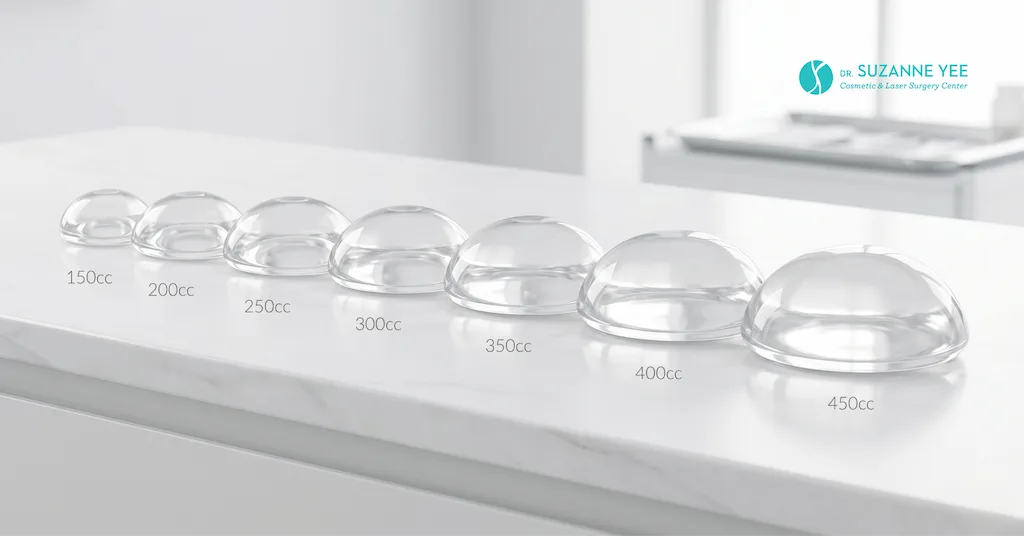
Choosing your breast implant size can be overwhelming. You probably have a desired figure in your head, or a friend mentioned hers, or you saw a photo, and you want to achieve the same cup size. Then a question arises, “What if I choose the wrong size?”
Here’s the reassuring part: the actual number was never the key factor. Breast augmentation remains one of the most popular cosmetic surgeries worldwide, with about 50% of patients aged 18 to 34, according to ISAPS in 2024. The most satisfied patients are not those who selected the most dramatic numbers, but those who chose options that suited their own bodies.
At Dr. Suzanne Yee Cosmetic & Laser Surgery Center in Little Rock, patients working with skilled plastic surgeons in the Little Rock region find their ideal match with a triple board-certified cosmetic surgeon who has over 35 years of experience. This article explains what implant size truly signifies, how your body influences the decision, and the roles of shape and profile. You’ll also learn how to preview your options. By the end, the number you have in mind will have meaningful context.
Key takeaways
- Breast implant size is measured in cubic centimeters, or cc, not cup sizes. One cc equals one milliliter, and cup labels aren’t standardized across bra brands.
- Most patients choose between 300 and 400cc. Roughly 150 to 200cc adds about one cup size, though your tissue and frame change the result.
- Your chest width, body frame, existing tissue, and natural asymmetry matter more than the number itself.
- Shape and profile determine how the same volume looks on your chest. A well-chosen round implant is the most common and natural-looking option.
- The rice test, sizers, and 3D imaging help you preview, but only an in-person consultation can match size, shape, and profile to your real anatomy.
What do breast implant sizes and measurements really mean?
That number you’re thinking of is almost certainly your cup size, and that’s the first thing to clarify. Breast implant sizes aren’t actually measured in cups at all. They’re measured in cubic centimeters, or cc, the volume of saline or silicone gel inside the implant shell. One cc equals one milliliter, which is slightly less than a fifth of an ounce. Volume is the key measure in any implant size and shape consultation.
Implants generally range from about 100cc for a subtle change to 800cc or more for a dramatic one. Most patients fall within the 300 to 400cc range. If switching from cups to cc feels like learning a new language, that’s normal.
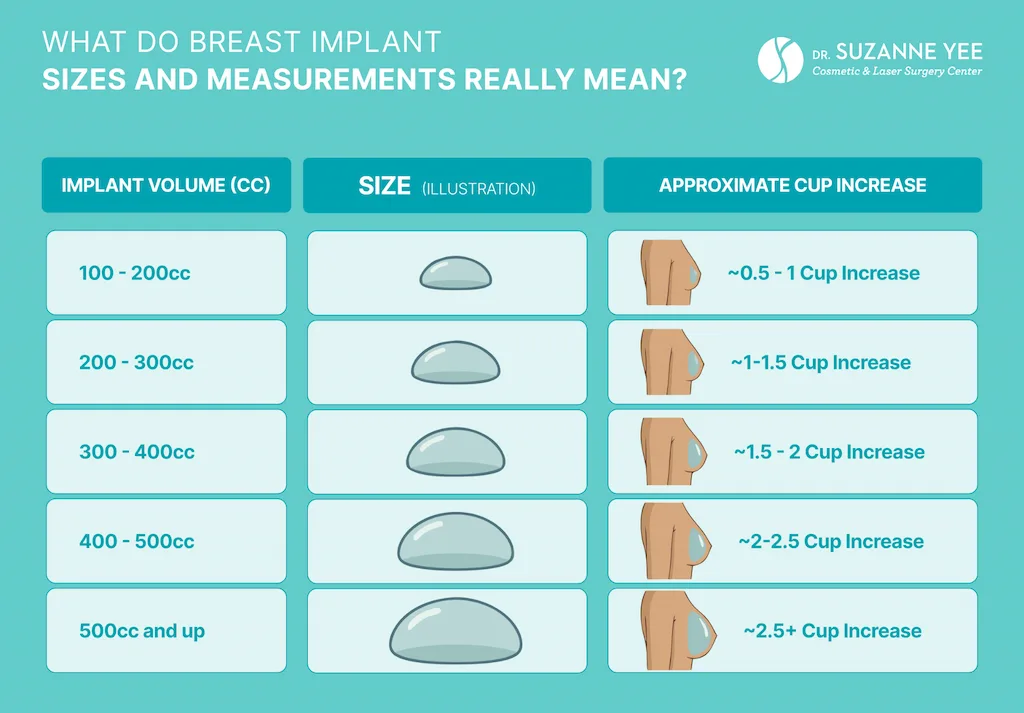
Here’s a general guideline for translation: every 150 to 200cc roughly increases one cup size, although this depends on your tissue and frame.
| Implant volume | Approximate cup size increase |
|---|---|
| 100 to 200 cc | About half a cup to one cup |
| 200 to 300 cc | About one to one and a half cups |
| 300 to 400 cc | About one and a half to two cups |
| 400 to 500 cc | About two to two and a half cups |
| 500 cc and up | More than two and a half cups |
Volume is just one aspect. Each implant also features a base width, the measurement across the bottom where it contacts your chest. A 350cc implant on a narrow base appears quite different from one on a wide base.
This is why cup size is not a reliable planning tool. Since cup labels vary across bra brands and band sizes, surgeons prefer using physical measurements. The key point is that accuracy is better than guesswork. You can schedule a consultation to get personalized measurements instead of just estimates.
How does your body anatomy affect the right implant choice?
Once the measurements make sense, your body becomes your true blueprint. The same implant can look natural on one person and a bit too big on another. Ultimately, it’s less about the number and more about the frame it’s working with.
Chest and breast base width
The width of your chest determines what can fit. Most breast base widths range from 11 to 15 centimeters, and the implant’s base must stay within that area.
If the implant is too wide, it may push toward the armpit. If it’s too narrow, a gap might form down the middle. Matching the implant base to your breast base is one of the most dependable ways to achieve a natural look.
Body frame and proportions
Height, weight, and the width of shoulders and hips all play a role in how balanced someone appears. If you have a narrower chest and shoulders, a higher-projection implant can create a fuller look in the front rather than spreading out to the sides. On the other hand, a broader frame can support a wider implant without it looking out of proportion. Dr. Yee evaluates frame, proportion, and goals together rather than reaching for a standard size.
Existing breast tissue
The amount of natural tissue you have influences the calculations. More tissue can support larger implants and help soften edges, while less tissue typically means a narrower profile is safer, as thin tissue more clearly shows rippling. However, there’s no right amount of tissue to start with. It’s one of the inputs, and a good plan works with what you have.
Natural breast asymmetry
Almost everyone has some degree of asymmetry, which is entirely normal. In a study involving over 2,000 patients, 49% had visibly uneven breasts.
Surgeons often use slightly different implant sizes on each side, usually less than 60cc, to achieve balance. If you’ve always noticed a difference between your two sides, augmentation can be an opportunity to make them more even.
Your anatomy tells your surgeon how much room there is to work with. Shape and projection are the next layer.
What are the main breast implant shapes and profiles available?
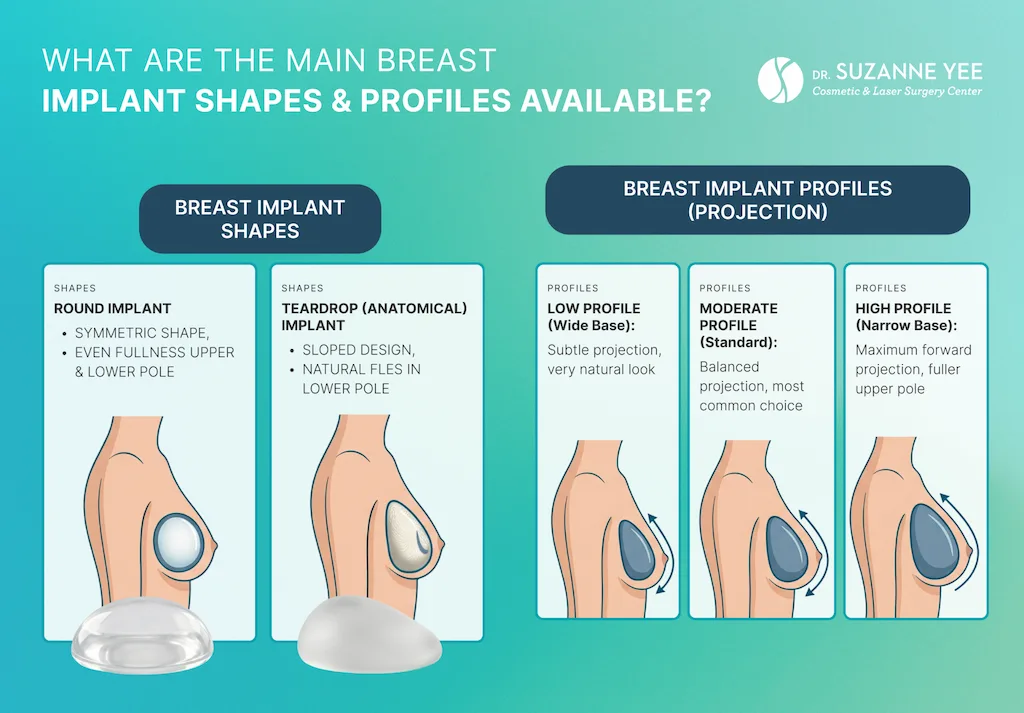
Two implants can contain identical volumes but appear completely different. The arrangement depends on shape and profile, not just volume (cc). These two factors, implant shape and profile, determine how the volume is distributed on your chest.
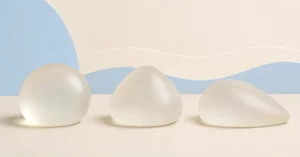
Round implants are symmetrical and have consistent fullness at both the top and bottom. Teardrop implants, also known as anatomical or shaped implants, feature a tapered top and a fuller bottom, mimicking the natural slope of a breast.
Round implants are by far the more common choice. In one meta-analysis, surgeons could distinguish the two shapes only 52% of the time and found no clear aesthetic advantage for teardrop implants.
Teardrop implants are typically made with a highly cohesive, form-stable silicone gel, sometimes called gummy bear gel. That’s a type of silicone, not a separate implant category. If you assumed teardrop automatically meant more natural, you’re not alone. The truth is more reassuring: a well-chosen round implant looks natural, too.
Bre, who walked into her consultation unsure and left feeling settled, shared her experience:
“I highly recommend Dr. Yee! I could go on and on about how wonderful she is and her staff. I knew at the beginning that I had made the right choice during my consultation. That is when I met Rachel and we talked about breast augmentation. She was super sweet and helpful and made me feel confident in my choices.”
Profile is the second concept. It indicates how far an implant extends forward from your chest for a specific base width. The same volume on a narrower base projects more, while on a wider base it appears flatter.
| Profile | Base width | Projection | Often suits |
|---|---|---|---|
| Low | Widest | Minimal | Broader chests, subtle fullness |
| Moderate | Balanced | Moderate | Most chest widths, natural slope |
| High | Narrower | Strong | Narrower chests, more upper fullness |
| Ultra-high | Narrowest | Maximum | Maximum projection, fuller look |
Photos make visualization much easier than words. You can browse actual patient before-and-after photos to see how shapes and profiles truly appear on real patients.

How do lifestyle, goals, and risks factor into your size decision?
At this point, you can specify your preferences using measurements. The final filter is the most personalized, reflecting your lifestyle, the appearance you desire in the mirror, and important considerations before choosing a size larger than your frame.
Your activity level
If you’re active, especially with upper-body movement, size is worth thinking through. A survey of 81 athletic women after augmentation found their strength was generally unaffected or even improved, with most choosing moderate sizes under the muscle.
Larger implants can add weight that may gradually pull on your daily routine, so many active patients choose a moderate volume. Desiring an enhancement that suits your lifestyle, not just a photo, indicates you’re on the right track.
The look you’re going for
There’s a real range here, and none of it is wrong. Implants in the 300 to 400cc range tend to read as natural and proportionate, and they’re the most common choice. Going higher, into 500cc and beyond, with a higher profile, creates a fuller and more obvious result.
Some people want subtle, and some want unmistakable. Both are valid, and the goal is to choose it on purpose rather than by accident.
The case against oversizing
Bigger isn’t always better, and this is where experience really matters. Implants that are much larger than your frame can handle increase the risk of rippling, where the implant edge shows or becomes noticeable. They can also put more stress on your tissue over time.
There’s a physical limit worth respecting, too. A 2015 study found that implants of around 400 grams per breast started to measurably change posture, with heavier loads affecting the spine more.
Dr. Yee has dedicated over 35 years and performed thousands of breast procedures to help patients avoid regrets, with oversizing being a common concern.
Weight changes over time
Weight changes after surgery shift the result. Losing weight thins your natural tissue and can make the upper breast look deflated or show rippling. Gaining weight can add fullness but also looseness.
A stable weight protects the look you chose. You can’t predict every change life brings, and you don’t need to, since a good plan accounts for a realistic version of you.
Lifestyle, goals, and risk all point back to one move: getting your hands on something real before you commit.
How can you preview and test implant sizes before surgery?
You don’t need to guess what size works best for you. Several preview methods allow you to explore your options before making any permanent commitments, helping you move closer to a final decision.
The at-home rice test
The rice test is the easiest way to begin. Fill a section of pantyhose or a plastic bag with measured rice, then place it into a sports bra. Approximately one cup of rice equals about 250cc, helping you get a sense of the added volume.
It’s a rough tool. It can’t replicate the weight or feel of a real implant, but it’s a low-pressure way to start narrowing your range from home.
Sizers and 3D imaging
At your consultation, the options get more precise. Sizers are adjustable implant shells you try on inside a bra, giving you a hands-on sense of volume and shape. Some practices also offer 3D imaging that simulates your result on screen.
These tools are helpful, not flawless. One study of 3D simulation found it predicted volume accurately about 73% of the time, within a 10 percent margin.
Your consultation visit
The consultation is the stage where all preview tools are integrated, functioning bidirectionally. It provides your surgeon an opportunity to examine your anatomy firsthand and allows you to determine if she is the right fit for your needs.
In-person interactions are essential here. A hands-on assessment, including measuring your base width and examining your tissue, cannot be done through a screen. Your appointment is held at an on-site, AAAHC-accredited surgical center, allowing you to see exactly where your procedure will take place.
A good consultation doesn’t feel rushed. Your surgeon should ask about your routine, your work, and what you want to feel comfortable doing again.
With Dr. Yee, you’ll understand why size and profile should be considered to suit your body. Between visits, our team proactively follows up instead of waiting for you to reach out.
Lisa, who had breast augmentation after a consultation that walked her through every detail, shared her experience:
“I had breast augmentation surgery with Dr Yee in January 2019. She made the entire process very easy, informative, and comfortable. She answered every question honestly and made sure I understood at every step along the way. She explained everything about the procedure and recovery in detail.”
If you’re thinking about the cost, flexible financing is available through Cherry, Alphaeon Credit, CareCredit, PatientFi, and Alle. Monthly payment plans can spread out the cost. At Dr. Yee’s Little Rock practice, a breast augmentation quote includes the surgeon’s fee, anesthesia, facility fees, and follow-up visits into one transparent total. Note that pre-op labs and any prescribed medications are not included in the quote.
Here’s an honest note: your preview will be close but not exactly your final result. Your body needs time to adjust to the implant, and it can take up to a year for the final outcome to be fully visible. Our breast augmentation recovery timeline lays out what each stage of that healing looks like.
Conclusion
You arrived with a specific number in mind and a quiet concern about it. Hopefully, that concern feels less significant now. The number wasn’t the true decision, because your body, proportions, and goals are what truly matter.
If you’re considering your next step, start by browsing real patient photos that resemble your current situation. This helps make all subsequent decisions more tangible. When you’re prepared, an in-person conversation will provide details that photos cannot give.
At Dr. Suzanne Yee Cosmetic & Laser Surgery Center in Little Rock, the promise is exceptional results and genuine care. That means every patient deserves to feel heard, respected, and confident in a choice this personal, with the goal always being enhancement, not transformation. When you’re ready, request your consultation or call (501) 224-1044.
Frequently asked questions
How many CC equals one cup size increase?
Roughly 150 to 200cc adds about one cup size, though it depends on your starting tissue, your frame, and even your bra brand. Because cup sizes aren’t standardized, your surgeon plans in cc rather than promising a specific letter.
What does a 300cc implant look like?
A 300cc implant usually gives a moderate, natural-looking increase of about one to one and a half cup sizes. On most frames, it adds noticeable fullness without looking dramatic. Your existing tissue and chest width shape the final result.
Can I get different-sized implants in each breast?
Yes, and it’s common. Most people have some natural asymmetry. Using slightly different sizes on each side, often a difference of under 60cc, is a normal way to create balance. An experienced cosmetic surgeon will plan for this rather than treating both sides the same.
Does silicone or saline affect your size choice?
It can. The same volume in silicone versus saline can feel and even look a little different because of how each fill behaves. Silicone is often chosen for a softer, more natural feel, which can influence the profile and shape you pair with your size.
Is there a maximum safe breast implant size?
There’s no single universal limit. However, FDA-approved silicone implants typically reach up to around 800cc. What is safe for you depends on your tissue, chest width, and frame, rather than a specific number. This highlights the importance of consulting a surgeon for proper sizing instead of trying to determine it online.
What if you want to go bigger later?
Going larger later is possible and fairly common, though it means a second surgery and its own recovery. The better path is usually to get the first decision right, which an unhurried, in-person consultation is designed to help you do.
*Disclaimer: This content is for educational purposes only and does not constitute medical advice. A consultation with a qualified board-certified surgeon is required to determine the best treatment plan for your individual needs.