Instagram
 Facebook
 Tiktok
 Youtube
 X
X LinkedIn
 (501) 224-1044

The eyes rarely lie. You can feel rested, confident, and completely yourself, and still catch a reflection that tells a different story. Shadows that seem deeper than last year. Puffiness that no amount of sleep seems to fix. Under-eye bags that have quietly become a permanent fixture, no matter what your concealer says.
You’re not imagining it. Under-eye aging, including fat pad bulging, skin laxity, and hollow tear troughs, can start appearing as early as your mid-thirties. And once these changes set in, topical creams and makeup can only do so much.
According to the ASPS, surgeons performed 120,755 blepharoplasty procedures in 2024, making it a top-five cosmetic surgical procedure for three years in a row. That kind of demand reflects something important: this surgery works, and patients trust it.
Dr. Suzanne Yee is a triple board-certified cosmetic surgeon with over 35 years of experience performing blepharoplasty surgery near Little Rock. She customizes every procedure to each patient’s anatomy, using techniques like fat repositioning to create a smooth, natural lid-to-cheek transition.
This guide covers everything: surgical techniques, candidacy, recovery timelines, costs, and what results actually look like.
5 Quick Facts About Lower Blepharoplasty
- Lower blepharoplasty targets under-eye bags, fat pad bulging, loose skin, and tear trough hollowing to restore a rested, refreshed appearance.
- Transconjunctival lower blepharoplasty uses an incision inside the eyelid, leaving no visible scars and offering a shorter recovery.
- Most patients return to social activities within 10 to 14 days, with final results visible at three to six months.
- The procedure carries a 93% percent “Worth It” rating on RealSelf based on nearly 3,000 patient reviews.
- Results are long-lasting, and many patients enjoy their refreshed appearance for a decade or more.
What Is Lower Blepharoplasty and What Does It Treat?
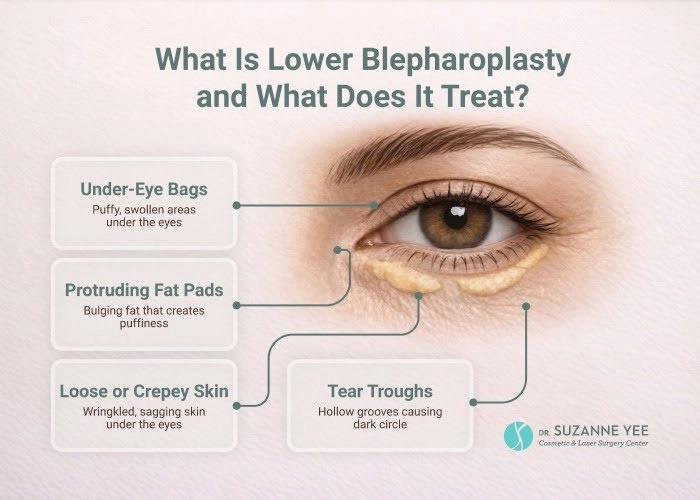
Lower blepharoplasty is a surgical procedure that addresses visible signs of aging in the lower eyelid area. It targets under-eye bags, protruding fat pads, loose or crepey skin, and the hollow grooves known as tear troughs. The goal is a smoother, more rested lower lid, one that finally matches how you actually feel.
Here’s what’s happening beneath the surface. As you age, the thin membrane holding orbital fat in place, called the orbital septum, weakens. Fat that was once neatly contained starts pushing forward, creating visible bulges. At the same time, volume loss in the mid-cheek deepens the tear trough, making those bags look even more pronounced.
These changes can begin as early as 35 to 40, especially if genetics play a role. Most patients seeking lower blepharoplasty are in their 40s through 60s, though younger patients with hereditary under-eye bags are also candidates.
Lower blepharoplasty is different from a Little Rock upper eyelid procedure, which addresses drooping or hooded upper lids. Many patients benefit from both, but each targets a distinct concern.
What Are the Different Techniques for Lower Eyelid Surgery?
Not all under-eye concerns are the same, and not all lower blepharoplasty techniques are identical. The right approach depends on your anatomy, the severity of fat prolapse, skin quality, and your goals. Here’s a quick comparison:
| Technique | Approach | Best For | Scarring |
| Subciliary | External incision just below the lash line | Excess skin, fat pads, and muscle laxity | Fine line hidden beneath lashes |
| Transconjunctival | Incision inside the lower eyelid | Fat prolapse with good skin elasticity | No visible scar |
| Fat Repositioning | Redistributes fat into the tear trough | Under-eye bags with hollow tear troughs | Depends on the incision approach |
| Pinch Technique | Removes a small strip of excess skin only | Mild skin redundancy, minimal fat issues | Minimal, along the lash line |
| Combined Approach | Pair lower bleph with laser or another procedure | Multiple concerns (bags, texture, wrinkles) | Varies by combination |
At her Little Rock practice, Dr. Yee tailors the technique to each patient’s anatomy, whether that means a scarless transconjunctival approach, fat repositioning, or a combination. The right technique depends on your specific concerns and goals.
Who Is a Good Candidate for Lower Eyelid Surgery?

If you’ve tried eye creams, cold compresses, and every concealer on the market without meaningful improvement, you already know the limits of surface-level solutions. Many of our patients come in after years of trying non-surgical solutions. Lower blepharoplasty is most effective when the underlying issue is structural, and not just surface-level.
You may be a good candidate if you:
- Have visible under-eye bags, puffiness, or fat pad herniation that doesn’t improve with rest or lifestyle changes
- Notice loose, crepey, or wrinkled skin on the lower eyelids
- Have hollow tear troughs that create a tired or aged appearance
- Are in good overall health with no uncontrolled conditions like dry eye disease, thyroid disorders, or bleeding issues
- Have realistic expectations about what the procedure can achieve
- Are a non-smoker, or willing to quit before and after surgery
During your evaluation, Dr. Yee will perform clinical assessments, including the snap test (checking lower lid elasticity) and the distraction test (evaluating how far the lid pulls from the eye). These help determine your risk profile and which technique is safest for your anatomy.
Patients with significant dry eye, unmanaged autoimmune conditions, or unrealistic expectations may benefit from exploring non-surgical options first.
And that support system matters more than most people realize, especially when you’re navigating multiple decisions at once. From your very first visit, Dr. Yee and her team make it a priority that you never feel like just another appointment on the schedule.
Kelly, one of our Little Rock patients, puts it:
“Everything and everyone in Dr. Yee’s office is very welcoming. The atmosphere and staff has made my journey so easy. I had several procedures done all at once on my face and I couldn’t be happier. Angie has been there for me every step of the way alongside Dr. Yee and every question I have had has been answered along the way!”
How Is Lower Blepharoplasty Performed Step by Step?
Knowing what happens during surgery takes away a lot of the uncertainty. The whole procedure typically takes one to two hours, and here’s what to expect from start to finish:
- Dr. Yee assesses your lower eyelid anatomy, reviews your medical history, discusses your goals, and recommends the most appropriate technique for your specific concerns.
- The procedure is performed under local anesthesia with sedation or light general anesthesia, administered by a nurse anesthetist.
- Depending on the technique, the incision is placed just below the lash line (subciliary) or inside the lower eyelid (transconjunctival).
- Excess fat is carefully removed or increasingly repositioned into the tear trough to create a smoother transition between the lower lid and cheek.
- If needed, redundant skin is trimmed, and the orbicularis muscle is tightened to restore tone and support.
- The incision is closed with fine sutures. Transconjunctival incisions often self-heal without external stitches.
Dr. Yee performs lower blepharoplasty at her AAAHC-accredited private surgical center in Little Rock, a setting designed for safety, privacy, and comfort. Her conservative approach to fat management preserves the natural lower eyelid contour and helps avoid the hollowed look that can result from removing too much.

What Does Lower Blepharoplasty Recovery Look Like?
Recovery is gradual, and it helps to know what’s normal at each stage. Dr. Yee’s team provides personalized aftercare instructions and stays closely connected with patients throughout healing. Here’s what most patients experience:
| Timeframe | What to Expect |
| Day 0 | Mild swelling, some oozing. Cold compresses applied. Rest with head elevated. |
| Days 1–3 | Peak swelling and bruising. Eyes may feel tight or watery. Prescribed drops and ointments started. |
| Days 5–7 | Sutures removed (if external). Bruising transitions from purple to yellow-green. Most discomfort subsides. |
| Week 2 | Socially presentable for most patients. Light makeup can cover residual discoloration. Desk work resumes. |
| Weeks 3–4 | Bruising fully resolved. Swelling continues to decrease. Light exercise was gradually reintroduced. |
| Months 2–3 | Incision lines continue to fade. Results become more defined as tissue settles. |
| Month 6 | Final results visible. Lower lids appear smooth, rested, and natural. |
One thing that catches some patients off guard: the bruising can look more dramatic than it actually feels. Discoloration often extends down into the cheeks during the first week. That’s completely normal, and it fades steadily.
During the first two weeks, avoid strenuous exercise, bending over, heavy lifting, and anything that raises your blood pressure. Sleeping with your head elevated on two pillows helps minimize swelling.
That kind of faster-than-expected recovery isn’t unusual for Dr. Yee’s patients, and it speaks to something deeper than just surgical technique.
LC experienced exactly that firsthand:
“I had 2 cosmetic surgery procedures prior to choosing Dr. Yee for my recent surgery. She is Board Certified and many cosmetic surgeons are not, so be careful. I was most impressed with the detailed preparations she required and followed me through prior to the actual surgery. My recovery was faster than expected with less bruising than expected. I am extremely pleased with the results of her knowledge and skilled hands! Thank you Dr.Yee! I highly recommend this surgeon!”
What Are the Risks and Complications of Lower Blepharoplasty?
Like any surgical procedure, lower blepharoplasty carries potential risks. A 2025 systematic review found that lower blepharoplasty is generally safe with a low complication rate, and no major complications such as blindness or double vision were reported.
That said, here are the complications to be aware of:
- Ectropion (lower lid pulling away from the eye), which is the most discussed risk, more common with the subciliary approach
- Scleral show (visible white below the iris), usually temporary but occasionally requiring revision
- Under-eye hollowing from over-aggressive fat removal, which is exactly why conservative fat management matters
- Chemosis (swelling of the conjunctiva), which typically resolves on its own within weeks
- Asymmetry between the two eyes, minor differences are normal and usually settle as swelling resolves
- Temporary dry eye, managed with lubricating drops during recovery
The lower eyelid has a smaller margin of error than the upper lid, which is why choosing a surgeon with specific lower blepharoplasty experience matters so much. Revision rates for lower blepharoplasty can reach up to 9% according to the literature, underscoring the importance of getting it right the first time.
How Much Does Lower Blepharoplasty Cost?
Cost is a real consideration, and it deserves a straightforward answer. The total investment for lower blepharoplasty varies based on several factors, including the surgical technique, whether you’re combining it with other procedures, anesthesia, and facility fees. Every patient’s plan is different, and the cost reflects that level of customization.
Insurance rarely covers lower blepharoplasty since it’s considered cosmetic. Combining upper and lower eyelid surgery in one session can reduce overall costs by sharing anesthesia and facility fees.
Financing options like CareCredit, Cherry, and Alphaeon Credit can help make the investment more manageable. Your consultation includes a detailed cost breakdown so you can make an informed decision on your own timeline.
What Results Can You Expect from Lower Eyelid Surgery?
Here’s the good news. Lower blepharoplasty delivers some of the most visible, lasting results in all of facial cosmetic surgery. You’ll notice early improvement within one to two weeks as swelling and bruising subside, but the final result takes shape over three to six months as tissues fully settle.
The outcome is a smoother, more rested under-eye area that looks natural, not “done.” Results are very long-lasting, with many patients enjoying their refreshed appearance for years to come.
On RealSelf, eyelid surgery holds a 93% “Worth It” rating based on 2,846 recent reviews, one of the highest satisfaction rates across all cosmetic procedures.
You can see real lower blepharoplasty outcomes in Dr. Yee’s eyelid surgery before-and-after gallery. Her approach focuses on enhancement, not transformation, and the results look natural and refreshed. Our walkthrough of real eyelid surgery before and after photos explains what to look for when judging results at each stage.
And that natural, refreshed outcome doesn’t happen by accident. It’s the result of both surgical precision and the kind of attentive, personalized care that follows you well beyond the operating room.
Lindsay experienced both:
“Dr. Yee and her team are the epitome of professionalism and kindness. Angie was my primary nurse and she made sure that I was completely at ease. I am very pleased with my results and so thankful I found their clinic.”
Can Lower Blepharoplasty Be Combined with Other Procedures?
The answer is yes. Many patients choose to combine lower blepharoplasty with other procedures, and for good reason. Today’s approach to facial rejuvenation has evolved well past one-size-fits-all solutions. Achieving natural, long-lasting results often means building a customized treatment plan that addresses multiple concerns in a single recovery period.
Lower blepharoplasty pairs well with several complementary treatments, such as:
- Upper blepharoplasty to address hooding and heaviness in the upper lids for a complete eye rejuvenation
- Facial lifting surgery results that address jowling, neck laxity, and mid-face sagging alongside under-eye concerns
- How a brow lift can improve your appearance by lifting a heavy brow that contributes to a tired upper face
- Laser skin resurfacing to improve fine lines, skin texture, and discoloration around the eyes
- Volume restoration from experienced dermal filler providers, or fat transfer, for areas that lower blepharoplasty alone doesn’t address
- Botox Little Rock treatments for crow’s feet around the eyes
During your consultation, Dr. Yee will help you prioritize which combinations make the most sense for your goals and anatomy.
What Should You Expect During Your Lower Blepharoplasty Consultation?
The consultation is your chance to ask every question, voice every concern, and find out whether this procedure aligns with your goals. Dr. Yee evaluates your lower eyelid anatomy in detail, assessing skin quality, fat distribution, lid laxity, and the relationship between your lower lid and cheek. She reviews before-and-after examples similar to your anatomy so you can see what realistic outcomes look like.
This isn’t a one-size-fits-all conversation. Dr. Yee discusses your specific concerns, explains which technique she recommends and why, and walks you through what recovery will look like for your situation. You’ll leave with a clear picture of the procedure and a detailed cost breakdown, so you can make an informed decision on your own timeline.
What Are Your Next Steps?
Taking the first step toward lower blepharoplasty doesn’t mean committing to surgery today. It means getting informed and seeing what’s possible for you.
- Research board-certified surgeons with specific experience in lower eyelid surgery
- Read patient reviews on Google and RealSelf to hear from real patients
- View before-and-after gallery to set realistic expectations for your results
- Schedule a consultation to discuss technique, recovery, costs, and long-term expectations
- Prepare a list of questions about your specific concerns
Conclusion
Lower blepharoplasty addresses the root causes of under-eye aging, not just the surface symptoms. Advanced techniques like fat repositioning and the transconjunctival approach mean smoother results, less scarring, and faster recoveries than ever before.
With a 93% patient satisfaction rate and long-lasting results, it’s one of the most reliable procedures in facial cosmetic surgery.
Dr. Suzanne Yee Cosmetic & Laser Surgery Center frames the benefits of cosmetic plastic surgery for patients around one philosophy: enhancement, not transformation. Whether you’re exploring lower blepharoplasty for the first time or comparing your options, the right consultation can help you see what’s possible.
Frequently Asked Questions
How long does it take to recover from lower blepharoplasty?
Most patients are socially presentable within 10 to 14 days, with bruising and swelling resolving steadily. Final results become visible at three to six months as tissues fully settle.
Will lower blepharoplasty remove my dark circles?
If your dark circles are caused by shadowing from fat pads or a deep tear trough, lower blepharoplasty can significantly improve them. Dark circles from skin pigmentation may require additional treatments like advanced facial laser resurfacing services or topical products.
How long do lower blepharoplasty results last?
Results are very long-lasting. Natural aging continues, but the structural improvements from surgery provide a durable foundation that patients enjoy for years.
Can lower blepharoplasty be done without visible scars?
Yes. The transconjunctival technique places the incision inside the eyelid, so there’s no external scar at all. This approach is preferred for patients with good skin elasticity whose primary concern is fat prolapse.
Can I combine upper and lower eyelid surgery in one procedure?
Yes, and many patients do. Combining upper and lower blepharoplasty in one session means one recovery period and can reduce overall costs by sharing anesthesia and facility fees.