
 (501) 224-1044
You’ve done the research and you know a breast lift is something you want. But then the options start piling up, crescent, donut, lollipop, anchor, each with different incisions, different scars, and different levels of correction. The gap between knowing you want a lift and knowing which technique fits your body can feel surprisingly wide.
Interest in breast lift surgery has grown sharply. According to ISAPS, breast lift procedures increased by 31.4 percent in a single year, reflecting a broader shift toward reshaping over adding volume. That growth means more women than ever are navigating the same question you are: which incision pattern matches my anatomy?
At Dr. Suzanne Yee Cosmetic & Laser Surgery Center in Little Rock, choosing the right breast lift incision starts with your anatomy, not a menu. With over 35 years of cosmetic surgery experience and a triple board-certified cosmetic surgeon guiding the process, each incision decision reflects what your tissue actually needs. This article compares the main breast lift techniques, explains how your anatomy determines which one fits, covers scarring and recovery for each pattern, and walks through the kind of results you can expect.
Key takeaways
- Four primary incision patterns, crescent, periareolar (donut), vertical (lollipop), and anchor (Wise pattern), address different levels of breast sagging, from barely noticeable drooping to severe ptosis.
- Your surgeon chooses the technique based on your ptosis grade, nipple position, skin elasticity, and breast volume, not personal preference or a one-size-fits-all formula.
- Scarring is unavoidable with any breast lift, but scars typically fade from red and raise to a thin pale line within 12 to 18 months, and most are hidden under bras and swimwear.
- Recovery timelines range from one to two weeks of downtime for minimal lifts to three to four weeks for anchor incisions, with full activity clearance at six to twelve weeks.
- Results stay ahead of the natural aging curve for years when you maintain a stable weight, wear supportive bras, and avoid smoking.
What are the different breast lift incision patterns?
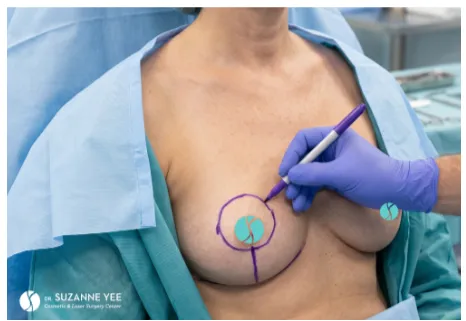
Breast lift surgery, or mastopexy, uses four primary incision patterns to correct different degrees of sagging. Each pattern removes a different amount of skin, leaves a different scar, and provides a different level of lift. Your surgeon selects the technique based on how much correction your tissue needs.
| Technique | Incision shape | Best for | Lift amount | Scar visibility |
|---|---|---|---|---|
| Crescent | Half-moon above areola | Minimal sagging | 1-2 cm | Barely visible |
| Donut (Benelli) | Circle around areola | Mild ptosis | Up to 2 cm | Hidden at areola edge |
| Lollipop (vertical) | Around areola + vertical line down | Moderate ptosis | 2-5 cm | Moderate, fades well |
| Anchor (Wise pattern) | Around areola + vertical + horizontal along crease | Severe ptosis | 5+ cm | Most visible initially |
Crescent lift
The crescent lift is the most minimal option. Your surgeon removes a small crescent-shaped strip of skin from the upper edge of the areola, raising the nipple by one to two centimeters. This technique works for patients with barely noticeable drooping who need only subtle repositioning.
Because the incision follows the natural border of the areola, the scar blends in quickly. Crescent lifts are sometimes performed alongside cosmetic breast enhancement procedures to fine-tune nipple placement when implants do most of the lifting.
Donut lift (periareolar or Benelli lift)
The donut lift, also called a periareolar or Benelli lift, uses a circular incision around the entire edge of the areola. Your surgeon removes a ring of skin surrounding the areola, then tightens the remaining tissue inward.
This technique corrects mild ptosis and can also reduce areola size. According to published data, the periareolar approach carries a patient satisfaction rate of around 85 percent when used for appropriate candidates, though it provides limited lift compared to more extensive patterns.
Lollipop lift (vertical mastopexy)
The lollipop lift adds a vertical incision running from the bottom of the areola down to the breast crease, creating a keyhole-shaped pattern. This additional incision allows your surgeon to remove more skin and reshape the breast tissue with greater precision.
Vertical mastopexy suits moderate ptosis and provides two to five centimeters of lift. Research comparing vertical and anchor techniques found that the lollipop approach preserves breast projection better while leaving less scarring than the anchor pattern.
Anchor lift (Wise pattern mastopexy)
The anchor lift, or wise pattern breast lift, is the most comprehensive technique. It combines the lollipop incision with an additional horizontal incision along the inframammary fold, the natural crease beneath your breast.
This pattern allows maximum skin removal and tissue reshaping, making it the standard choice for severe ptosis or patients who have lost significant breast volume after pregnancy or weight loss. A long-term follow-up study found that anchor lift results remain stable over 10 years, with the breast shape holding well when patients maintain a steady weight.
Brazilian breast lift
The term “Brazilian breast lift” refers to a technique that uses fat grafting rather than skin excision to create lift and volume. Your surgeon harvests fat from another area of your body and transfers it to the breasts. While this approach avoids traditional mastopexy scars, published evidence suggests it provides limited correction compared to excisional techniques and works best for patients with minimal sagging who also want modest volume enhancement.
Understanding these techniques is helpful, but what matters most is knowing which one your body actually needs.
How do you choose the best incision for your body and sagging level?
The right incision depends on measurable anatomical factors, not personal preference alone. Your surgeon evaluates several characteristics during an in-person assessment and matches them to the technique that will give you the most predictable outcome.
The most important factor is your ptosis grade, which measures how far your nipple has dropped relative to the inframammary fold. The Regnault classification system grades sagging from mild to severe.
| Ptosis grade | Nipple position | Recommended technique |
|---|---|---|
| Grade I (mild) | At the level of the breast crease | Periareolar (donut) or crescent |
| Grade II (moderate) | Below the crease but above the lowest breast point | Vertical (lollipop) |
| Grade III (severe) | At or below the lowest breast point | Anchor (Wise pattern) |
| Pseudoptosis | Above the crease, but breast tissue hangs below | Periareolar or vertical, depending on volume |
Breast volume and skin elasticity also influence the decision. Patients with larger breasts or significant skin laxity tend to benefit from anchor incisions because those patterns allow more tissue redistribution. Good skin elasticity, on the other hand, gives your surgeon flexibility to use a less extensive technique and still achieve a stable result.
Nipple position matters too. The distance from your nipple to the inframammary fold tells your surgeon exactly how much repositioning is needed. A distance under two centimeters typically calls for a periareolar approach, while five centimeters or more points toward an anchor pattern.
If you’re considering pregnancy in the future, your surgeon may recommend waiting. Research suggests that postpartum ptosis worsens to grade II or III in approximately 60 percent of cases, which could mean a second procedure down the road.
Triple board-certified cosmetic surgeon Dr. Yee evaluates each of these factors during an in-person consultation at her Little Rock office, because the incision that gives one patient beautiful results may not be the right fit for another.
What kind of scarring comes with each breast lift technique?
Scarring is the tradeoff you make for a lifted, reshaped result. Every breast lift technique leaves some visible mark, but where those scars fall, how noticeable they are, and how quickly they fade varies with each incision pattern.
Scar placement by technique
The crescent lift leaves only a small half-moon scar along the upper edge of the areola. The donut lift creates a circular scar around the areola that typically blends into the natural border between areolar and breast skin.
The lollipop lift adds a vertical scar running from the bottom of the areola to the breast crease. The anchor lift includes that same vertical line plus a horizontal scar along the inframammary fold, resulting in an inverted T-shape.
Scar healing timeline
All breast lift scars follow a predictable healing timeline. In the first one to three months, scars appear red and raised. Between three and six months, they start fading to pink as the tissue matures.
By the 12-month mark, most scars have flattened and faded to a thin pale line. Full maturation continues for up to two years. Most breast lift scars are easily concealed under bras and swimwear, even with the anchor pattern.
Factors that affect scar quality
Several factors influence how well your scars heal. Genetics play the largest role, some people naturally form thinner, flatter scars. Smoking significantly impairs healing and increases the risk of widened scars, so most surgeons require patients to stop well before the procedure.
Sun exposure on fresh scars can cause permanent darkening. Silicone scar sheets (such as Silagen), gentle massage after clearance from your surgeon, and consistent sun protection are the most effective steps you can take to support healing.
Daphne, a patient who has had multiple procedures including a breast lift and implants at the Little Rock practice, shared their experience:
“I can not say enough good stuff about Dr. Yee and her staff. Everybody is so welcoming and kind. I have had a facelift..browlift..chin implant..fillers…ThermiVa…breast lift and implants. I have only felt confidence and safety with ever procedure. I had lost my smile over the years from putting myself last on the to do list and Dr Yee has helped me not only find it but surpass where it was before.”
Knowing what scars to expect helps you prepare, but recovery is where the real planning happens.

What is recovery like after different breast lift incisions?
Recovery after sagging breast correction surgery varies depending on which incision pattern your surgeon uses. Less extensive techniques like the crescent or donut lift involve shorter downtime, while anchor lifts require more patience as deeper tissue repairs.
| Recovery milestone | Crescent or donut | Lollipop | Anchor |
|---|---|---|---|
| Initial rest period | 3-5 days | 5-7 days | 7-14 days |
| Return to desk work | 5-7 days | 7-10 days | 10-14 days |
| Light exercise | 3-4 weeks | 4-6 weeks | 4-6 weeks |
| Full activity clearance | 4-6 weeks | 6-8 weeks | 8-12 weeks |
During the first week, you can expect swelling, bruising, and tightness across the chest. Pain typically peaks in the first three to five days and is managed with prescribed medication.
Your surgeon will ask you to wear a supportive compression bra for four to six weeks. Avoid lifting anything over 10 pounds, bending at the waist, or sleeping on your stomach during the initial healing phase.
At the AAAHC-accredited surgical center in Little Rock, your procedure is performed with a dedicated nursing staff monitoring your care. General anesthesia is administered by a Certified Registered Nurse Anesthetist (CRNA) as part of our experienced surgical team, ensuring your safety and comfort throughout the procedure. The recovery room team stays with you until you’re fully awake and comfortable, typically about one hour after surgery.
To help make your goals more accessible, flexible financing is available through Cherry, Alphaeon Credit, CareCredit, PatientFi, and Alle, so you can choose a payment plan that works for your budget.
Recovery is temporary, but the results that follow are what make the process worthwhile.
What results can you expect from each incision type?
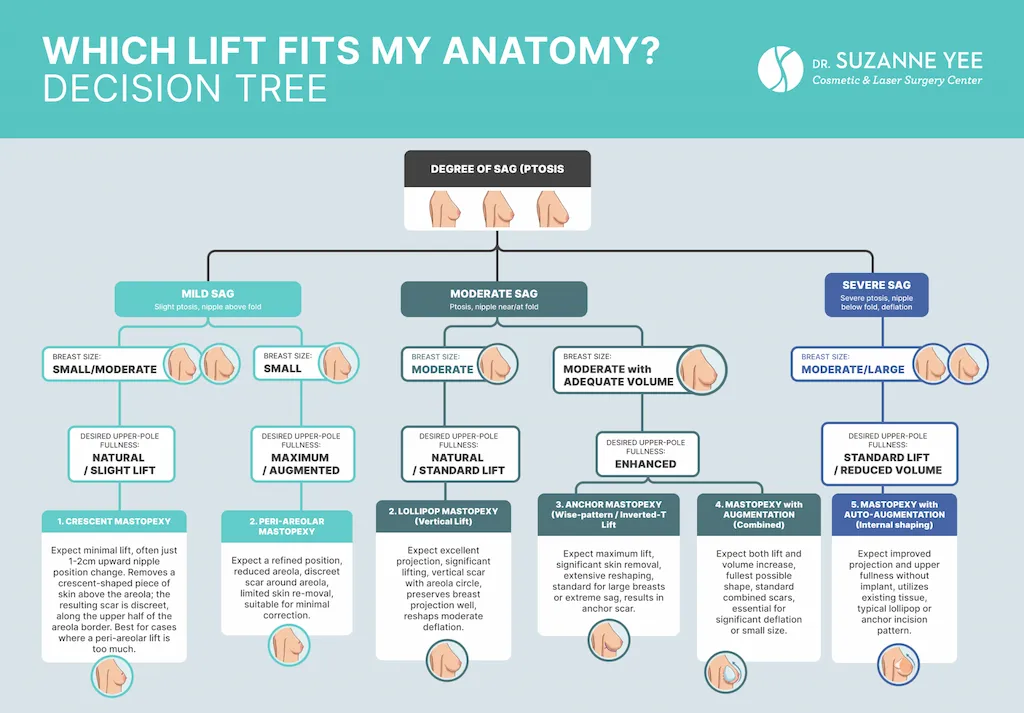
Each breast lift technique delivers a different degree of reshaping, and the results you see depend on which pattern your anatomy requires. Our breast lift before-and-after results by procedure type shows how each technique looks on real patients.
The donut lift achieves a rounded upper pole with modest nipple elevation of one to three centimeters. The lollipop lift provides greater projection and reshaping for moderate ptosis.
Research comparing vertical and anchor techniques found that the lollipop approach preserves breast projection better while leaving less scarring.
The anchor lift produces the most dramatic correction for severe sagging, removing the greatest amount of excess skin and allowing your surgeon to completely reshape the breast mound. For patients who have experienced significant volume loss after pregnancy or weight changes, this technique often delivers the most noticeable improvement.
How long do breast lift results last? Most patients can expect their results to hold for 10 to 15 years, though aging and gravity will gradually affect the shape over time. The key to maintaining your results is keeping a stable weight, wearing supportive bras during exercise, and avoiding smoking.
Dr. Yee’s philosophy of enhancement, not addition, means the goal is a natural-looking result that feels like a refreshed version of you. The before-and-after gallery shows what different techniques achieve on different body types.
Aeawun, a patient who had a breast lift and augmentation at the Little Rock practice, shared their experience:
“Extremely pleased with my breast lift and augmentation. Hands down amazing job by Dr. Yee. Staff was compassionate and helpful from my very first visit through the entire process and aftercare. They take care of you like you are family.”
What should you expect at a breast lift consultation?
A breast lift consultation is a two-way conversation. You’re evaluating whether this surgeon and this approach feel right, and your surgeon is assessing whether your anatomy supports the result you’re hoping for.
During an in-person visit, your surgeon examines your breast tissue, skin elasticity, nipple position, and overall chest anatomy. You’ll discuss your aesthetic goals, and your surgeon explains which incision pattern matches your anatomy and why. There’s time for every question, nothing is off the table.
The consultation also gives you a chance to see the surgical facility firsthand. Procedures are performed at an AAAHC-accredited private surgical center that meets national safety and quality standards, part of a Little Rock practice known for personalized cosmetic surgical consultations.
Cost is a common concern, and it’s one worth addressing early. Financing is available through Cherry, Alphaeon Credit, CareCredit, PatientFi, and Alle, each offering manageable payment plans with qualifying zero-percent interest options.
Conclusion
Choosing the right breast lift technique isn’t just a clinical decision — it’s a personal one. Your ptosis grade, skin elasticity, nipple position, and breast volume all play a role, but so do your goals, your lifestyle, and how you want to feel when you look in the mirror. The best outcomes happen when the technique is matched not just to your anatomy, but to you.
At Dr. Suzanne Yee Cosmetic & Laser Surgery Center, that’s exactly how we approach every consultation — by listening first. Every patient deserves to feel heard, respected, and genuinely confident in the choices they make about their body.
When you’re ready, schedule your personal consultation or call (501) 224-1044 to start the conversation. And if you’re not quite there yet, that’s okay too — we’re here whenever the time feels right.
Frequently asked questions
What is the least scarring breast lift option?
The crescent lift leaves the smallest scar, a thin half-moon along the upper areola edge that fades quickly. The donut lift is a close second, with a circular scar that blends into the natural areola border. Both options work only for mild sagging, so the least scarring isn’t always the most effective for your needs.
How much lift does a donut breast lift give?
A donut lift typically raises the nipple by one to three centimeters and can also reduce areola size. This makes it a good fit for mild ptosis where the nipple sits near or just below the breast crease. For moderate to severe sagging, a more extensive technique provides better correction.
Is a lollipop lift better than an anchor lift for moderate sagging?
For moderate ptosis, the lollipop lift often gives excellent results with less scarring than the anchor. Published comparisons show the vertical approach preserves breast projection well and results in higher scar satisfaction scores. Your surgeon makes the final call based on your specific tissue quality and volume.
Can you get a breast lift with implants?
Yes, combining a breast lift with breast augmentation is common when sagging occurs alongside volume loss. Your surgeon can place silicone or saline implants during the same procedure, with the incision technique tailored to accommodate both the lift and the implant placement.
How long do breast lift scars take to fade?
Most breast lift scars go through a predictable cycle. They appear red and raised for the first few months, fade to pink by six months, and flatten to a thin pale line within 12 to 18 months. Full maturation can take up to two years, and silicone scar sheets and sun protection help the process along.
Is a crescent lift enough for mild sagging?
A crescent lift can correct mild, barely noticeable sagging where the nipple needs only subtle repositioning. It provides one to two centimeters of elevation and leaves minimal scarring. The correction it offers is limited, so it works best for patients who need only subtle repositioning.
Can you breastfeed after a breast lift?
Many women breastfeed after a breast lift, though the ability depends on which technique was used and how the milk ducts were affected. Discussing your plans with your surgeon beforehand allows them to choose an approach that preserves as much duct function as possible.
How do you choose the right surgeon for a breast lift?
Look for a surgeon who is board-certified by recognized cosmetic surgery boards and has specific experience performing mastopexy procedures. Review before-and-after photos of actual patients, and schedule an in-person consultation to see whether the surgeon listens to your goals and explains the recommended technique clearly.
Are breast lift results permanent?
Breast lift results are long-lasting but not permanent. Aging, gravity, weight fluctuations, and hormonal changes gradually affect breast shape over time. Most patients enjoy results that keep them ahead of the natural aging curve for years, and maintaining a stable weight and wearing supportive bras helps preserve the outcome.
What is ptosis grade 2 versus grade 3?
Grade 2 (moderate ptosis) means your nipple has dropped below the breast crease but still sits above the lowest point of the breast. Grade 3 (severe) means your nipple sits at or below that lowest point. Grade 2 often responds well to a lollipop lift, while grade 3 typically requires an anchor incision.
*Disclaimer: This content is for educational purposes only and does not constitute medical advice. A consultation with a qualified board-certified surgeon is required to determine the best treatment plan for your individual needs and any questions you may have about a medical condition or procedure.




 Instagram
 Facebook
 Tiktok
 Youtube
 X
X LinkedIn